

On this page
Almost everyone learning matrices for the first time has the same thought. Matrix addition is easy: you just add the matching numbers. So why is matrix multiplication this strange, sideways process of sliding rows across columns?
The confusion comes from seeing matrices merely as grids of numbers. But when matrices were invented, they were built to do a specific job.
Who invented matrix multiplication?
Matrices were not created to be a new kind of arithmetic. In 1858, British mathematician Arthur Cayley published A Memoir on the Theory of Matrices (MacTutor History of Mathematics). He was the first to define an abstract matrix and lay out its rules, including the row-by-column multiplication.
Cayley was dealing with linear transformations. He wanted to know what happens when you take a point, move it using one set of linear equations, and then move that result using a second set of linear equations. While earlier mathematicians like Gabriel Cramer and the determinant rule of 1750 used grids to solve equations, Cayley's matrix multiplication was a shortcut to substitute them.
Why is matrix multiplication done row by column?
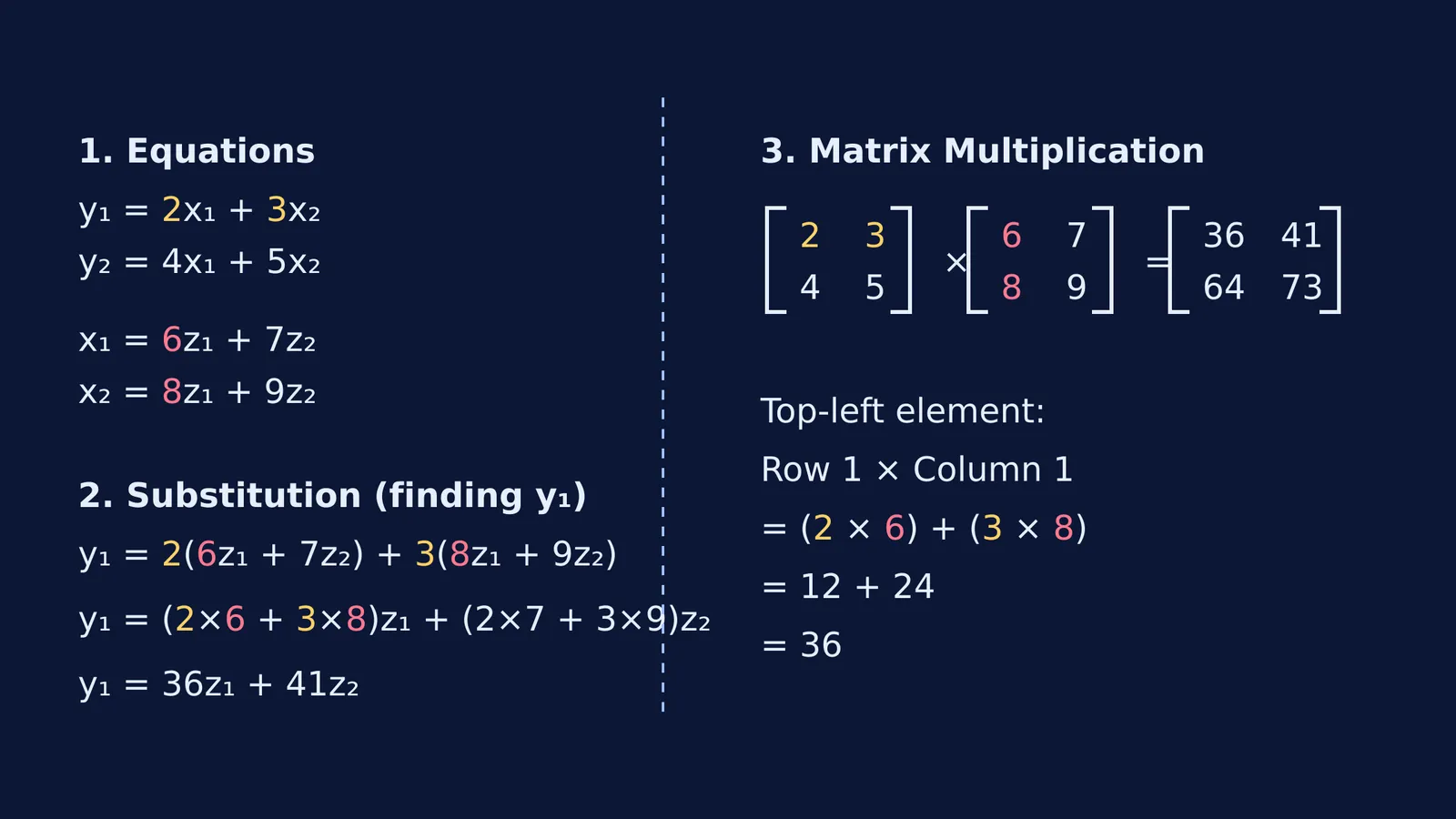
Imagine you have two equations linking a variable y to x:
y₁ = 2x₁ + 3x₂ y₂ = 4x₁ + 5x₂
And you have another set of equations linking x to a new variable z:
x₁ = 6z₁ + 7z₂ x₂ = 8z₁ + 9z₂
If you want to find the direct link from z straight to y, you have to substitute the x equations into the y equations. Let us substitute them into the very first equation for y₁:
y₁ = 2(6z₁ + 7z₂) + 3(8z₁ + 9z₂)
Now, expand the brackets and group the z₁ and z₂ terms together:
y₁ = (2 × 6 + 3 × 8)z₁ + (2 × 7 + 3 × 9)z₂
Look closely at the numbers in the first bracket: (2 × 6 + 3 × 8). The 2 and 3 came from the first row of our first system of equations. The 6 and 8 came from the first column of our second system.
When we lay these numbers out in Cayley's matrices, the substitution step matches exactly. To find the top-left number of the combined matrix, we take the top row of the first matrix [2, 3] and multiply it by the left column of the second matrix [6, 8], then add them up. The row-by-column rule is just algebra doing its job.
What if we multiplied matrices term-by-term?
You can multiply matrices term-by-term. In mathematics, this is called the Hadamard product. It is useful in computer science, such as when compressing images or processing data in neural networks. But if you try to use the Hadamard product to combine two physical transformations—like rotating a shape and then stretching it—you will get the wrong answer. This is why Finding Aⁿ for a matrix by spotting the pattern relies on row-by-column multiplication rather than simple exponentiation.
A simple framework for new rules
When a new rule in mathematics seems unnatural, it usually means you are looking at the solution without knowing the original problem. If you feel stuck, use this simple framework:
Find the inventor: Who first wrote the rule down, and in what year?
Find the problem: What physical or algebraic problem were they trying to avoid doing the long way?
Do it the long way once: Write out the full substitution or derivation by hand.
Once you trace the steps yourself, the formula stops being a rule you have to memorise and becomes a shortcut you are glad to have.
If you are struggling to build intuition for why rules work, the Fermi Concept Library has every concept in physics, chemistry, biology, mathematics and computing, each with its own lesson and its place in the map. Because when you see the whole picture, the rules explain themselves.


