

On this page
If you have ever watched footage from a Mars mission, you might wonder why these multi-billion-dollar machines move at a snail's pace. The Perseverance rover's top speed on flat, hard ground is just under 0.1 miles per hour (approximately 152 meters per hour).
The primary reason is not the rover's motors, but the vast distance between Earth and Mars and the absolute speed limit of the universe: the speed of light.
Why do Mars rovers move so slowly?
Unlike a remote-controlled car in your driveway, a Mars rover cannot be driven with a joystick in real time. Because Mars is tens of millions of kilometres away, it takes a long time for a signal from Earth to reach the rover, and just as long for the rover's cameras to send an image back.
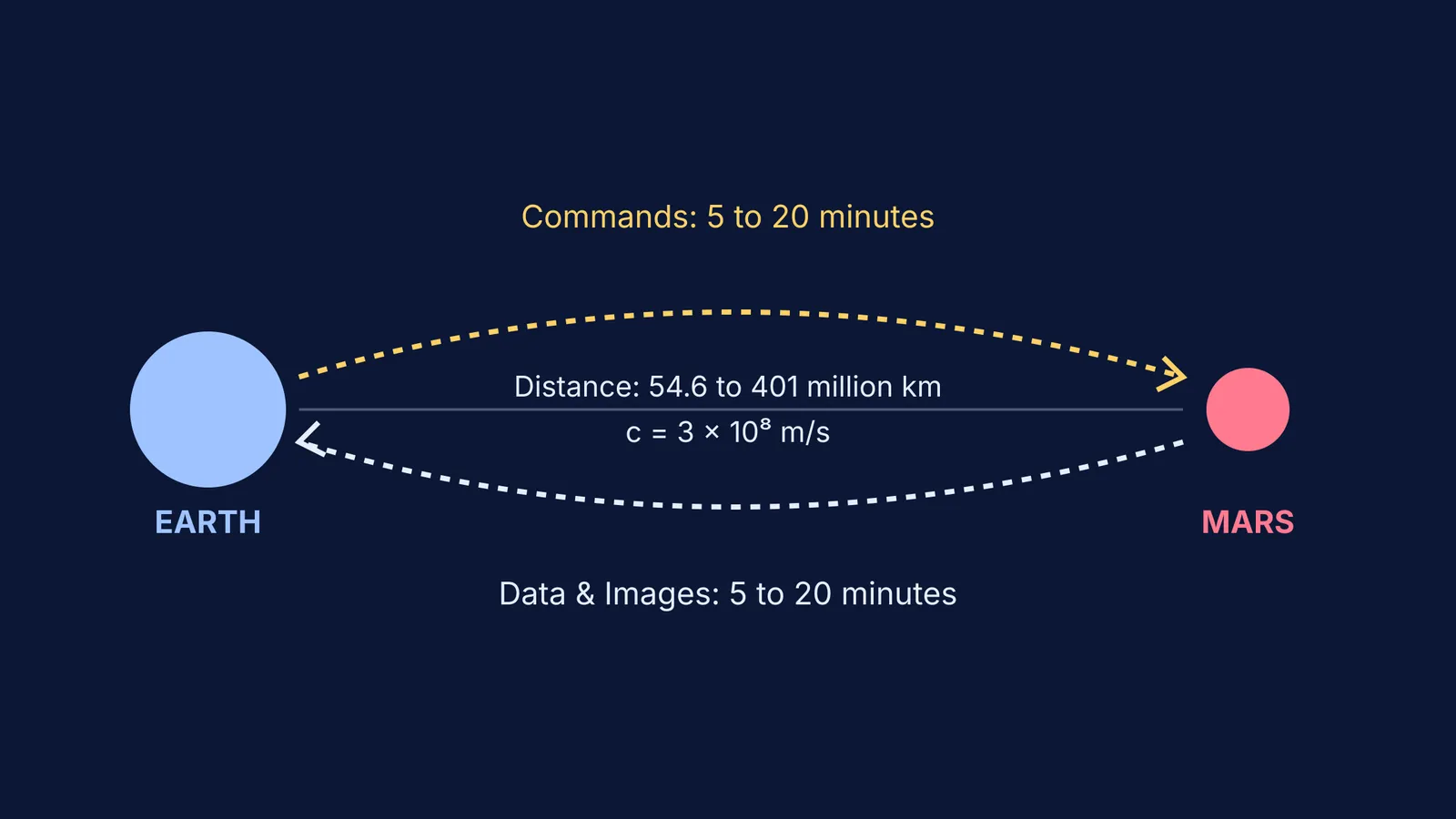
According to NASA, radio signals (which travel at the speed of light) take anywhere from 5 to 20 minutes to travel one way between Earth and Mars. This delay depends on where the two planets are in their respective orbits around the Sun. This means a simple "stop" command could take up to 20 minutes to arrive. If the rover were driving quickly and headed towards a cliff, it would fall over the edge long before engineers on Earth even saw the danger.
How do rovers avoid hazards on Mars?
Because they cannot be driven live, rovers must move autonomously and carefully. Engineers on Earth send a batch of commands for the day, and the rover executes them on its own. As it moves, the rover constantly takes pictures of the terrain ahead, processing them to check for sharp rocks or deep sand.
This computational process is slow. The rover often drives a short distance, stops to take more images, processes the safe path forward, and then drives again.
Furthermore, moving slowly conserves power. Mars rovers operate on less than 200 watts to conserve energy for their scientific instruments. This is a tiny fraction of the power used by an ordinary car. Moving slowly ensures the rover does not drain its battery or get hopelessly stuck in soft Martian soil.
How do Mars rovers talk to Earth?
To understand the delay, it helps to look at how these signals actually travel back and forth. Mars rovers do not just have a single radio; they are equipped with multiple antennas to handle different types of communication across the void of space.
The Perseverance rover uses three main antennas. The first is an Ultra-High Frequency (UHF) antenna, which relays data to orbiters circling Mars at speeds up to 2 megabits per second. These orbiters act as massive relay stations in the sky, passing the data along to Earth.
The rover also carries two X-band antennas. The X-band High-Gain Antenna beams data directly to Earth's Deep Space Network, while the X-band Low-Gain Antenna is primarily used for receiving the daily batch of commands from engineers on Earth. Even with these advanced communication arrays, the signals still cannot break the speed of light. The data trickles in slowly, and the delay remains an unavoidable law of physics.
What causes the communication delay?
We can see exactly why this delay happens by calculating the time it takes for a radio signal to cross the solar system. Electromagnetic waves, including radio signals, travel at the speed of light in a vacuum (c = 3 × 10⁸ m/s).
The distance between Earth and Mars changes constantly. At their closest approach (when Earth and Mars are aligned on the same side of the Sun), the distance is about 54.6 million kilometres. At their farthest, they are over 401 million kilometres apart. Suppose Mars is at an average distance of 228 million kilometres from Earth. We can find the one-way travel time using the basic formula for speed:
Convert the distance into metres: d = 228,000,000 km = 2.28 × 10¹¹ m. (For more on keeping units consistent, see our guide on converting a quantity between unit systems using dimensions.)
Divide the distance by the speed of light: t = d / c
t = (2.28 × 10¹¹) / (3 × 10⁸)
t = 760 seconds
Dividing 760 seconds by 60 gives roughly 12.7 minutes. In the worst-case scenario (401 million kilometres), this stretches to over 22 minutes. When you consider that a rover might need to know its distance in the nth second to execute precise movements, this massive delay shows why autonomous hazard avoidance is essential.
If you find distances in the solar system hard to picture, the Fermi Simulation Lab has interactive simulations for the ideas that are easier to see than to read. You can watch how orbital mechanics change the distance between planets over time, fundamentally altering how we explore space.


