

On this page
Most people know Makar Sankranti as the rare Hindu festival that falls on a fixed date: January 14. But if you ask your grandparents, they might remember it occasionally falling on January 13, and in recent years, it increasingly lands on January 15.
The date is not actually fixed. It is slowly drifting forward through the Gregorian calendar, a movement driven by the deep mechanics of the Earth's orbit and the way we measure a year.
Why does the Makar Sankranti date change?
To understand the shift, you have to look at how different calendars measure a year. The everyday Gregorian calendar is a "tropical" calendar. It is locked to the Earth's seasons. The Winter Solstice (the shortest day of the year in the Northern Hemisphere) is firmly anchored around December 21, ensuring that summer and winter happen in the exact same months every year.
Most Hindu holidays follow a lunisolar calendar, where dates move around rapidly based on the phases of the Moon. Makar Sankranti, however, is different. It is based on a "sidereal" solar calendar, which tracks the Sun's position against the background of fixed stars, according to Britannica. The festival marks the exact astronomical moment the Sun crosses into the zodiac sign of *Makara* (Capricorn).
Where does the 72-year calendar drift come from?
If the Earth spun perfectly straight, the tropical and sidereal calendars would stay in perfect sync forever. But the Earth wobbles.
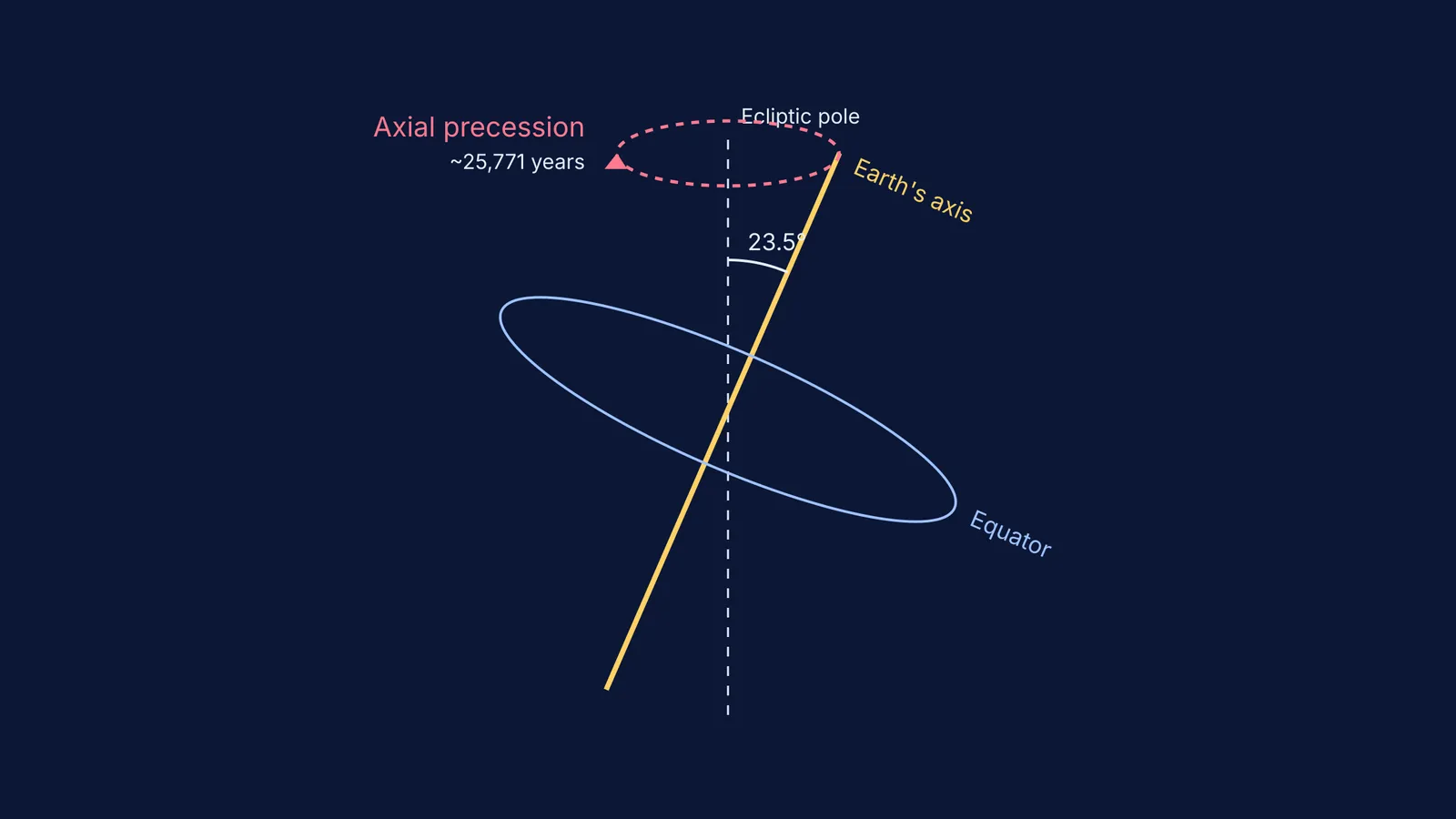
Our planet's axis is tilted at 23.5°, and like a slowing spinning top, this axis slowly traces a wide circle in space. NASA measures this cycle, known as axial precession, at approximately 25,771.5 years. The NASA data also shows that when this wobble is combined with apsidal precession (the gradual shift of Earth's elliptical orbit), the overall precession cycle experienced on Earth averages out to about 23,000 years.
Because the axis is continuously wobbling, the background of stars appears to shift slightly from our perspective every year. This means the Sun enters the Capricorn zodiac sign slightly later each year when compared to our seasonal tropical calendar. Ancient Indian astronomers understood this slow separation between the seasons and the stars, calling the measurable shift *ayanamsha*, as detailed on Wikipedia. Today, the Lahiri Ayanamsha is the most widely used system in India to calculate this exact gap and keep the festival dates astronomically accurate.
Here is how the 72-year rule works out in practice, according to Wikipedia:
The sidereal year (one full orbit relative to the fixed stars) takes 365.256 days.
The tropical year (one full orbit relative to the seasons) takes 365.242 days.
The difference is 0.014 days, or about 20 minutes a year.
If you multiply that 20-minute gap by 72 years, you get 1,440 minutes. That is exactly 24 hours, or one full calendar day on the Gregorian calendar.
How do calendars handle this wobble?
No simple calendar can track both the stars and the seasons perfectly because the Earth's wobble constantly pulls them apart.
The Gregorian calendar uses a system of leap years to keep itself locked to the tropical seasons, completely ignoring the slow drift of the stars. It inserts a leap day every four years, and skips three leap days every 400 years, to match the 365.242-day tropical cycle, as detailed on Wikipedia.
The sidereal calendar, on the other hand, strictly follows the stars and ignores the drifting seasons. Because we use the seasonal Gregorian calendar for our daily lives and school schedules, the star-based festival of Makar Sankranti appears to be the one moving, creeping forward by one day per lifetime.
Will Makar Sankranti fall on January 16 in the future?
Yes. Over the last 1,700 years, the date has shifted 24 days to its current spot. While our leap years cause short-term fluctuations that make the festival bounce between January 14 and 15, the long-term trend is a slow, unstoppable march forward. Because the year 2100 is not a leap year in the Gregorian calendar, Makar Sankranti will begin falling on January 16 for the first time in the year 2102, as noted on Wikipedia.
Visualising thousands of years of orbital motion is easier when you can speed up time. The Fermi Simulation Lab lets you watch the Earth's orbit and precession happen in seconds to see exactly why these astronomical dates shift.
Read next:


