

On this page
People often wonder why a fridge magnet snaps instantly to a steel door (which is mostly iron) but falls straight off an aluminium can or foil. The answer lies in how the electrons inside these metals respond to an external magnetic field.
Why do magnets not attract aluminium?
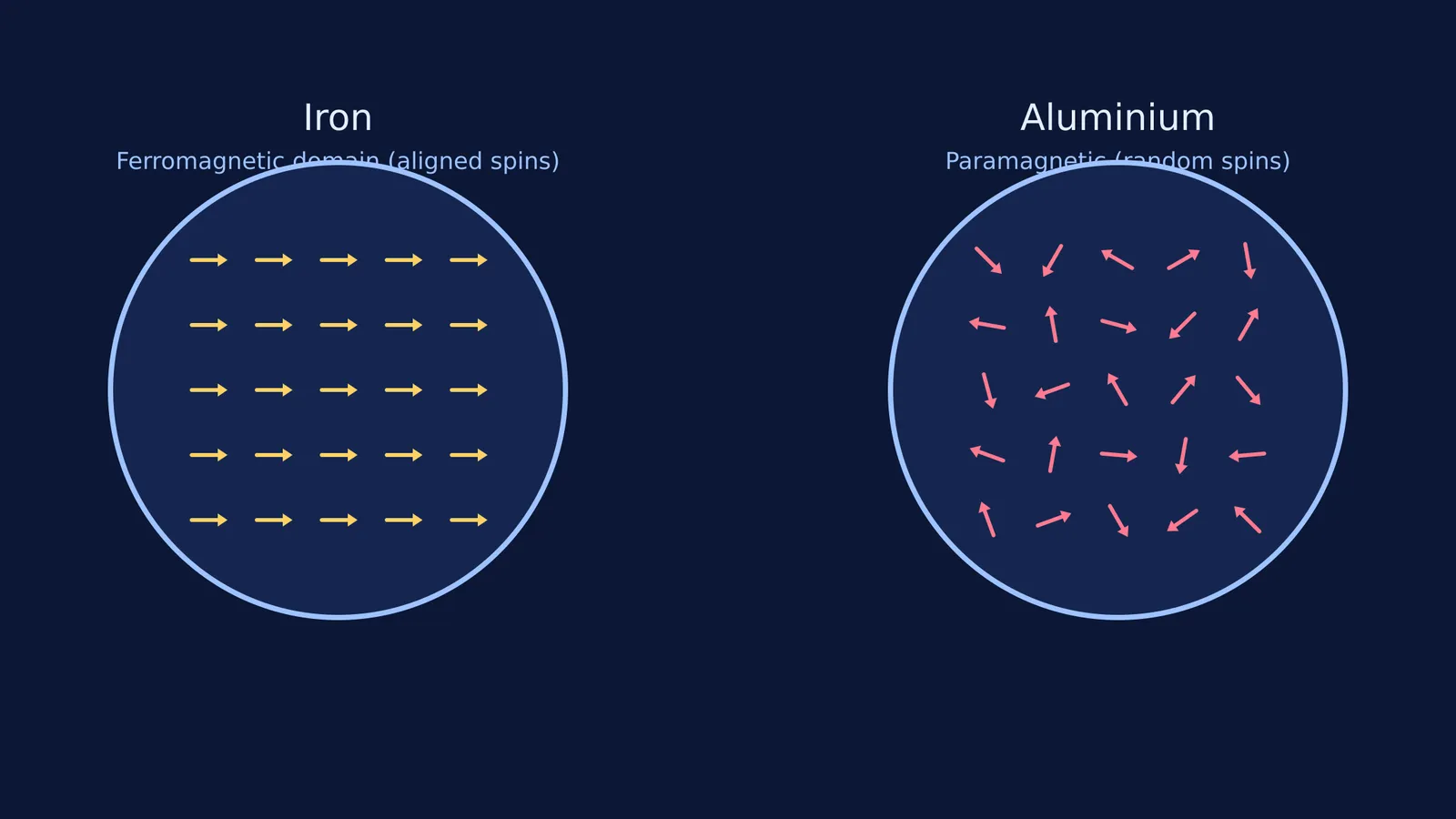
Aluminium is a paramagnetic material. According to Georgia State University's HyperPhysics, its atomic structure gives each atom a very weak individual magnetic moment. Aluminium has an atomic number of 13, and its electron configuration is [Ne] 3s² 3p¹. That single unpaired 3p electron is the source of its magnetism. Moving charges create magnetic fields, and an electron spinning on its axis acts like a tiny bar magnet.
When an external magnet is brought near, these tiny atomic magnets try to line up with the field. However, thermal agitation at room temperature easily disrupts this weak alignment. As a result, aluminium has a tiny magnetic susceptibility of about +2.2 × 10⁻⁵. This means the attractive force is so weak it cannot be felt by hand and requires sensitive lab equipment to detect. The moment the magnet is removed, the spins randomise again, leaving the metal completely unmagnetised.
Why does iron stick to a magnet?
Iron behaves completely differently because it is ferromagnetic. Iron (atomic number 26) has an electron configuration of [Ar] 4s² 3d⁶, which leaves four of its 3d electrons unpaired. This gives each iron atom a much stronger individual magnetic moment than an aluminium atom. But having unpaired electrons is not enough on its own to make a material stick to a fridge. The secret is the exchange interaction.
This quantum mechanical interaction acts like a powerful glue, locking the magnetic moments of neighboring iron atoms together so they point parallel to each other. They form microscopic clusters called magnetic domains, where billions of atoms point in the exact same direction. When you bring a magnet near iron, these domains instantly snap into alignment with the magnet's field. This collective response gives pure iron a magnetic susceptibility of several thousand, pulling it strongly towards the magnet.
What happens when you heat a magnet?
Because the magnetic domains in iron rely on the exchange interaction overpowering thermal agitation, temperature plays a crucial role. If you heat a piece of iron enough, the thermal energy will eventually become so intense that it breaks the exchange interaction's hold.
The temperature at which this happens is called the Curie temperature, which for iron is 770 °C. Above this point, the ordered magnetic domains fall apart, and the iron becomes purely paramagnetic, behaving much like aluminium does at room temperature.
A practical framework for testing metals
If you are sorting scrap metal or just exploring physics at home, you can use a strong magnet (like a neodymium magnet) to test and identify materials:
The stick test: Bring the magnet close. If it snaps strongly to the metal, the material is ferromagnetic. It is highly likely to be iron, plain steel, nickel, or cobalt.
The slide test: If you slide the magnet quickly across a smooth, flat piece of the metal and feel a sluggish, dragging resistance, you are feeling the effect of eddy currents. This happens strongly with excellent conductors that are not ferromagnetic, such as aluminium and copper.
The quiet test: If the metal does not stick and does not drag noticeably, it might be a poorer conductor that also lacks ferromagnetism, such as certain grades of austenitic stainless steel or brass.
If you have concept gaps around magnetic properties and electron configurations for chemistry or physics, the Concept Library covers every concept in physics and chemistry. Fermi's AI tutor can work out what you already know and build a plan for the session to help you understand the quantum numbers of iron and aluminium.
You can also read more about related topics such as the Electron configuration of ions like Fe³⁺ and Cu⁺ or understand Why zinc, cadmium and mercury are not called transition elements.


