

On this page
Why do long jumpers run so fast before jumping?
When Indian national record holder Jeswin Aldrin leaped 8.42 metres in Bellary, as ratified by the Athletics Federation of India, or when Murali Sreeshankar jumped 8.41 metres, neither athlete jogged to the board. In his foundational review in *Exercise and Sport Sciences Reviews*, biomechanist James G. Hay showed that elite competitors sprint at roughly 10.5 metres per second over a 40-metre approach.
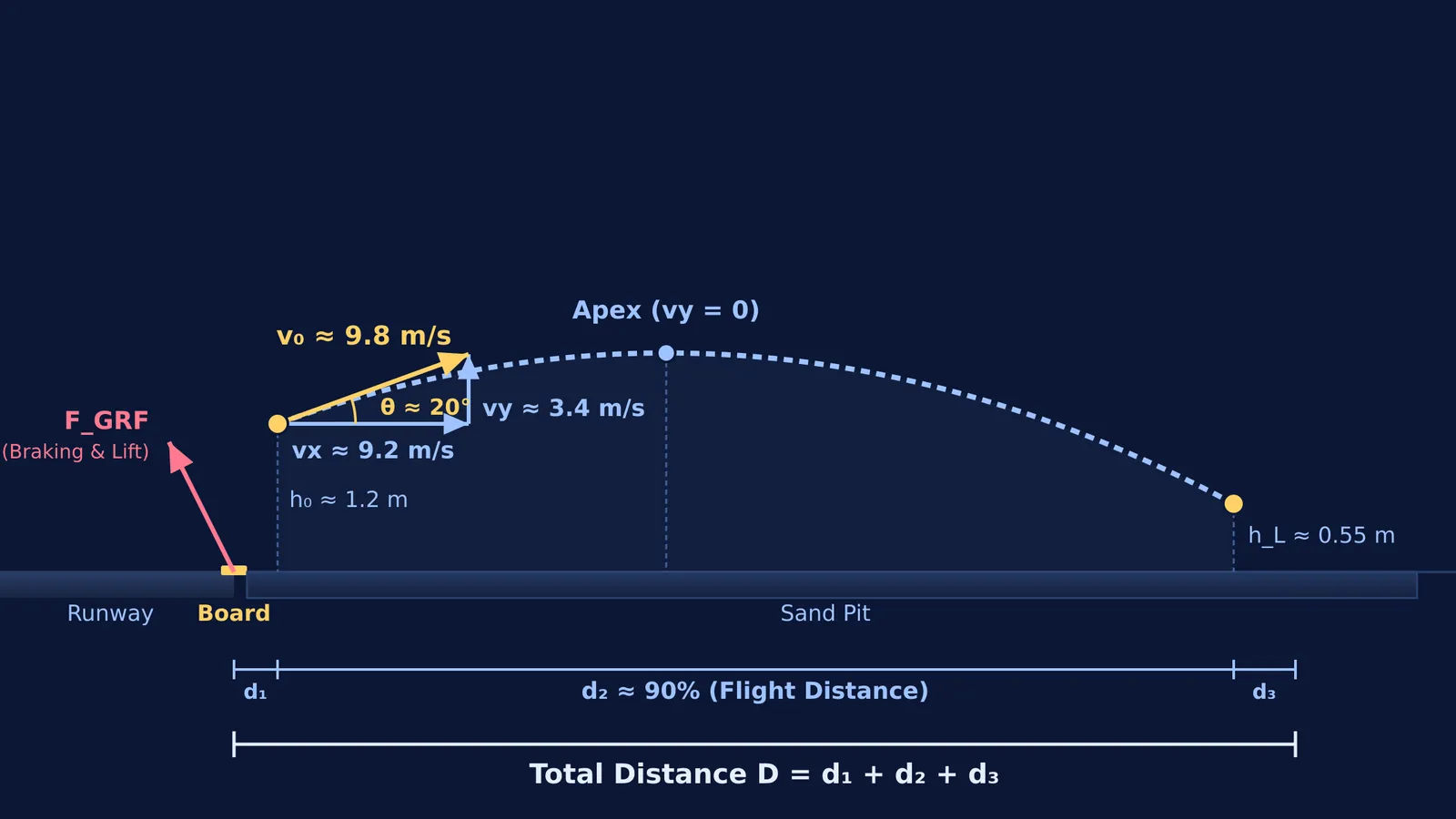
Hay demonstrated that total jump distance D is the sum of three horizontal segments: take-off distance d₁ (board edge to centre of mass at toe-off), flight distance d₂ (airborne path of the centre of mass), and landing distance d₃ (centre of mass to heel mark).
Airborne flight distance d₂ accounts for 88% to 90% of the total mark. Once airborne, an athlete is an unpowered projectile governed by gravity. Flight distance equals horizontal velocity v_x multiplied by flight time t. Because human biology caps airborne time at roughly 0.85 to 0.95 seconds, sprinting faster horizontally is the single most effective way to extend distance.
Why is the take-off angle so much lower than 45 degrees?
Textbook formulas for projectile motion on level ground teach that a 45° launch angle maximizes horizontal range. Yet elite long jumpers launch at angles between 18° and 22°, as shown by Nicholas P. Linthorne and colleagues.
This divergence stems from a velocity-angle trade-off. Foot contact on the take-off board lasts only 0.11 to 0.13 seconds, according to Lisa A. Bridgett and Nicholas P. Linthorne.
During that tenth of a second, an athlete sprinting at 10.5 metres per second cannot generate an upward impulse equal to their forward speed without severe braking. Forcing a 45° angle would drop forward speed below 7.0 metres per second. That lost forward momentum cuts range far more than added height gains. A flatter angle near 20° preserves forward velocity while generating enough lift to maximize distance.
How does sprint kinetic energy convert into vertical lift?
A fast approach builds substantial kinetic energy. Connecting velocity and momentum through the kinetic energy and momentum relation and James G. Hay's biomechanical analysis, a 75-kilogram jumper sprinting at 10.5 metres per second carries approximately 4,134 joules of kinetic energy (E = ½mv²).
The athlete redirects this energy during the final two strides:
On the penultimate stride, the jumper lowers their centre of mass by flexing the knee, setting up a low base.
On the final stride, the athlete plants the take-off foot ahead of the body with a stiff, extended leg.
This foot plant acts as a lever. Hay documented that the ground exerts a vertical reaction force reaching 5 to 6 times body weight—often exceeding 3,500 newtons—alongside horizontal braking. This impulse creates 3.2 to 3.5 metres per second of vertical speed while losing only 1.0 to 1.5 metres per second of forward speed, pivoting sprint momentum upward into the air.
How does run-up speed dictate flight distance?
Using take-off parameters documented by Lisa A. Bridgett and Nicholas P. Linthorne and the standard equation of trajectory of a projectile, we can model how approach speed dictates flight distance.
Assume an athlete's centre of mass is at h₀ = 1.20 metres at take-off and lands at h_L = 0.55 metres, giving a drop h = 0.65 metres. With vertical velocity v_y = 3.30 metres per second and g = 9.80 m/s², flight time t satisfies ½gt² − v_yt − h = 0:
t = (3.30 + √(3.30² + 2 × 9.80 × 0.65)) / 9.80 = (3.30 + 4.86) / 9.80 = 0.833 seconds.
Now compare two horizontal velocities:
Moderate sprint (v_x = 8.80 metres per second):
Flight distance d₂ = 8.80 × 0.833 = 7.33 metres. With take-off distance d₁ = 0.35 metres and landing distance d₃ = 0.50 metres, total jump D = 8.18 metres.
Fast sprint (v_x = 9.30 metres per second):
An increase of 0.50 m/s in forward velocity yields d₂ = 9.30 × 0.833 = 7.75 metres. Total jump D reaches 0.35 + 7.75 + 0.50 = 8.60 metres.
The 0.50 m/s speed gain delivers 42 centimetres of extra distance. This aligns with Linthorne's finding that each 0.1 metre-per-second increase in run-up speed adds roughly 5 to 8 centimetres of jump distance.
How can students master projectile motion for competitive exams?
Competitive exams like JEE Main test whether students can resolve velocity vectors along independent axes rather than relying on memorized special-case formulas. Real-world events involve unequal launch and landing heights where standard level-ground shortcuts fail.
To build visual intuition for how launch angles, velocity vectors, and release heights shape parabolic paths, Fermi Simulation Lab provides interactive simulations for ideas that are easier to see than to read. You can manipulate take-off vectors in real time to observe how kinetic energy redirects into parabolic flight.
When practicing numerical calculations, the Fermi Problem Library offers worked problems with a step-by-step solver that explains the reasoning rather than printing an answer, helping you connect fundamental equations of motion directly to exam-level problems.


