

On this page
When you pull your finger or bend a knuckle until it pops, the sharp snap sounds like bones knocking together or a ligament snapping across a tendon. In reality, the bones never touch. The sound comes from fluid dynamics: a sudden pressure drop in your joint fluid that nucleates a microscopic gas bubble, followed by a pressure oscillation as the cavity partially collapses.
The knuckle at each finger's base is the metacarpophalangeal (MCP) joint. In our guide on counting appendicular bones in the human skeleton, we examine how the metacarpals meet the proximal phalanges. These synovial joints are enclosed in a fibrous capsule containing a thin lubricating film of synovial fluid covering the articular cartilage. At rest, this fluid sits near atmospheric pressure, maintaining smooth joint contact.
What actually happens inside a cracking knuckle?
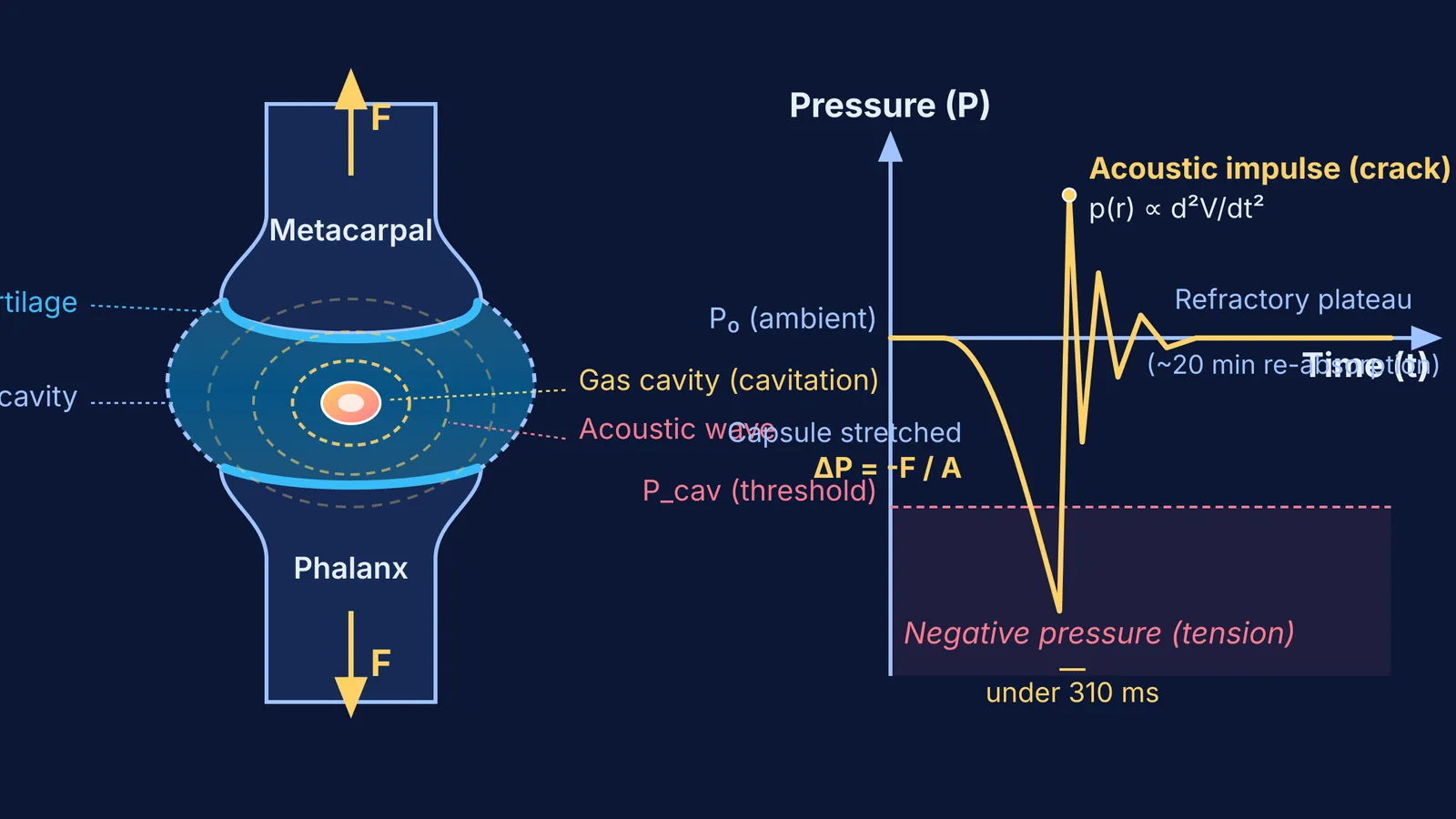
Pulling a finger stretches the sealed joint capsule. Because fluid volume is constrained, expanding the capsule forces hydrostatic pressure inside the synovial fluid to drop sharply.
In 1947, J. B. Roston and R. Wheeler Haines used X-rays to show that joint surfaces resist separation until tension reaches roughly 7 kilograms of force, when the bones suddenly separate by 1 to 3 millimetres. In 2015, Gregory Kawchuk and colleagues recorded knuckle cracking using cine MRI at 3.2 frames per second in PLOS ONE. The MRI showed that cracking occurs in under 310 milliseconds. As joint surfaces separate, fluid cohesive resistance breaks in a process called tribonucleation, nucleating a gas cavity at the exact moment of the sound.
Visualising how volume changes trigger phase changes is easier with dynamic models. That is why the Fermi Simulation Lab provides interactive simulations for the ideas that are easier to see than to read.
Why does joint fluid form a gas bubble under tension?
In introductory physics, liquids are often treated as incompressible. But as shown in our guide on pressure drops in fluid mechanics, fluids under rapid expansion can experience negative gauge pressure—mechanical tension.
Synovial fluid contains dissolved gases, predominantly carbon dioxide (about 80%) along with nitrogen and oxygen, as analysed by A. Unsworth and colleagues in the Annals of the Rheumatic Diseases. When traction pulls the articular surfaces apart, hydrostatic pressure drops below the saturation pressure of these gases. Gas molecules nucleate out of solution, forming a low-pressure gas cavity.
Does the sound come from bubble creation or bubble collapse?
For decades, researchers debated whether the acoustic pop stems from the bubble's formation or its collapse. Because Kawchuk's 2015 MRI showed the bubble persisting for minutes after the crack, many concluded that collapse could not be the cause.
In 2018, Vineeth Chandran Suja and Abdul Barakat resolved this puzzle in Scientific Reports. Coupling the Rayleigh-Plesset equation of bubble dynamics with acoustic wave equations, they demonstrated that the bubble only needs to *partially* collapse. This rapid partial collapse produces fluid pressure oscillations that radiate into surrounding tissue as an acoustic pulse, explaining both the sound and the surviving bubble. This matches the acoustic mechanisms explored in displacement and pressure waves in sound.
Worked example: how much pressure drop creates the sound?
We can calculate the order of magnitude of tension inside a metacarpophalangeal joint:
Contact area: An adult metacarpal head has an effective articular area A ≈ 1.5 cm² = 1.5 × 10⁻⁴ m².
Applied tension: A firm finger pull delivers a tensile force F ≈ 60 N before the joint snaps apart.
Internal pressure change: The resulting hydrostatic stress in the fluid is ΔP = -F / A = -60 N / (1.5 × 10⁻⁴ m²) = -4.0 × 10⁵ Pa.
A drop of -4.0 × 10⁵ Pa equals roughly 4 atmospheres of negative gauge pressure. As demonstrated in Chandran Suja and Barakat's acoustic model, this tension breaches the cavitation threshold, triggering rapid cavity inception and an acoustic pressure transient that radiates a pop peaking around 83 decibels.
For students connecting mechanics to human biology, the Fermi Concept Library covers concepts across physics and biology, each with its own lesson and its place in the map.
Does cracking your knuckles cause arthritis?
A common belief is that habitual knuckle cracking causes arthritis. Rigorous clinical research shows that painless knuckle cracking is harmless.
In a famous 50-year self-experiment, physician Donald Unger cracked the knuckles of his left hand at least twice daily—over 36,500 times—while keeping his right hand uncracked as a control. In his 1998 report in Arthritis & Rheumatism, he found no arthritis in either hand, earning the 2009 Ig Nobel Prize in Medicine.
Larger clinical trials confirm this finding. A case-control study of 215 participants aged 50 to 89 by Kevin deWeber and colleagues in The Journal of the American Board of Family Medicine found osteoarthritis prevalence was 18.1% among habitual crackers and 21.5% among non-crackers, with no link to cracking frequency.
However, if joint cracking is accompanied by pain, swelling, or reduced mobility, it is not simple cavitation. Those symptoms suggest cartilage or ligament injury and warrant medical evaluation.


