

On this page
Have you ever noticed how a sticky, messy bowl of flour and water slowly transforms into a smooth, elastic ball of dough as you knead it? This familiar kitchen routine is actually a masterclass in biochemistry.
When you add water to *atta* (wheat flour), you awaken dormant proteins. The mechanical effort of kneading then forces these proteins to align, cross-link, and form a microscopic three-dimensional web. This network is what gives baked goods their characteristic structure.
What are the two proteins behind the stretch?
Wheat flour contains a complex mixture of hundreds of related proteins, but the texture of your dough depends primarily on two of them: glutenin and gliadin. In dry flour, these proteins are coiled and inactive. Gluten makes up 75–85% of the total protein in bread wheat, and its unique ability to retain gas is what makes wheat stand out among cereal grains for baking.
When you add water, the proteins hydrate and become mobile. Together, they form the structural complex we call gluten. They are complex biological molecules, much like how carbohydrates form the ring structures of sugars, and each protein brings a distinct physical property to the final dough:
Glutenin: These are massive, chain-like molecules that provide the dough with its elasticity and strength. They act like microscopic springs, allowing the dough to bounce back to its original shape after you stretch it. The attainable elasticity of the dough is proportional to its content of low-molecular-weight glutenins.
Gliadin: These are smaller, globular proteins that act as a plasticizer within the network, giving the dough its extensibility and viscosity. They act as a lubricant between the glutenin strands, allowing the dough to stretch out into a thin sheet without tearing.
Visualising microscopic proteins sliding and bonding can be hard. The Simulation Lab provides interactive simulations for the ideas that are easier to see than to read.
How does kneading build the gluten network?
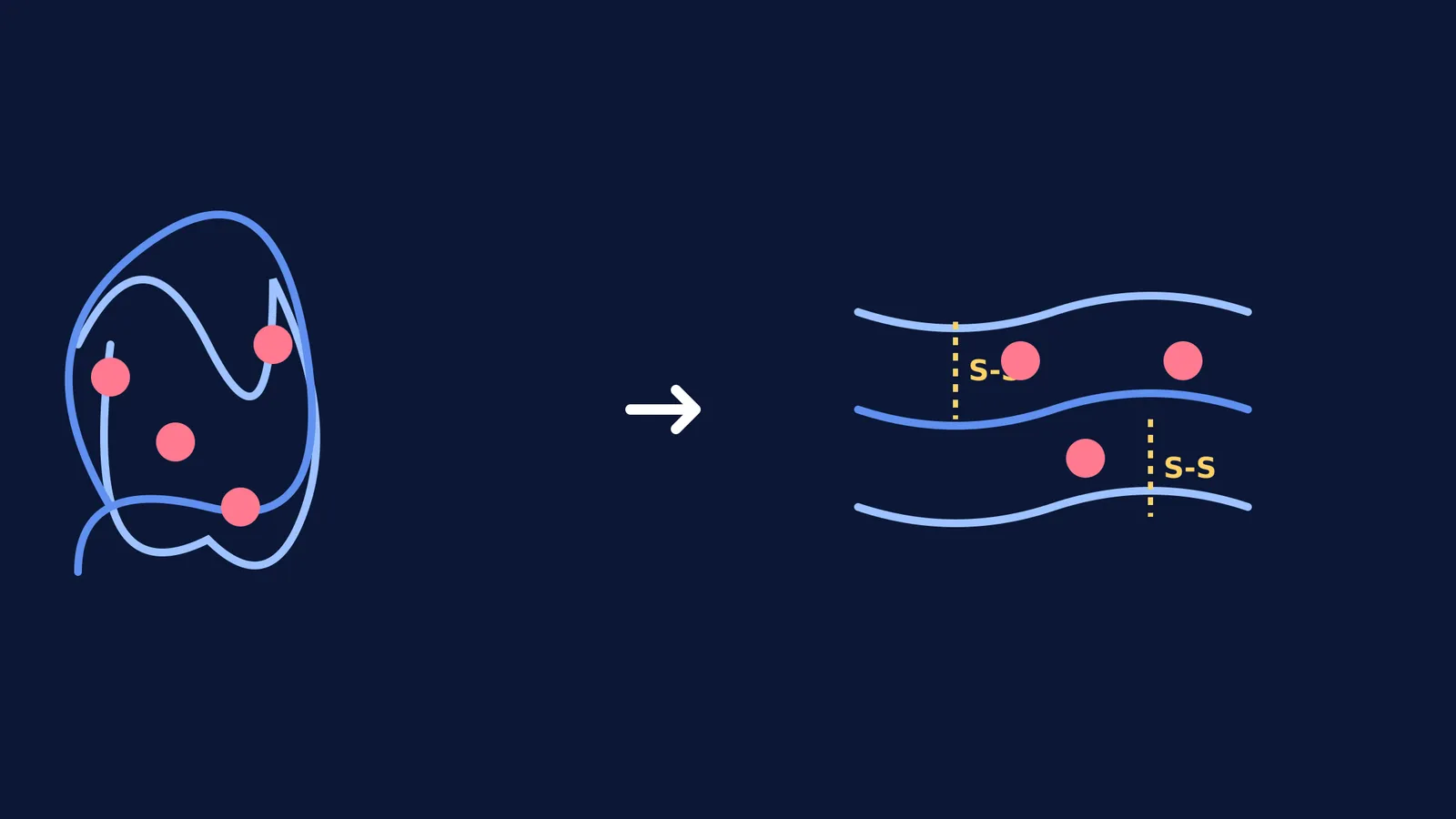
If you just stir water and flour together and stop, the proteins remain in a chaotic, tangled mess. The dough will be weak and tear easily. Kneading provides the mechanical shear force necessary to organise this chaos.
As you stretch and fold the dough, you physically pull the coiled glutenin chains into long, parallel strands. Kneading promotes the formation of these gluten strands and cross-links, creating baked products that are chewier. But alignment alone isn't enough to make the dough hold its shape.
The real magic is a chemical reaction. As the glutenin strands slide past one another, sulfur-containing amino acids on different chains come into contact. They react to form disulfide bonds.
These covalent bonds are incredibly strong. They act like molecular staples, linking the individual glutenin molecules to form a submicroscopic, rubbery network attached to gliadin. The longer the dough is worked, the more cross-links form, increasing the structural integrity of the bread. This is why a well-kneaded dough feels firm and springs back, storing elastic potential energy in a stretched wire or spring. During baking, heat coagulates the gluten, which stabilizes the shape of the final product.
Do you always have to knead the dough?
While kneading is the traditional way to develop gluten, it is not the only way. Increased moisture content also enhances gluten development. In very wet doughs left to rise for a long time, the gluten network can organize itself without any mechanical kneading.
During fermentation, yeast produces carbon dioxide bubbles. As these bubbles expand, they gently stretch the dough from the inside out, aligning the proteins just as your hands would. These gas bubbles are trapped by the gluten network, causing the dough to rise. This biological and chemical process is the principle behind no-knead bread.
What happens in gluten-related disorders?
While the elastic gluten network is essential for baking, it can cause significant health issues for some individuals. The average daily gluten intake in a Western diet is estimated to be between 5 and 20 grams per day, which is harmless for most people. However, gluten has been implicated in several distinct medical disorders.
The most well-known condition is celiac disease, a serious autoimmune disorder where the ingestion of gluten leads to damage in the small intestine. When individuals with celiac disease consume gluten, their immune system mistakenly attacks their own intestinal lining. This condition affects approximately 1 to 2 percent of the global population.
In addition to celiac disease, some individuals experience non-celiac gluten sensitivity, reporting similar symptoms that improve when they adopt a gluten-free diet. Furthermore, a classic wheat allergy can trigger a rapid immune response to wheat proteins. Because of these conditions, food labeling standards are strictly enforced, with products typically required to contain less than 20 parts per million of gluten to be classified as gluten-free.


