

On this page
You tap, you shake, you hit the bottom of the glass bottle, and nothing happens. Then, without warning, half the bottle of ketchup erupts onto your plate. This frustrating kitchen experience is not bad luck; it is a textbook demonstration of fluid mechanics. Ketchup gets stuck and then rushes out because it is a shear-thinning fluid that needs a minimum amount of force to start moving.
Why does ketchup get stuck and then rush out?
Most liquids we drink, like water or milk, have a constant viscosity regardless of how hard you push them. Ketchup is different. It is a non-Newtonian fluid made of crushed tomatoes, water, vinegar and thickeners like xanthan gum.
When the bottle is resting, the long polymer chains in the thickeners and the suspended tomato solids tangle together into a microscopic web. This three-dimensional network makes the ketchup act almost like a soft solid. The molecules are physically jammed together, unable to slide past one another. When you finally hit the bottle hard enough, you apply a sudden shear stress that breaks these tangled chains apart. The polymers align in the direction of the flow, the structure collapses instantly, and the viscosity plummets, creating the sudden deluge that floods your chips.
What is a non-Newtonian fluid?
A fluid is Newtonian if its viscosity—its internal resistance to flow—remains exactly the same no matter how fast it is stirred or pushed. Non-Newtonian fluids, however, change their thickness depending on the force applied to them.
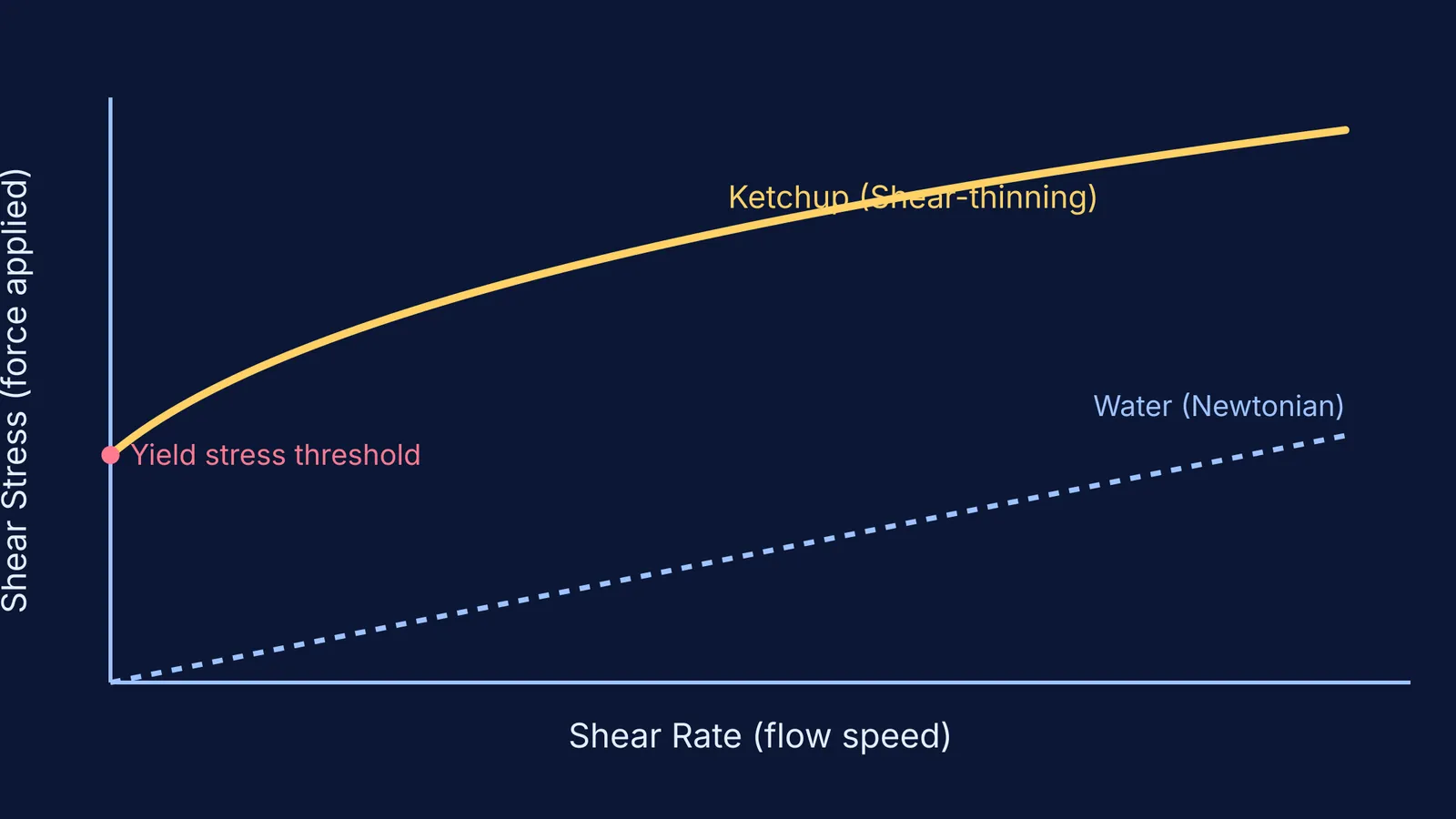
Ketchup combines two specific non-Newtonian behaviours. First, it has a yield stress, meaning it behaves like a solid until you push it hard enough, much like toothpaste sitting on a brush. Second, it is "shear-thinning", or pseudoplastic. Once it starts moving, the harder you shear it, the thinner and more runny it gets. The fluid literally changes its internal structure in response to the stress.
Visualising how complex molecules align under stress can be difficult from a textbook alone. The Fermi Simulation Lab offers interactive simulations for ideas that are easier to see than to read, helping you picture exactly when a fluid transitions from a rigid lattice to a flowing liquid.
If you are studying fluid mechanics for your exams—whether you are calculating volume flow rates or solving for two immiscible liquids in a manometer—understanding these real-world examples is key.
How much force is needed to make ketchup flow?
The exact point where ketchup transforms from a stubborn solid into a flowing liquid is called the yield stress. Ketchup has an apparent yield stress of approximately 15 Pascals (Pa) (Barnes, 199900094-9)). Until the force you apply exceeds this 15 Pa threshold, the liquid simply will not pour.
Fifteen Pascals might sound like a large number, but it is actually a very small pressure—roughly equivalent to the weight of a few sheets of paper resting on your hand. However, inside the narrow neck of a glass bottle, this small structural strength is more than enough to hold a plug of ketchup firmly in place against the pull of gravity.
Researchers continue to study these properties to optimise food packaging and flow. A study confirmed that commercial ketchup exhibits pseudoplastic behaviour when tested at 22 °C across a shear rate range of 0.1 to 68 s⁻¹ (Kumbár et al., 2019). By mapping these values, engineers can design better bottles that squeeze smoothly without sudden explosions.
How can you pour ketchup perfectly?
Instead of wildly hammering the base of the glass bottle, you can use physics to pour your ketchup smoothly.
Wake up the fluid: Shake the bottle with the lid on to break up the polymer chains before you try to pour. This pre-thins the fluid.
Angle it: Hold the bottle at a tilted angle. Just as powder sliding down a slope depends on the angle of repose and angle of friction, tilting the bottle lets gravity help pull the ketchup toward the neck smoothly.
Tap the sweet spot: Do not smack the bottom. Instead, tap firmly on the neck of the bottle. This applies concentrated shear stress right where the ketchup needs to thin out to squeeze through the opening.
Mastering physics is not just for passing exams—it can save your dinner. If you want to dive deeper into fluid dynamics, Fermi's AI tutor can work out what you already know and build a plan for the session, and teach through it step by step.


