

On this page
If you tap the rim of a water glass with a spoon, you hear a clear, ringing note. Pour a little more water in, tap it again, and the note drops.
This simple action is the secret behind the jal tarang. The jal tarang is an Indian classical instrument made of a series of porcelain or metal bowls whose pitch is controlled by varying the volume of water inside. By carefully pouring in or removing water, a musician tunes each bowl to a specific note in a raga.
But why does adding water push the pitch down rather than up? The answer lies in how mass affects vibration.
What vibrates when you strike a bowl?
When a wooden stick strikes a jal tarang bowl, it forces the solid walls to vibrate. The rim rapidly bends in and out—an effect called a quadrupole mode—creating displacement and pressure waves in sound that travel through the air to your ear.
If the bowl is empty, it vibrates at its own natural frequency, determined by its size, thickness, and material. However, the water inside is not just resting there; it is forced to vibrate along with the bowl. This coupling between the solid wall and the liquid changes the physics of the system.
In 2011, physicists Denis Terwagne and John W. M. Bush published a detailed study on fluid-filled singing bowls in the journal *Nonlinearity*. They confirmed that the water acts as a "mass load" on the bowl's vibrating walls. The liquid essentially grabs onto the sides of the bowl, meaning the bowl now has to drag the water back and forth every time it flexes.
How do water bowls in a jal tarang make different notes?
The pitch of a note depends on its frequency: how many times the bowl vibrates back and forth each second.
In physics, the natural frequency of an object depends on two things: its stiffness (how hard it is to bend) and its mass (how heavy it is). You see this in a mass on a vertical spring: if you attach a heavier weight to the same spring, it will bounce up and down more slowly.
The same rule applies to the jal tarang. Adding water to a bowl significantly increases the total mass that has to move, without significantly changing the stiffness of the porcelain or bronze.
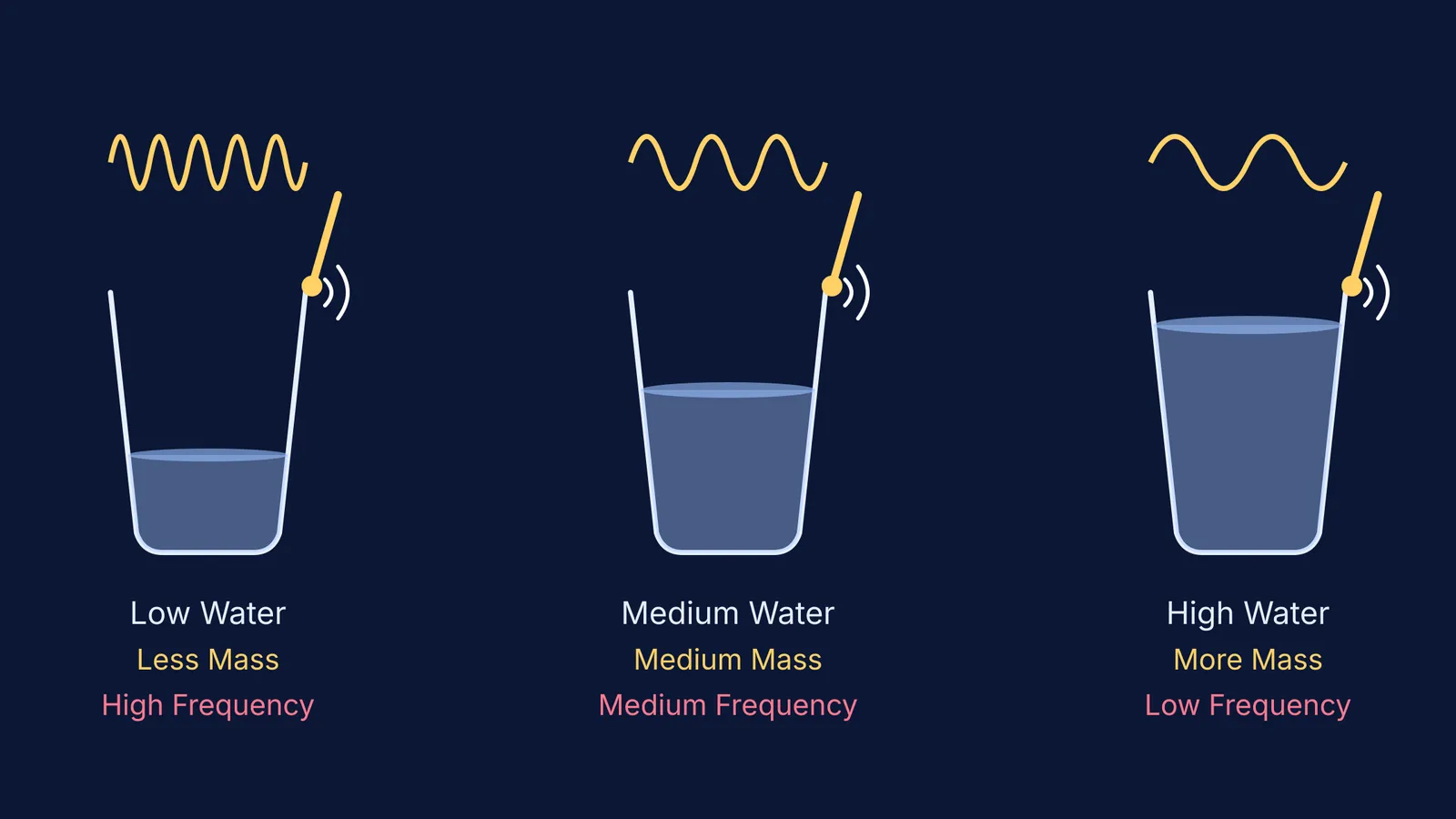
More water means more mass. The heavier bowl-and-water system vibrates more slowly, creating a lower frequency and a deeper pitch.
Less water means less mass. The lighter system vibrates faster, creating a higher frequency and a sharper pitch.
To play a full scale, a jal tarang player uses bowls of varying sizes for the rough tuning. Smaller bowls naturally ring higher because they have less mass and higher stiffness. The musician then fine-tunes them by adding or removing drops of water until the pitch hits the exact frequency required.
If you want to see how mass changes a wave's frequency in real time, the Fermi Simulation Lab has interactive models where you can alter variables and watch the resulting waves shift.
Striking vs blowing: the air column trick
You might have tried making music by blowing across the top of a half-full glass bottle. If you did, you likely noticed the exact opposite effect: adding water made the note *higher*.
This happens because striking and blowing vibrate two completely different physical systems.
When you strike a glass with a spoon, the glass and the water vibrate. As we have seen, more water means more mass, which slows the vibration down and creates a lower pitch.
When you blow across a bottle, you are not vibrating the glass. You are vibrating the column of air trapped inside the bottle. The water simply acts as the floor of that column. More water means a shorter column of air. Just like a shorter guitar string or a shorter flute, a shorter air column vibrates faster, creating a higher pitch.
A safe home experiment
You can test this mass-loading effect at home by building a simple water xylophone.
Gather four to six identical drinking glasses. Thin glass or ceramic works best, as heavy mugs are too stiff to ring clearly.
Leave the first glass nearly empty. Fill the second glass a quarter of the way, the third halfway, and the last one almost to the brim.
Gently tap the side of each glass with a metal spoon, moving from the empty one to the full one.
You will hear the pitch step down as you hit the fuller glasses. If you want a challenge, download a free tuning app on your phone. See if you can add or remove water drop by drop until your glasses match a major scale. It takes patience to hit the perfect note—which is exactly what makes the jal tarang such a remarkable instrument to master.


