

On this page
An induction cooktop feels like magic: the glass surface stays cool while the water inside the pot boils violently. It achieves this by turning the pan itself into the heating element. But if you try to use a pure aluminium or copper pan, the stove will simply beep and refuse to turn on.
The reason lies in a combination of electromagnetism, eddy currents, and a phenomenon known as the skin effect.
How does an induction stove generate heat?
An induction cooktop does not have a traditional thermal heating element. Instead, beneath the glass-ceramic surface lies a tightly wound coil of copper wire. When the stove is turned on, an alternating current (AC) — usually oscillating at frequencies between 25 kHz and 50 kHz — passes through this coil, according to the physics of induction cooking.
This rapidly changing current generates a dynamic magnetic field that extends upwards through the glass and into the base of the cooking vessel. According to Faraday’s law of induction, this oscillating magnetic field induces an electromotive force (EMF) in the metal pan. The EMF drives swirling loops of electricity known as eddy currents.
As these eddy currents flow through the metal base, they encounter the electrical resistance of the material (the same principles you use when solving circuits). This resistance converts the kinetic energy of the electrons into heat via Joule heating (P = I²R).
Why does the skin effect matter?
To generate enough heat for cooking, the pan must offer significant electrical resistance. If the resistance is too low, the currents will simply flow freely without transferring much energy to the metal.
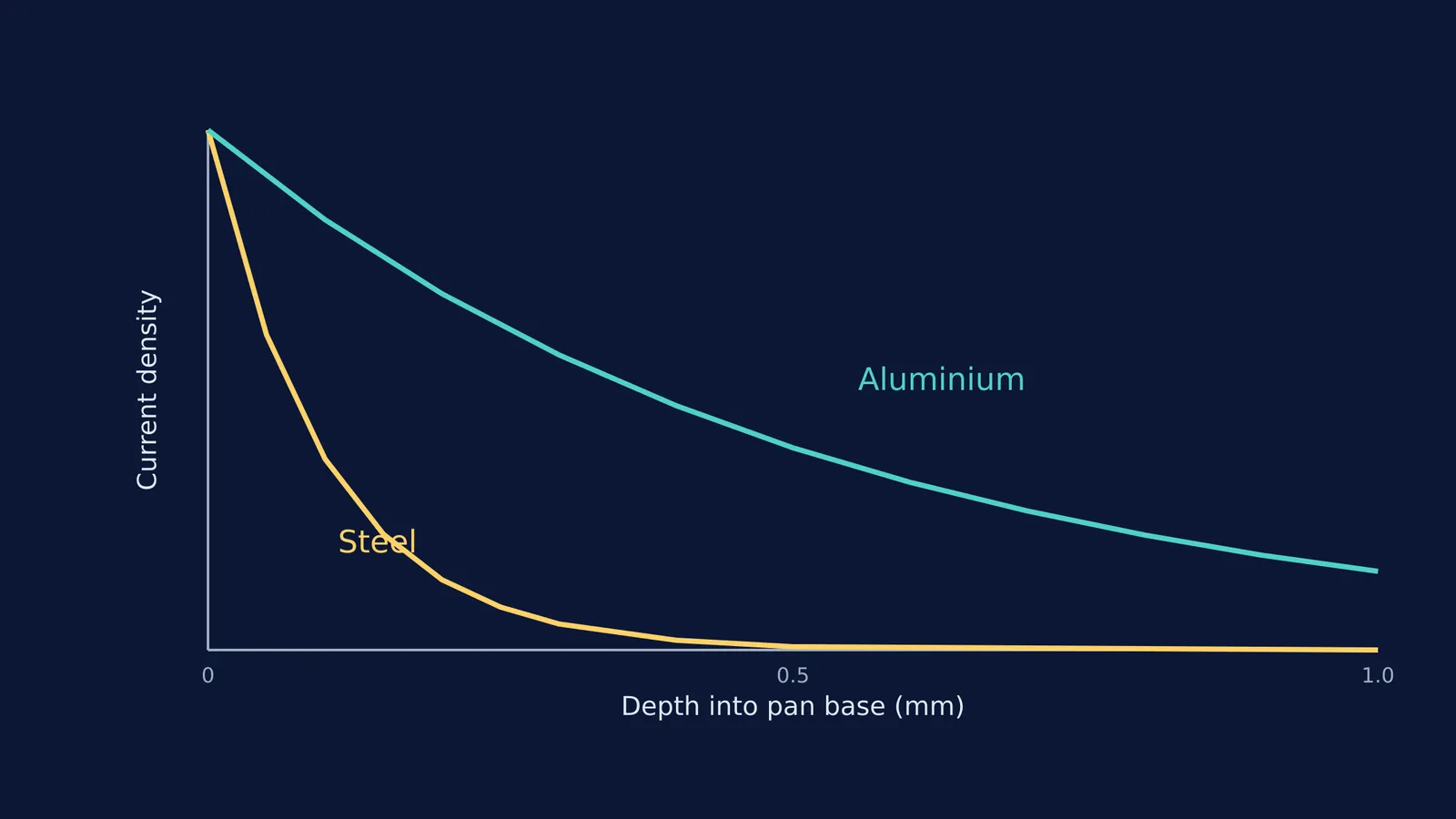
This is where the high frequency of the induction coil becomes crucial. At 24 kHz (a common induction cooking frequency), an alternating current does not flow evenly through the entire thickness of the metal base. Instead, it is pushed toward the surface—a phenomenon known as the Skin effect.
The depth to which the current penetrates is called the skin depth (δ). A shallower skin depth means the current is forced through a much smaller cross-section of the metal, which dramatically increases its effective resistance.
Why do induction stoves need steel?
The secret to induction cooking lies in magnetic permeability (μ), which measures how easily a material supports the formation of a magnetic field.
Ferromagnetic materials like cast iron and most types of stainless steel have a very high relative permeability. This acts like a magnet for the field lines, pulling them tightly together and concentrating the eddy currents. In a carbon steel pan at 24 kHz, the skin depth is roughly 0.10 mm, as seen in standard Skin effect tables.
Because the entire current is squeezed into this paper-thin layer at the bottom of the pan, the electrical resistance spikes. This high resistance generates intense and immediate heat.
In addition to Joule heating from eddy currents, ferromagnetic materials contribute a second source of heat: magnetic hysteresis. As the alternating magnetic field rapidly flips the magnetic domains back and forth 24,000 times a second, internal friction within the metal structure generates additional thermal energy. While eddy currents are the primary heat source, hysteresis provides a helpful boost that non-magnetic materials entirely lack.
Why can't you use aluminium or copper pans?
Aluminium and copper are excellent conductors of electricity, but their magnetic permeability is essentially the same as air (μ_r ≈ 1), as noted in induction cooking physics.
Without the magnetic properties of steel to compress the field, the skin depth in an aluminium pan expands to several millimetres. The eddy currents spread out through the thick base of the pan, encountering very little resistance. Because the resistance is so low, minimal heat is produced. To generate cooking temperatures in an aluminium pan, the stove would need to push massive amounts of current—often enough to melt its own internal copper coils. Modern stoves detect this lack of resistance and safely turn off.
If you find it hard to picture how magnetic fields change across different materials, the Fermi Simulation Lab has interactive simulations for the ideas that are easier to see than to read.
To get around this limitation, cookware manufacturers have developed hybrid pans. If you have a favourite aluminium or copper pan that is marketed as "induction-compatible," turn it over. You will see a heavy steel plate bonded or brazed to its base. This plate acts as the target for the magnetic field, generating the heat and then conducting it upward into the aluminium shell.
How do you test pans with a magnet?
If you are setting up a kitchen for an induction stove, you do not need to read the manufacturer labels to know if a pan will work. Use this simple checklist:
Find a magnet: A fridge magnet works perfectly.
Test the base: Hold the magnet against the bottom surface of the pan.
Check the pull: If the magnet sticks firmly, the pan is highly ferromagnetic and will heat up quickly. If it barely sticks or falls off, the skin depth will be too large and the pan will fail to heat.


