

On this page
Drop an ice cube on the kitchen counter, and it might sit there for an hour. Drop the same ice cube into a glass of room-temperature water, and it disappears in minutes. The question of why ice melts faster in water than in air is a classic physics puzzle that touches on the fundamentals of thermodynamics.
Why does ice melt faster in water than in air?
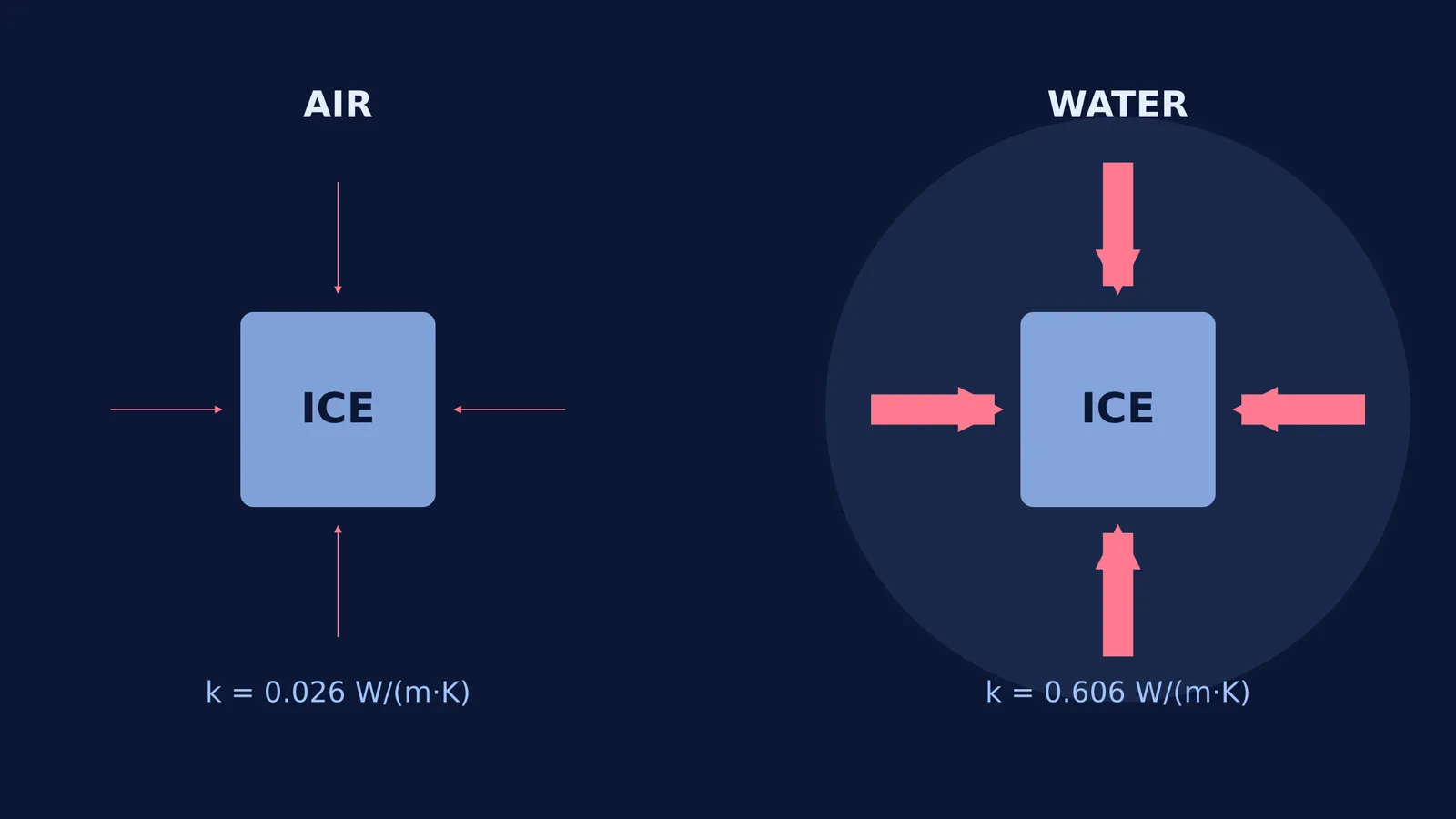
The secret lies in two properties of matter: thermal conductivity and heat capacity. Thermal conductivity measures how quickly a material can pass heat to something else. According to the Engineering ToolBox, water's thermal conductivity at standard conditions is 0.606 W/(m·K), while air's is only 0.026 W/(m·K). This means water conducts heat nearly 24 times faster than air. When an ice cube is in water, the liquid rapidly funnels its thermal energy into the cold solid.
Furthermore, water holds vastly more energy to begin with. The specific heat capacity of water is 4,182 J/(kg·K), while air is roughly 1,005 J/(kg·K). Because liquid water is much denser than air, a given volume of water stores vastly more heat than the exact same volume of air. The water immediately surrounding the ice cube does not cool down as rapidly as a layer of air would. Instead, it maintains a steep temperature gradient, keeping the heat flowing steadily into the solid ice.
How does convection speed up melting?
When heat flows into the ice, the ice melts into cold water. In air, the cold air surrounding the ice sinks because it is denser than the warmer room air, pulling in slightly warmer air from above. However, because air is such a poor conductor to begin with, this natural draft transfers heat very slowly.
In a glass of water, the newly melted, cold water sinks to the bottom (meaning the near-freezing water from the ice falls quickly). This creates strong, continuous convection currents. Room-temperature water constantly rushes in to replace the sinking cold water, bringing fresh thermal energy directly to the surface of the ice cube. This combination of high conduction and rapid convection is why ice vanishes so quickly in a liquid. If you are studying calorimetry and heat transfer, identifying which mechanism moves the most heat is a key step in setting up the equations.
How can we test thermal conductivity at home?
To make these abstract numbers concrete, you can run a simple, timed experiment in your kitchen. This transforms passive reading into active observation.
Find two identical bowls or glasses and place them on the kitchen counter away from direct sunlight.
Pour room-temperature tap water into one bowl. Leave the other bowl empty, so it is filled only with room air.
If you have a cooking thermometer, use it to verify that both the water and the room air are at the exact same temperature.
Take two roughly identical ice cubes from the freezer.
Drop one ice cube into the water and place the other in the empty bowl at the exact same time.
Start a stopwatch and record how many minutes it takes for each to completely vanish.
You will typically see the water-submerged ice melt much faster, depending on the air currents in the room. This direct, hands-on experience builds a strong intuition for matter in our surroundings before a student ever has to memorise the underlying physics formulas.
How does an AI tutor help picture heat transfer?
If your child struggles to picture invisible processes like thermal conductivity or phase changes, talking through the mechanisms step by step can bridge the gap. Instead of just memorising definitions, students need to see how the variables interact.
When a textbook's explanation of heat conduction and thermal resistance is not clicking, you can explore the Fermi Simulation Lab to interact with models of particle motion and thermodynamics. Fermi's AI tutor can also help by working out what a student already knows about energy and building a plan for the session, so they sit down to a clear next step instead of a blank page.
By testing the world around them, students learn that physics is not just an abstract set of equations—it is the operating system of the kitchen.


