

On this page
The moment you drop a fresh ice cube into a room-temperature drink, you usually hear a sharp pop or crack. This familiar sound is not trapped air escaping, nor is it the ice instantly melting. It is the sound of the ice physically tearing itself apart under intense mechanical stress. The mechanism behind it is a perfect everyday example of thermal expansion and material strength, concepts that engineers use to build bridges and that students encounter in physics exams.
Why does the outside expand first?
Ice is a solid crystal, and like most solids, it expands as it absorbs heat. The coefficient of linear thermal expansion for ice near 0 °C is approximately 51 × 10⁻⁶ K⁻¹ (often written as 51 ppm/K) (Engineering ToolBox). This means that for every degree it warms, a metre of ice would grow by 51 micrometres. While that sounds tiny on a human scale, it is a massive rate of expansion compared to common structural materials like steel or glass.
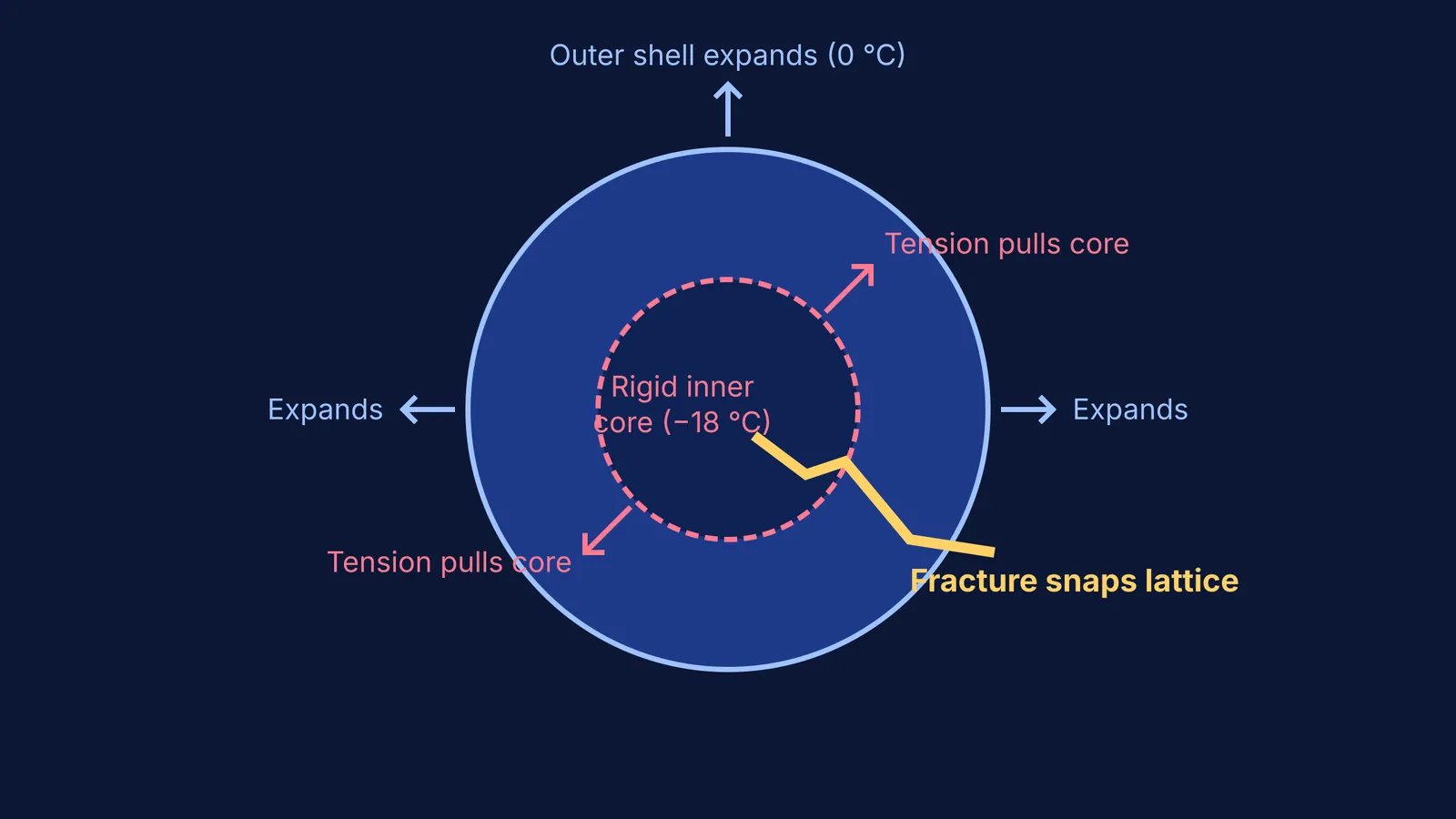
However, ice is also a very poor conductor of heat. Its thermal conductivity is just about 2.2 W/(m·K) (Engineering ToolBox). When an ice cube straight from the freezer at −18 °C hits a 20 °C liquid, the heat from the drink does not spread instantly to the centre of the cube. The outermost layer of the ice warms up in a fraction of a second and immediately tries to expand to its new, larger volume. Meanwhile, the inner core, insulated by the outer layers, stays stubbornly at −18 °C and refuses to change its size.
The tug-of-war inside the ice
This severe temperature gap creates an intense physical tug-of-war known as thermal shock. The warm outer shell desperately wants to grow, but it is tightly bound to the cold, rigid inner core. Because the outer layer is forced to stay smaller than its natural warm state, it pushes in on the core. Conversely, the expanding outer layer pulls the cold core outward, forcing the entire structure into a state of tensile stress (tension).
When structural forces clash in opposite directions, something has to give. If you want to visualise how these internal stresses build up inside a material until it fails, the Fermi Simulation Lab provides interactive simulations for the ideas that are easier to see than to read.
Why does it snap?
Ice is a remarkably brittle material. While it can handle quite a bit of weight being pressed down on it (compressive strength), it is incredibly weak when pulled apart. The tensile strength of ice is generally between 0.7 and 3.1 MPa (megapascals) (JOM, 1999).
The mechanical stress generated by the outer layer's sudden thermal expansion can easily reach over 9 MPa (Engineering ToolBox), depending on how warm the drink is. Because this outward stress is vastly greater than the material's maximum tensile strength, the delicate hydrogen bonds making up the ice's hexagonal crystal lattice simply snap. The fracture propagates through the cube at the speed of sound in ice, releasing the pent-up elastic energy as an audible pop.
How air bubbles make the cracking worse
Not all ice cracks the exact same way. If you look closely at standard freezer ice, it usually has a cloudy white centre. This cloudiness is caused by trapped air bubbles and dissolved gases that were pushed inward as the water froze slowly from the outside in.
In the world of materials science, these tiny bubbles act as stress concentrators—microscopic weak points where the crystal lattice is already broken. When the thermal shock hits, the massive tensile stress finds it much easier to initiate a tear at the edge of a bubble. This is why cloudy home ice tends to shatter into many small shards when dropped in water. On the other hand, perfectly clear ice (often made in commercial machines that freeze water in flowing layers to push air out) might only crack in a few clean, straight lines.
Understanding how everyday materials behave under sudden temperature changes helps explain much more than just the sounds in a glass of water. It is exactly the same underlying physics that dictates the thermal expansion of the rod in an old pendulum clock or the elastic potential energy in a stretched wire. The next time you pour yourself a cold drink, you can listen to the snap and know you are hearing the breaking limits of molecular bonds.


