

On this page
Have you ever stopped to wonder why you have two strips of hair perched above your eyes? While many mammals have facial hair, human eyebrows are a unique evolutionary feature that serves highly specific biological functions. We evolved to have them for two primary reasons: to protect our vision from sweat and rain, and to communicate complex emotions with each other without saying a word.
How do eyebrows protect your eyes?
Because humans are elite sweaters who rely on eccrine glands to regulate temperature across our entire body, we produce a significant amount of moisture on our foreheads. Sweat contains salts and oils that irritate the eyes and temporarily blur vision. Unlike dogs that pant to cool down, our reliance on sweat made a built-in sweatband uniquely necessary for survival.
The American Academy of Ophthalmology notes that the natural arch of the eyebrow, combined with the direction the hairs grow—pointing outward toward the temples—channels moisture away from the eye sockets and down the sides of the face. This diversion system allowed early humans to maintain clear vision while tracking prey or navigating terrain in hot climates.
Why do we use eyebrows to communicate?
As human society became more complex, our anatomy had to adapt. A 2018 study by Godinho, Spikins, and O'Higgins in the journal *Nature Ecology & Evolution* investigated the massive, rigid brow ridges of ancient hominins like *Homo heidelbergensis*. Using 3D engineering software, the researchers found that these thick bone structures were not mechanically necessary to support heavy chewing, as previously thought. Instead, heavy brow ridges likely evolved to signal physical dominance and aggression, much like a stag's antlers.
Over the last 100,000 years, as our faces became smaller and flatter, these intimidating ridges were replaced by smooth foreheads and highly mobile eyebrows. This anatomical shift provided a wide canvas for subtle non-verbal communication. Our ancestors used these highly mobile muscles to express sympathy, surprise, skepticism, and trustworthiness. This ability to signal friendly intent—a process researchers call "self-domestication"—was crucial for early humans to build the large, cooperative social networks that helped *Homo sapiens* thrive while other hominin species went extinct.
Visualising how these traits evolved in the human skeleton over millennia can be difficult from flat textbook diagrams. If you are struggling with hard-to-picture ideas in biology—from cranial changes to reading graphs for stabilising, directional and disruptive selection—the Fermi Simulation Lab lets you interact with dynamic models and see the mechanics of evolution firsthand.
Do eyebrows help us recognise faces?
Beyond just showing emotion, eyebrows are essential for identifying other people in a crowd. Because they provide a high-contrast, stable frame that sits firmly on the brow ridge, they are less affected by changes in lighting or shadows than other facial features like the eyes or cheeks. This makes them a highly reliable landmark for your brain's facial recognition system.
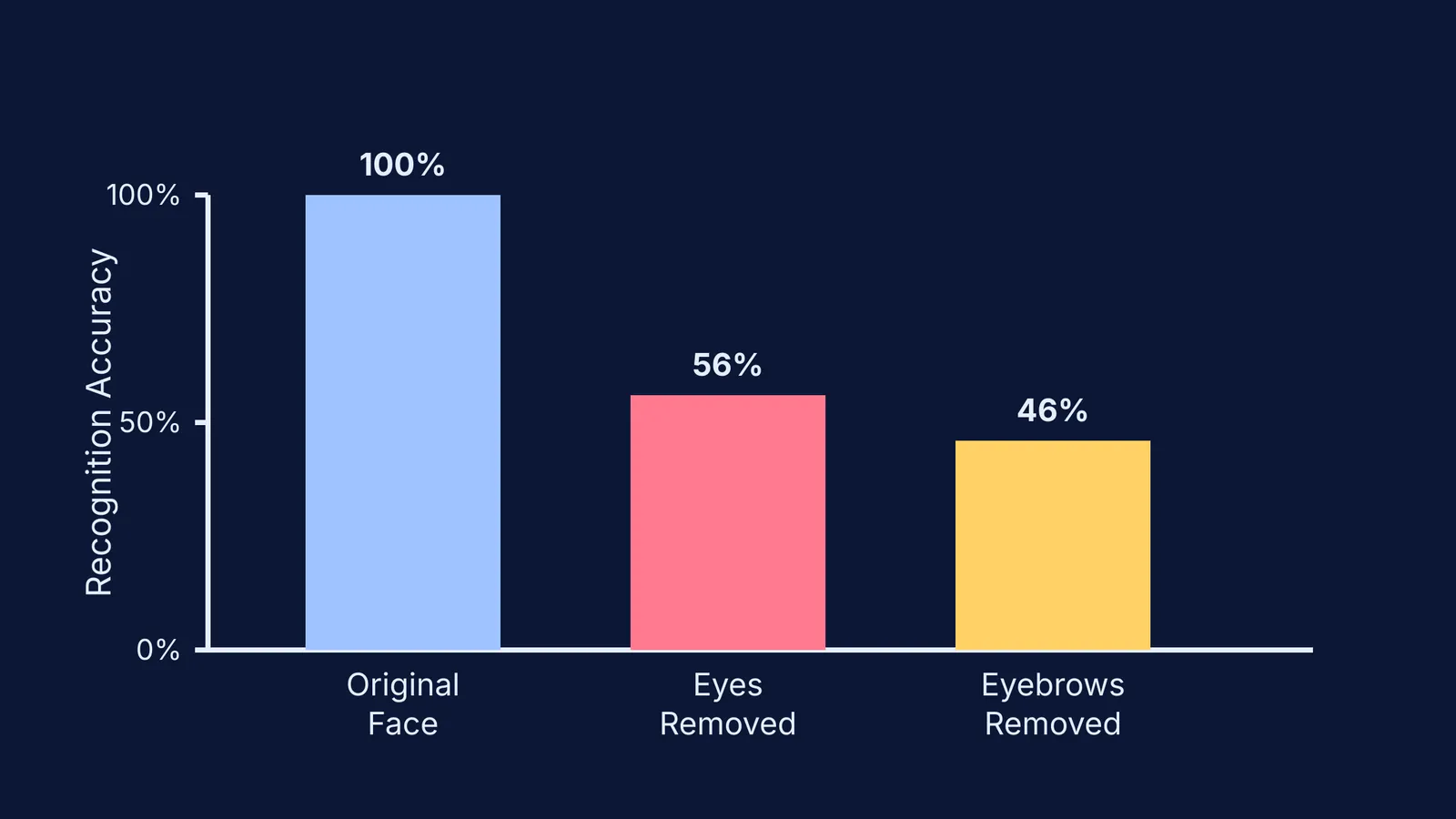
A landmark 2003 study by Sadr, Jarudi, and Sinha published in the journal *Perception* tested exactly how much we rely on them. The researchers showed participants digitally altered images of familiar celebrity faces. When the eyes were entirely removed from the photos, participants could still recognise the celebrities 56% of the time. However, when the eyebrows were removed and the eyes were left intact, recognition dropped significantly to just 46%.
The study concluded that eyebrows are actually more important for recognising familiar faces than the eyes themselves. Your brain relies heavily on the geometry and contrast of the eyebrows to quickly map and identify a face, which explains why a simple change in eyebrow shape can dramatically alter a person's appearance.


