

On this page
Have you ever wondered why you can hear a car horn blowing from around the corner of a building, even though you cannot see the car? The answer lies in how waves behave when they hit an obstacle—a phenomenon called diffraction.
Why can we hear a horn around a corner?
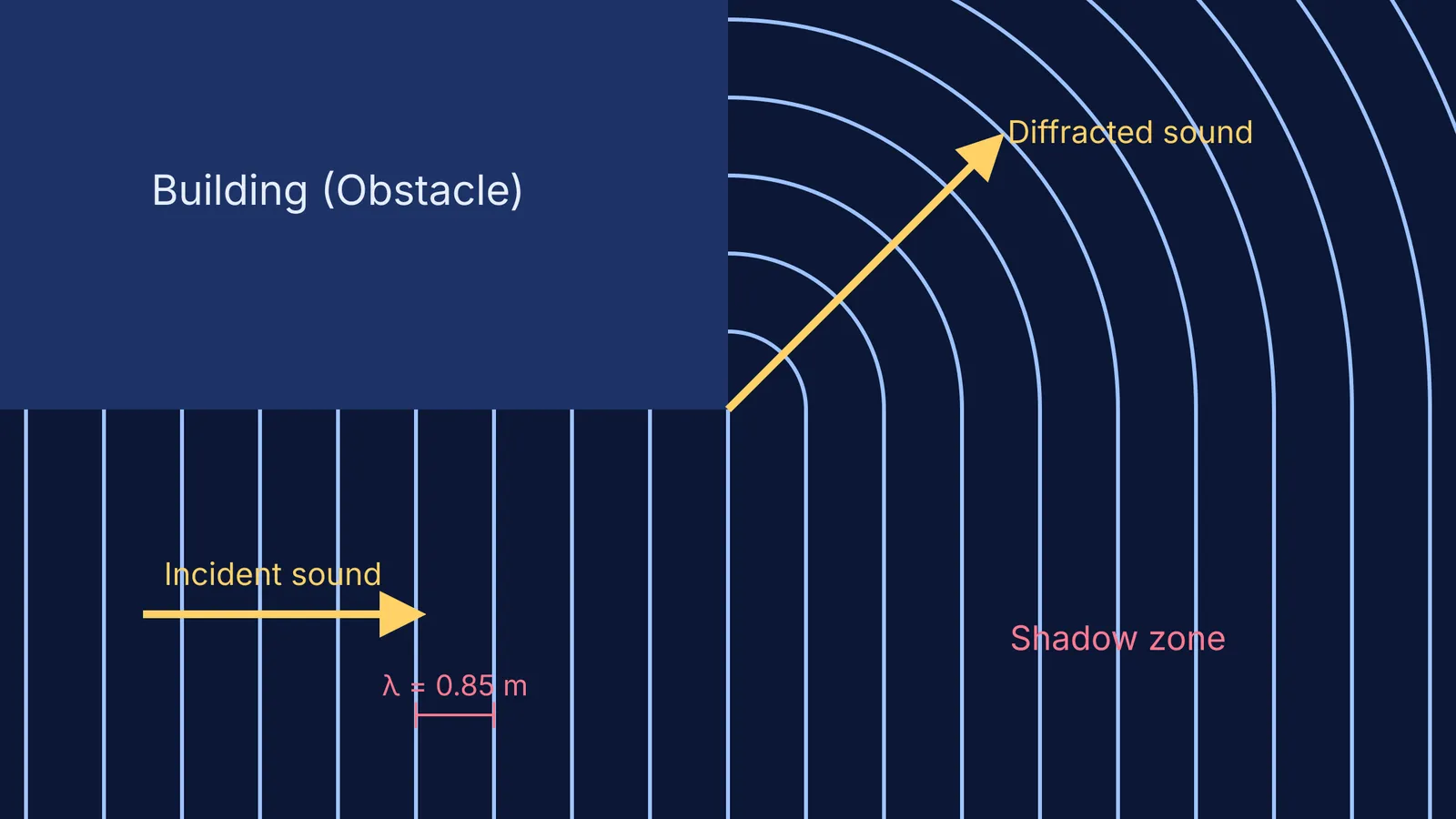
Diffraction is the bending of waves around the edges of an opening or an obstacle. When a sound wave travels down a street and reaches the edge of a wall, it does not simply stop or continue in a perfectly straight line. According to Huygens's principle, every single point on a wavefront acts as a source of secondary spherical wavelets. As the main wave passes the corner, these tiny wavelets spread out into the empty space behind the building, filling the shadow zone with sound.
However, waves do not always diffract equally. The degree of bending depends heavily on how the wave's length compares to the size of the obstacle. Diffraction is most noticeable when the wavelength is comparable to, or larger than, the size of the object it encounters. If the wavelength is far smaller than the object, the wave is blocked and leaves a sharp, distinct shadow behind the barrier.
Why does sound bend when light does not?
To see why sound bends around a building but light does not, we can compare their wavelengths using the standard examples from OpenStax University Physics.
A typical car horn has a low pitch, often with a frequency of about 400 Hz. Given that the speed of sound in air at room temperature is approximately 340 m/s, we can find the exact wavelength of the sound using the wave equation:
Sound wavelength: Using the wave formula v = fλ, the wavelength of the car horn is λ = 340 / 400 = 0.85 m.
Light wavelength: Visible light, on the other hand, is an electromagnetic wave with an extremely small wavelength, ranging from roughly 4 × 10⁻⁷ m for violet light to 7 × 10⁻⁷ m for red light.
A building corner or a standard street doorway is roughly one metre wide. Because the 0.85 m sound wave is comparable in size to the corner itself, it diffracts significantly, allowing the sound energy to travel smoothly into the hidden space behind the wall.
The wavelength of visible light is millions of times smaller than the building. Because it is so tiny compared to the obstacle, light does not bend noticeably around the edge. This is why the car remains completely hidden from your line of sight in a sharp geometric shadow, even while the blast of its horn reaches your ears clearly.
Why do low pitches bend more than high pitches?
This relationship between frequency, wavelength, and diffraction also explains why different types of sounds behave differently in an everyday environment. Because lower frequencies produce longer wavelengths, they diffract far more effectively around large obstacles.
If you stand behind a large building while a marching band goes past on the next street, the deep, low-frequency boom of the bass drum will reach you much more clearly than the high-pitched trill of the flutes. The bass drum's long wavelength easily wraps around the structures, whereas the shorter wavelengths of the higher-pitched instruments are more easily blocked. This is also why the deep rumble of thunder can be heard rolling over hills for miles, while the sharp, high-frequency crack of a nearby lightning strike is easily muffled by trees and houses.
How do you solve diffraction questions in exams?
In physics exams, diffraction questions often ask you to check the condition for a wave to bend. The key rule is that significant diffraction requires λ ≈ D, where D is the size of the obstacle or gap. This explains everything from single-slit diffraction and Malus's law to why AM radio signals travel further around mountains than higher-frequency FM signals. The discovery of this wave bending dates back to Francesco Grimaldi and the discovery of diffraction in the 17th century.
If you find it hard to picture how wavefronts spread, the Fermi Simulation Lab has interactive simulations for the ideas that are easier to see than to read. You can drop a wave into a gap and watch it bend. For practice with the formulas, the Fermi Problem Library has worked problems with a step-by-step solver that explains the reasoning rather than printing an answer, including exercises on finding wavelength and single-slit diffraction minima.


