

On this page
Archaeologists excavating ancient Egyptian tombs have uncovered sealed clay jars containing honey over 3,000 years old that remains entirely unspoiled. Although honey is a concentrated syrup of 80% to 82% sugars (Bogdanov et al., 2008), bacteria and fungi cannot grow in it.
Honey prevents spoilage through three physical and biochemical barriers:
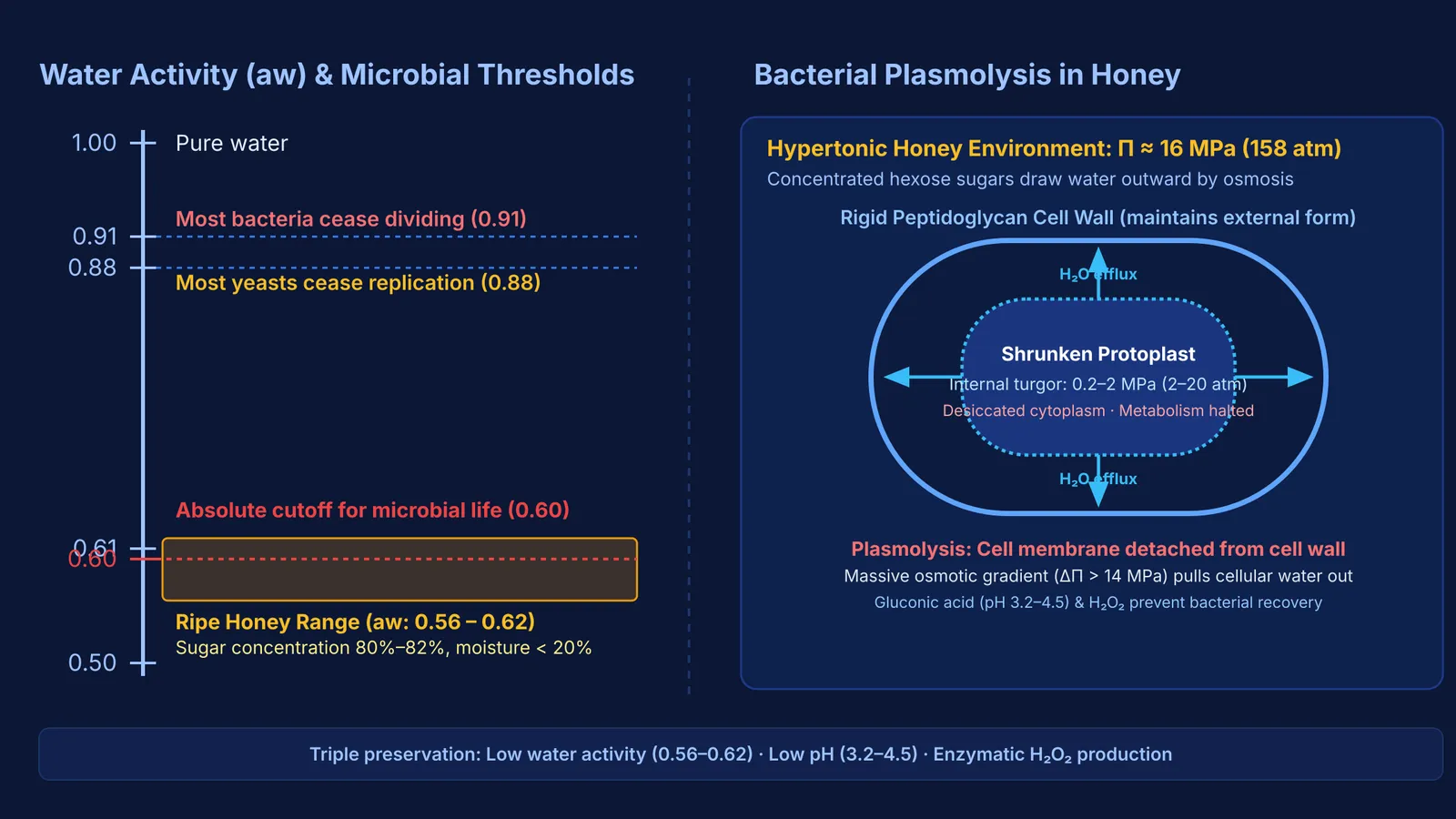
Low water activity (0.56 to 0.62), creating steep osmotic pressure that dehydrates cells.
Acidic pH (3.2 to 4.5), dominated by gluconic acid.
Enzymatic production of hydrogen peroxide, providing continuous antiseptic defense.
How does low water activity kill bacteria through osmosis?
Food standards reviewed by Bogdanov et al. (2008) require pure honey to contain under 20% water by mass, with ripe honeys averaging between 15% and 18%. Moisture percentage alone does not govern microbial survival; the decisive parameter is water activity (aw), the ratio of water vapour pressure in food to that of pure water at the same temperature.
In foundational work on microbial water relations, W. J. Scott (1957)60247-5) established that common bacteria cease dividing below aw 0.91, yeasts halt replication below 0.88, and xerophilic molds cannot divide below 0.60.
Ripe honey maintains an aw between 0.56 and 0.62, far below bacterial thresholds. Because sugar molecules form hydrogen bonds with water dipoles, virtually zero free water remains. In this hypertonic environment, water rushes out of an invading bacterium by osmosis. The cell membrane detaches from the rigid peptidoglycan wall—a process called plasmolysis—leaving the cell desiccated and metabolically inert.
To see how solute concentration drives bulk water movement across boundaries, studying Wilhelm Pfeffer's measurement of osmotic pressure shows how membranes respond to dissolved solutes. For concepts where fluid dynamics and membrane boundaries are easier to see than to read, interactive models in the Fermi Simulation Lab let you adjust concentrations and track cellular volume changes directly.
How do bee enzymes produce acid and hydrogen peroxide?
Honey also deploys active chemical defenses. When honeybees (*Apis mellifera*) forage, hypopharyngeal gland secretions add glucose oxidase to nectar. In biological classification, oxidoreductases form one of the six enzyme classes, specialising in electron transfers.
Glucose oxidase catalyses the oxidation of beta-D-glucose in the presence of water and molecular oxygen:
Glucose + H₂O + O₂ → D-glucono-δ-lactone + H₂O₂
The resulting glucono-delta-lactone hydrolyses spontaneously into gluconic acid. As established in Biochimica et Biophysica Acta90108-1) by Jonathan W. White Jr. and colleagues, this reaction establishes honey's natural acidity, maintaining a pH between 3.2 and 4.5, as reviewed by Bogdanov et al. (2008). Because most vegetative bacteria require pH 6.5 to 7.5, honey's acidic milieu denatures bacterial transport proteins and disables transmembrane proton pumps.
The reaction's second product is hydrogen peroxide (H₂O₂). A laboratory study by Kwakman et al. (2010) in The FASEB Journal showed that honey accumulates up to 5.62 mM hydrogen peroxide alongside bee defensin-1 peptides. While undiluted honey keeps glucose oxidase largely dormant, slight dilution activates it, producing reactive oxygen species that damage bacterial membranes and DNA. A review in the Asian Pacific Journal of Tropical Biomedicine60016-6) confirmed that this multi-target chemical barrier prevents bacteria from multiplying.
How much osmotic pressure does honey exert on bacteria?
We can calculate the osmotic force honey exerts on bacteria using the Van 't Hoff equation (Π = CRT). As shown when finding molar mass from osmotic pressure, colligative properties depend strictly on solute particle density.
Using composition data from Bogdanov et al. (2008), we evaluate ripe honey at 25 °C (298.15 K):
Solute mass: Ripe honey contains roughly 82% hexose sugars (fructose and glucose, molar mass M ≈ 180.16 g/mol) at a density of 1.42 g/cm³ (1420 g/L). One litre contains 0.82 × 1420 g ≈ 1164 g of sugar.
Molar concentration (C): Dividing mass by molar mass yields C = 1164 / 180.16 ≈ 6.46 mol/L = 6460 mol/m³.
Osmotic pressure (Π): Applying R = 8.314 J/(mol K):
Π = CRT = 6460 mol/m³ × 8.314 J/(mol K) × 298.15 K ≈ 1.60 × 10⁷ Pa = 16.0 MPa.
Conversion to atmospheres: Dividing by 1.013 × 10⁵ Pa yields Π ≈ 158 atmospheres.
By comparison, Gram-negative bacteria maintain an internal turgor pressure of roughly 2 to 5 atmospheres, and Gram-positive bacteria reach up to 20 atmospheres (Rojas and Huang, 2018). Honey's 158 atmospheres creates an overwhelming gradient that dehydrates bacterial cells in seconds.
When can honey actually spoil?
Honey can deteriorate under specific environmental conditions:
Moisture absorption: Honey is hygroscopic. In an unsealed container in humid air, it absorbs moisture. When water content exceeds 20%, water activity rises above 0.61, allowing osmophilic yeasts like *Zygosaccharomyces rouxii* to ferment sugars into ethanol and carbon dioxide (W. J. Scott, 195760247-5)).
Bacterial endospores: Desiccation and acid inhibit vegetative growth but do not destroy endospores. Spores of *Clostridium botulinum* can survive dormant in honey. Because an infant's developing intestinal microbiota cannot suppress these spores, public health guidelines advise against feeding honey to children under 12 months (Bogdanov et al., 2008).
Connecting physical chemistry laws to biological mechanisms requires practice across multiple topics. Fermi's AI tutor can work out what you already know and build a plan for the session, guiding you through solution thermodynamics and cellular osmosis one step at a time.


