

On this page
Why does honey crystallise and become solid?
When liquid honey turns cloudy and stiff, people often assume it has spoiled or contains added sugar. In reality, crystallisation is proof of pure honey. Honey is not an ordinary syrup; it is a supersaturated solution of sugars in water.
A solution becomes saturated when water holds the maximum mass of solute possible at a given temperature, a concept covered in lessons on solutes, solvents, and saturation. Under standards established by the Food Safety and Standards Authority of India, genuine blossom honey contains at most 20% moisture by mass and at least 65% reducing sugars. This packs over 80% dissolved solids into less than 20% water.
Because honeybees evaporate nectar inside the hive, honey exists in an unstable supersaturated state. According to solubility data in the *Journal of Chemical & Engineering Data*, 100 grams of water at 25 °C dissolves only about 91 grams of D-glucose. In typical honey with 35 grams of glucose and 17.5 grams of water, the glucose concentration equals 200 grams per 100 grams of water—more than double the saturation point. Glucose must eventually precipitate out of solution.
Why does glucose precipitate while fructose stays liquid?
Honey consists mainly of two simple sugars: fructose and glucose. Both are reducing sugars like glucose and fructose, whose ring shapes were uncovered through Walter Haworth's discovery of sugar ring conformations. Despite sharing the chemical formula C6H12O6, their solubilities differ dramatically.
D-fructose dissolves up to 375 grams per 100 grams of water at 20 °C, according to phase equilibrium data in *The Journal of Physical Chemistry*. Because honey contains around 38 to 40 grams of fructose in 17 grams of water, fructose remains well below saturation. Glucose, with its lower solubility, easily exceeds its limit.
When glucose separates, it binds water to form alpha-D-glucose monohydrate (C6H12O6 · H2O) crystals, as analysed in *Food Chemistry*. Because glucose monohydrate contains only 9% water by mass compared to 17% to 20% in raw honey, crystal formation removes sugar faster than water. This leaves the remaining liquid enriched in fructose and slightly higher in free moisture.
Why does honey set faster around 14 °C than in the fridge?
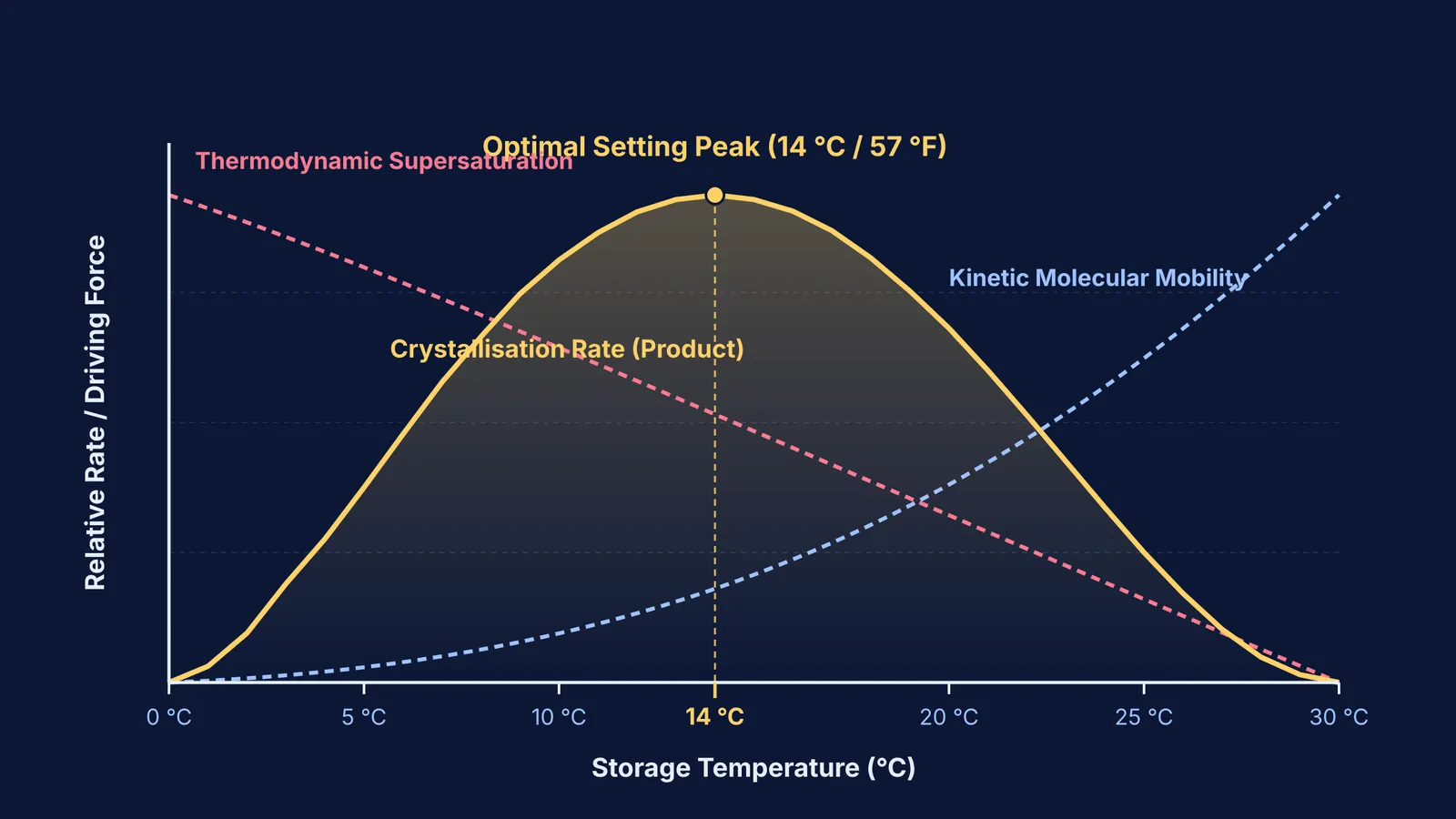
Lower temperatures reduce solubility, yet honey solidifies faster in a cool pantry than in a cold refrigerator. This happens because crystallisation depends on both thermodynamics and kinetics.
Crystallisation requires nucleation (forming tiny crystal seeds) and crystal growth (glucose molecules traveling to those seeds). As temperature drops:
Supersaturation increases because glucose solubility falls, speeding up crystal nucleation.
Molecular mobility decreases because cooling raises honey viscosity, as documented in the *International Journal of Food Properties*. High viscosity slows glucose diffusion toward crystal faces.
In Cornell University Agricultural Experiment Station Bulletin 528, Elton J. Dyce showed that crystal formation peaks near 14 °C (57 °F). Above 25 °C, higher solubility suppresses nucleation. Below 10 °C, high viscosity stalls molecular diffusion. At 14 °C, supersaturation and molecular mobility reach the ideal balance for rapid growth.
To explore how temperature shifts the balance between molecular motion and crystal binding, the Fermi Simulation Lab provides interactive simulations for the ideas that are easier to see than to read.
How can you predict which honey will turn solid first?
A study of 136 honey samples in *Food Chemistry* showed that crystallization rates depend on the floral nectar source and two chemical ratios:
The fructose-to-glucose (F/G) ratio: Honeys with an F/G ratio above 1.4 (such as acacia or chestnut) stay liquid for years, while honeys below 1.1 (such as mustard or sunflower) solidify in weeks.
The glucose-to-water (G/W) ratio: A G/W ratio below 1.7 yields slow granulation, whereas a ratio above 2.0 brings fast, complete solid formation.
The Food Safety and Standards Authority of India permits an F/G ratio between 0.95 and 1.50 across commercial blossom honeys. Natural pollen grains and wax particles also accelerate setting by serving as nucleation centres.
When studying solution chemistry and solubility equilibria, the Fermi Concept Library maps every concept in chemistry, each with its own lesson and its place in the map.
How do you safely decrystallise honey without damaging it?
Crystallised honey is completely wholesome, but you can safely reliquefy it using gentle heat under quality standards maintained by the Food Safety and Standards Authority of India. Uncontrolled heating destroys delicate aroma and elevates hydroxymethylfurfural (HMF).
Follow this gentle heating method:
Loosen the jar lid. If the honey is in plastic, transfer it to glass.
Heat a water bath in a pot to between 40 °C and 45 °C (warm to the touch, not simmering).
Place the jar in the bath with water reaching two-thirds up its sides.
Rest the jar for 20 minutes, stirring occasionally with a dry spoon.
As glucose monohydrate crystals absorb heat, they dissolve back into solution.
This temperature window protects enzymes and keeps HMF well below the 80 mg/kg ceiling set by the Food Safety and Standards Authority of India. Storing the jar in a pantry between 20 °C and 25 °C prevents new crystals from forming.


