

On this page
Unlike ice hockey, field hockey requires players to use only one face of the stick. The International Hockey Federation (FIH) mandates that the playing side must be flat. To adapt to this rule, the modern stick has a curved toe, forming a "J" or hook shape, and a slight curvature along its shaft known as the bow.
Why does a field hockey stick have a curved flat head?
This hook gives you more surface area to stop or trap the ball. Because you cannot use the rounded back of the stick, playing the ball on your left side requires the "reverse stick" technique. By rolling the handle in your hands, you turn the toe backwards so the flat face points right. The curved head ensures that when you rotate the stick, enough flat surface remains close to the ground to hit or control the ball.
The shape of the stick has evolved alongside the playing surface. When the game was primarily played on natural grass, sticks featured long, straight toes that were ideal for hitting the ball forward but clumsy for tight maneuvers. As the sport transitioned to faster artificial turf in the late 20th century, players needed a stick that supported quick, precise dribbling.
The first J-shaped hook was patented by Toon Coolen in 1982 and mass-produced by Grays starting in 1983. This design changed ball control, allowing players to cradle the ball within the curve of the hook during aggressive sprints.
How does a hockey stick act as a lever?
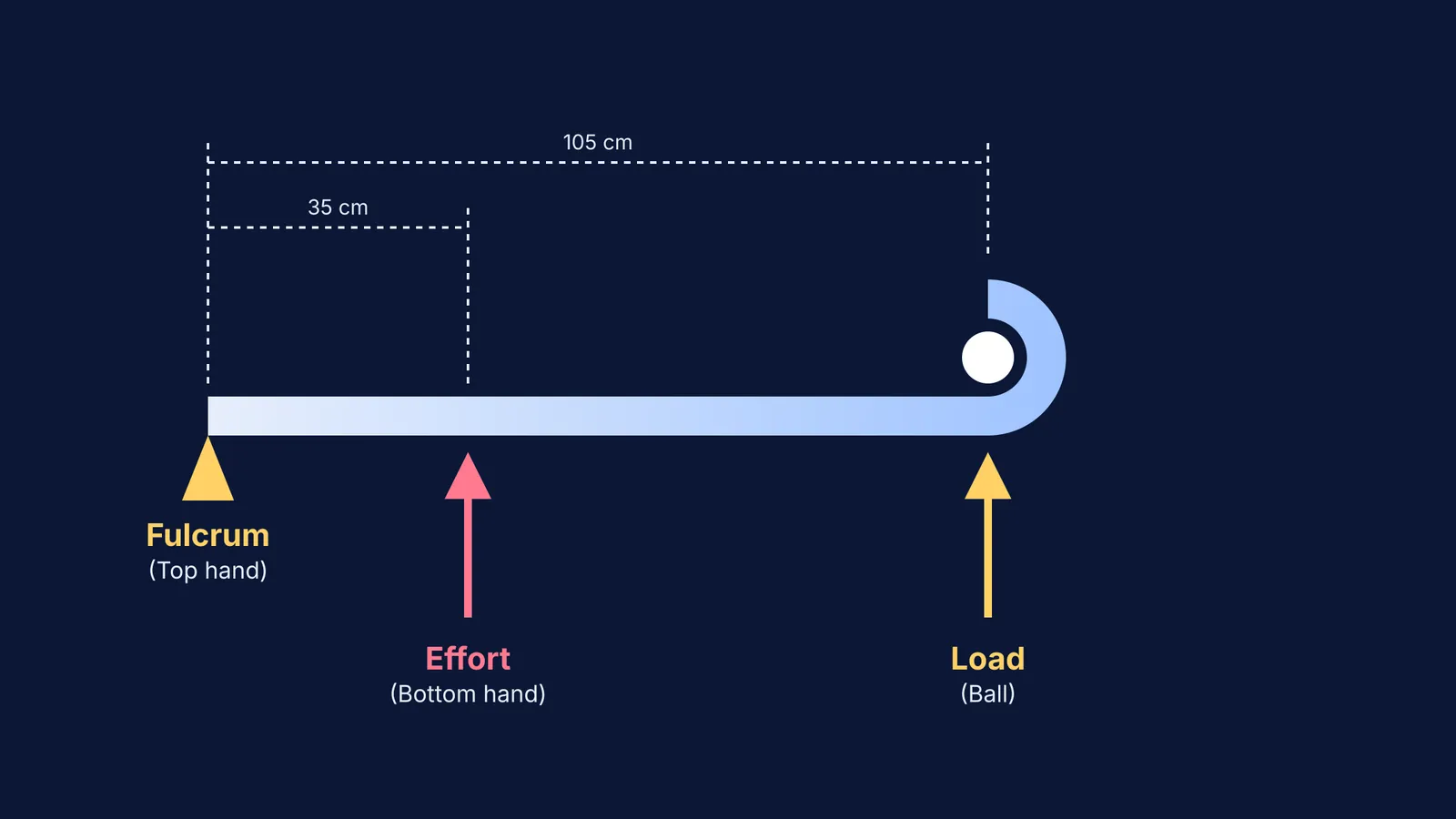
A field hockey stick is a classic example of a Class 3 lever. In this type of lever, the effort force is applied between the fulcrum and the load (Wikipedia).
When you execute a standard hit or sweep, the mechanics break down as follows:
Fulcrum: Your top hand holding the top of the grip acts as the stationary pivot.
Effort: Your bottom hand applies the forward driving force to swing the stick.
Load: The ball resting against the flat head of the stick.
Because the effort (your bottom hand) is closer to the fulcrum than the load (the ball), the mechanical advantage is less than 1. This means you must push with a force greater than the force delivered to the ball. However, what you lose in raw force, you gain in speed.
A Class 3 lever acts as a speed multiplier. The head of the stick travels a much larger arc in the same amount of time as your hands. If your bottom hand pushes at a distance of 35 centimeters from the top hand, and the ball is struck at the end of a stick measuring 105 centimeters, the tip moves three times as fast as your bottom hand. This amplification of linear velocity is what allows a player to drive a ball at high speeds.
How does the bow alter the physics of a shot?
While the head of the stick handles contact, the shaft is rarely perfectly straight. Modern composite sticks feature a longitudinal curve called the "bow".
By moving the point of maximum curvature closer to the head (a "low bow"), the stick effectively creates an angled ramp. When a player performs a drag flick, the ball travels up this ramp, staying in contact with the flat face for a fraction of a second longer. This increases the impulse—the product of force and time—transferring more kinetic energy to the ball. The low bow also makes it significantly easier to get under the ball's center of gravity to execute "3D skills" like scoops and aerial lifts.
What are the FIH rules for stick dimensions?
To prevent sticks from becoming dangerously long or having unpredictable slingshot effects, the sport's governing body sets strict limits.
Every stick must pass through a ring with an internal diameter of 51 millimeters.
The maximum permitted length for a field hockey stick is 105 centimeters.
A stick's total weight must not exceed 737 grams.
The vertical limit for the upturn of the curved toe is 100 millimeters.
These dimensions ensure the stick remains a controlled lever rather than an overpowering catapult.
Checklist: How to choose your lever
Understanding the physics of your stick can help you select the right tool for your position on the field. Keep these mechanical principles in mind:
Check the hook size: A smaller "shorti" head reduces weight at the end of the lever, allowing for faster stick turnover and rapid dribbling. A larger "maxi" or full hook increases the surface area for trapping and drag flicking.
Evaluate the bow: If your role involves hitting flat, accurate passes, a mid-bow provides a more predictable face angle. If you specialize in aerials and drag flicks, a low bow maximizes your lifting mechanical advantage.
Assess the length: A longer stick increases your maximum possible tip speed (and therefore hitting power), but it requires more effort from your bottom hand to overcome the increased rotational inertia.
If you are learning the physics of sports and want to experiment with how changing the fulcrum or effort distance affects speed, the Fermi Simulation Lab lets you adjust variables in a lever system and see the resulting forces in real time.


