

On this page
Have you ever wondered why hill stations offer an escape from the summer heat, even when the sun is blazing? The answer lies in the physics of the air around us.
When you travel up to a hill station, you are moving higher into the Earth's atmosphere. At these higher altitudes, the rules of thermodynamics dictate that the air must be cooler. Here is the science behind why a higher altitude means a lower temperature, and how you can calculate the difference yourself.
Why does air pressure drop as you go up?
The atmosphere is held against the Earth by gravity. The air molecules at sea level have the weight of the entire atmosphere pressing down on them, squeezing them together. This continuous squeezing creates high atmospheric pressure at the surface.
As you climb a mountain, there is simply less air above you pushing down. Because the weight of the overlying air is lower, the atmospheric pressure is also lower. The molecules are no longer squeezed as tightly, so they spread out. This decrease in pressure is the fundamental reason why ascending into the mountains changes the climate so drastically. This expansion means the air parcel's volume increases significantly compared to what it would be at sea level.
Why does lower pressure mean lower temperatures?
Temperature is a measure of how much kinetic energy the molecules in a gas have. When wind pushes a parcel of air up a mountainside, it enters an area of lower pressure and expands.
However, expanding takes work. The air parcel has to push against the surrounding air to make room for itself. Because it is doing this work without any extra heat being added from the outside, it uses up its own internal kinetic energy. As its kinetic energy drops, its temperature drops. This process is called adiabatic cooling.
If you are trying to picture how pressure, volume and temperature change together, the Simulation Lab lets you watch an air parcel expand and cool as it rises, rather than just reading about the equations. (This physical process is related to the free expansion of an ideal gas, though in the atmosphere, the expansion is not completely free as there is still surrounding pressure to push against.)
What is the environmental lapse rate?
The rate at which the temperature falls as you gain altitude is known as the environmental lapse rate. While the exact number varies depending on the weather and humidity of a specific location, the globally accepted average is 6.5 °C per kilometre.
If you take a parcel of completely dry air, it cools even faster as it rises—at a constant rate of 9.8 °C per kilometre. This is meteorologically known as the dry adiabatic lapse rate.
So why is the average environmental rate only 6.5 °C? The difference comes down to water. Our atmosphere contains moisture. As air rises and cools, the water vapour inside it eventually condenses into liquid water droplets, forming clouds. Condensation releases latent heat into the air parcel, which partially offsets the adiabatic cooling. Because of this added heat, moist air cools more slowly than dry air, bringing the global average to that 6.5 °C per kilometre figure.
How do you calculate the temperature at a hill station?
We can use the environmental lapse rate to predict the temperature of popular hill stations before packing our bags.
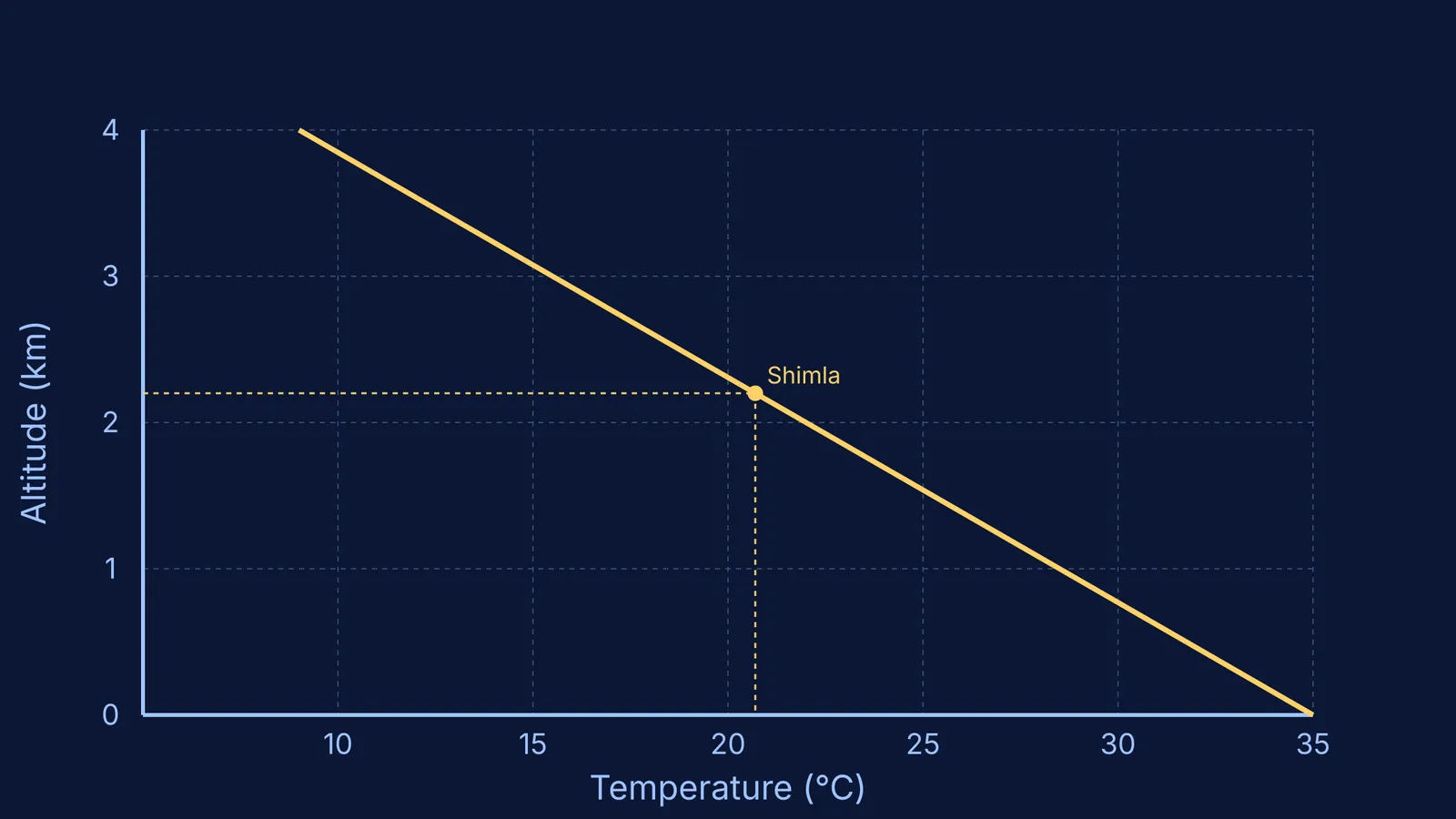
Imagine it is a sweltering 35 °C on the plains near sea level. You decide to travel to Shimla, which sits at an average altitude of approximately 2,206 metres (about 2.2 kilometres).
Find the altitude difference: 2.2 kilometres.
Multiply by the lapse rate: 2.2 km × 6.5 °C/km = 14.3 °C.
Subtract this from the sea-level temperature: 35 °C − 14.3 °C = 20.7 °C.
In this scenario, while people on the plains are dealing with 35 °C heat, you would be enjoying a comfortable 20.7 °C in Shimla.
The same mathematics applies to Ooty (Udhagamandalam), which sits at roughly 2,240 metres (2.24 kilometres) above sea level in the Nilgiri Hills. A similar calculation explains why its climate is drastically different from the nearby coastal plains. This predictable drop in temperature is exactly why these towns were established as summer retreats in the first place, offering a much-needed respite from the blistering heat below.
If you are preparing for competitive exams and need to solve thermodynamics problems like converting PV, PT and VT graphs, remembering the principles behind adiabatic expansion will help you understand the real-world applications of the formulas on your page.


