

On this page
When driving down an unlit highway at night, you need headlights that cast illumination hundreds of metres ahead rather than scattering light into the sky. An unshielded bulb or LED emitter radiates light in all directions, losing intensity rapidly following the inverse-square law. Surrounding the light source with an inward-curving concave reflector captures this wasted light and directs it forward. In CBSE Class 10 Science, this design illustrates how spherical mirrors manipulate light rays in everyday engineering.
Why do car headlights use concave mirrors instead of plane or convex ones?
A headlight requires a tight, forward-projecting beam. A plane mirror reflects rays at their angle of incidence, producing a virtual image behind the surface while allowing light to keep diverging widely. A convex mirror curves outward, spreading rays over an even wider angle—useful for vehicle side mirrors in our Class 10 light, reflection, and refraction guide, but useless for forward illumination.
A concave mirror curves inward, gathering light emitted backwards and sideways and redirecting it toward the optical axis. This converging action concentrates luminous flux that would otherwise scatter, forming a strong directional beam.
What happens when a light source sits at the principal focus?
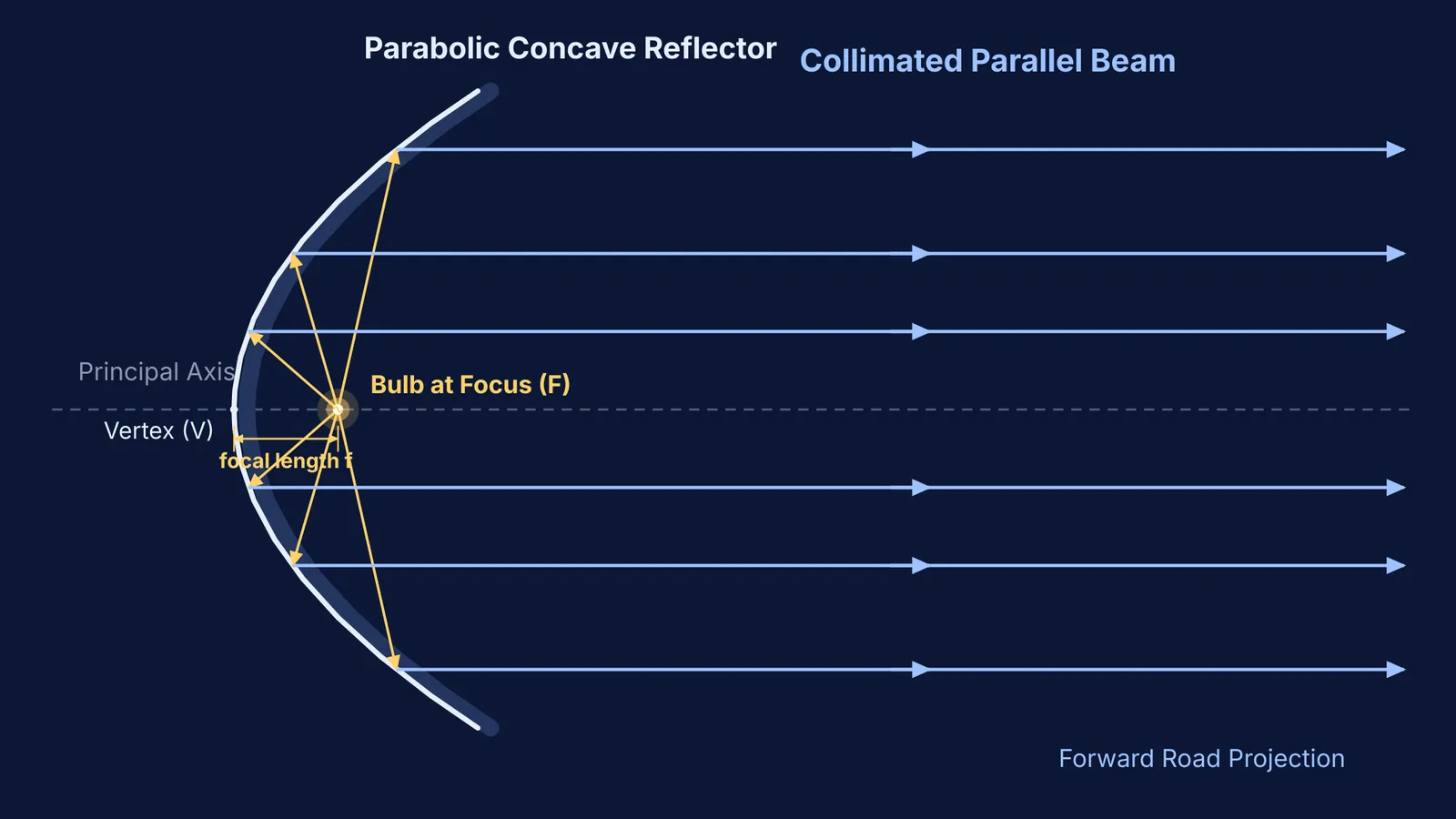
The optical design relies on the geometry of the principal focus (F). In ray optics, incident rays traveling parallel to the principal axis converge at the focus after reflecting from a concave surface. Because light paths are reversible, rays that originate at the principal focus must reflect outward parallel to the principal axis.
In our guide to concave mirror six object positions, an object placed at the focus produces an image at infinity. While that prevents forming a sharp image on a screen, it is ideal for headlamps: the reflector collimates diverging light into a parallel cylinder that travels far into the night without spreading.
Why do modern headlights use parabolic reflectors rather than spherical mirrors?
Class 10 textbooks introduce concave mirrors with spherical curvature because spheres are simple to manufacture. As explained in OpenStax University Physics, spherical concave mirrors only produce parallel rays under the paraxial approximation, where rays strike near the mirror's pole.
A headlight reflector must cup around the bulb to catch rays emitted at steep angles. When rays hit near the outer rim, a spherical mirror exhibits spherical aberration: marginal rays reflect to a point closer to the mirror than paraxial rays, causing the beam to blur into stray glare.
Automotive headlamps solve this with parabolic reflectors governed by y² = 4ax. In a parabola, every ray originating from the focus at (a, 0) reflects strictly parallel to the axis of symmetry, eliminating on-axis spherical aberration. Research by Sun et al. (2015) in Applied Optics demonstrates how modern vehicle headlamps combine parabolic and elliptical reflectors with lenses to collimate LED light efficiently while meeting regulatory beam cutoffs.
How do different reflector geometries compare?
Reflector geometry determines whether light reaches down the road or blinds oncoming drivers:
Plane mirror: Reflected rays continue diverging; intensity falls off with distance; ineffective for long-range driving.
Convex mirror: Diverges rays outward from a virtual focus; maximizes field of view for rear-view mirrors, but fails to project light forward.
Spherical concave mirror: Parallelizes central paraxial rays, but marginal rays suffer spherical aberration, creating scattered glare.
Parabolic concave mirror: Collimates rays across the entire surface into a parallel beam with zero on-axis spherical aberration.
Under automotive safety standards such as those documented by the Automotive Research Association of India, headlamps must balance intense throw with controlled glare. To see how shifting a source along the axis changes ray paths, explore the Fermi Simulation Lab, which provides interactive simulations for the ideas that are easier to see than to read.
How do you solve Class 10 exam questions on headlight mirrors?
Under the CBSE Class 10 Science curriculum, board exam questions on headlights test whether you can connect focal length calculations to ray diagrams. Here is a standard worked example:
Problem: A vehicle headlight uses a concave reflector with a radius of curvature of 24 cm. Where should the bulb filament be placed to produce a parallel beam?
Step 1: Identify the given radius of curvature: R = 24 cm.
Step 2: Use the focal length relation for small apertures: f = R / 2 = 24 cm / 2 = 12 cm.
Step 3: State the filament placement: Place the bulb at the principal focus, exactly 12 cm in front of the reflector pole.
Step 4: State the optical principle: Rays starting from the principal focus reflect parallel to the principal axis, creating a collimated beam.
Step 5: Mention practical engineering: Real headlights use parabolic curvature to prevent spherical aberration.
For lab revision, review our concave mirror focal length practical guide. To master optics across the syllabus, the Fermi Concept Library covers every concept in physics, chemistry, biology, mathematics, and computing, each with its own lesson and its place in the map.


