

On this page
Hair frizz is fundamentally a chemistry problem. Understanding what happens at the molecular level can help you keep your hair smooth, even on the wettest days. When you step outside into a humid morning, you are walking into an invisible cloud of water vapor, and your hair is perfectly evolved to soak it up.
Why does hair get frizzy in humid weather?
Keratin is a tough, fibrous protein that makes up most of the volume of the hair shaft. The keratin molecules are bundled together in the inner part of the hair, called the cortex. These bundles give the hair its structural strength and elasticity, and they are held in place by two main types of chemical bonds.
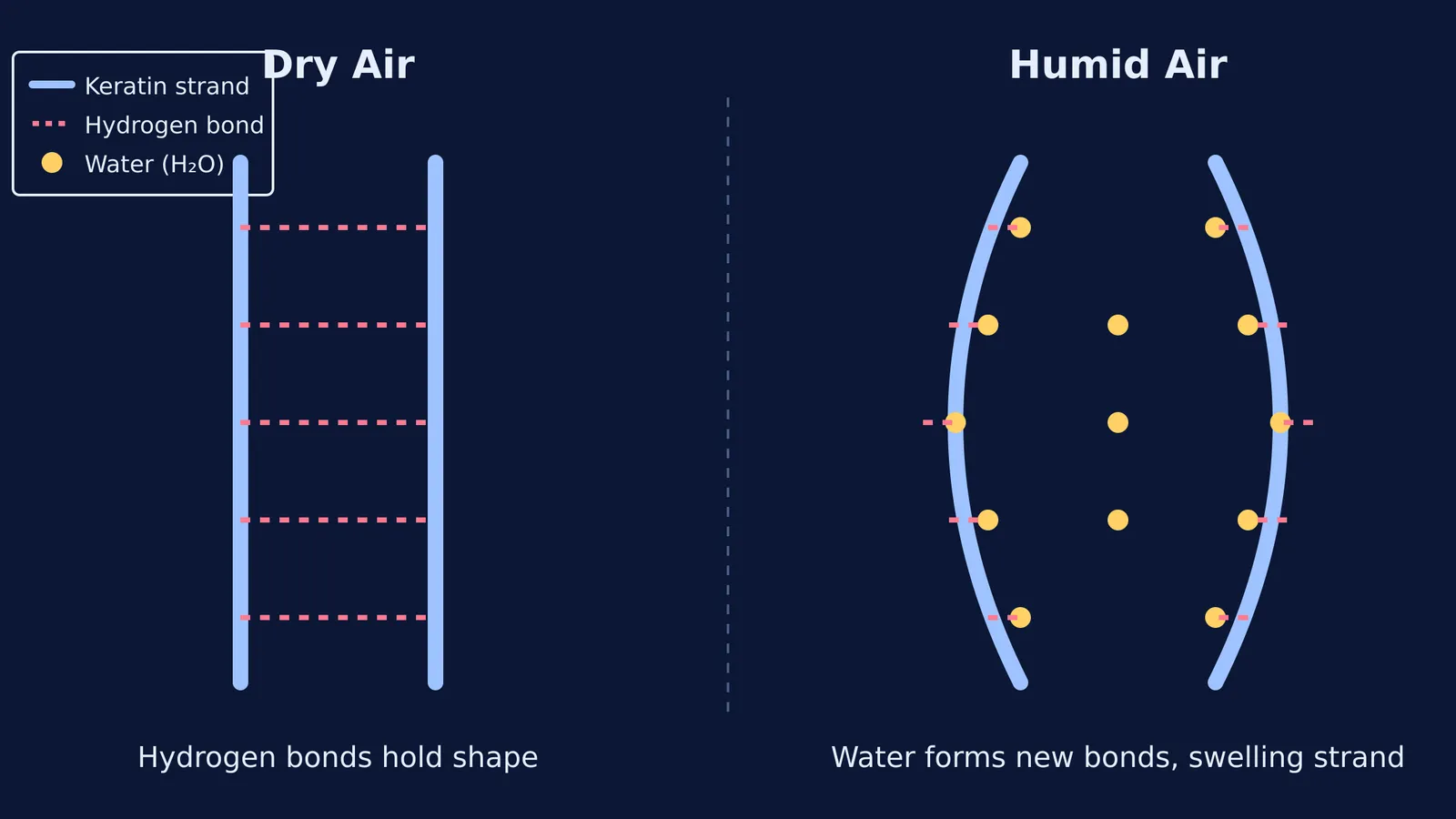
Disulfide bonds are strong, permanent covalent bonds that decide if your hair is naturally straight, wavy, or curly. These bonds can only be altered by chemical treatments, such as perms or relaxers. But there is a second type of bond at play: the hydrogen bond. Hydrogen bonds are much weaker and form between the long protein chains. When you wash and style your hair with heat, you are essentially breaking these temporary hydrogen bonds and resetting them. As the hair dries and cools, the hydrogen bonds lock the keratin proteins into your desired smooth shape.
When the air is saturated with moisture, it contains a very high concentration of water molecules. Hair is naturally porous and hygroscopic, meaning it readily absorbs water from the surrounding environment. The water molecules from the humid air sneak between the keratin chains and disrupt the existing hydrogen bonds you carefully created during styling.
How do water molecules change the hair's shape?
Once inside the cortex, the water molecules do not just sit there; they actively interact with the hair's structure. They form new hydrogen bonds with the keratin proteins. The partial positive charge of the hydrogen atoms in the water molecules is drawn to the electronegative atoms along the keratin chains. This forces the keratin proteins to fold back on themselves, or "kink up" at the molecular level. (Keratin itself is a protein built of amino acids linked by peptide bonds, which are packed with sites where water can easily attach).
As millions of these new hydrogen bonds form, the hair's cortex swells unevenly. This internal swelling forces the outer protective layer of the hair, called the cuticle, to lift and roughen. The cuticle cells resemble overlapping roof shingles, and when pushed outward by the swollen cortex, they catch on neighboring strands. As a result, the hair strands bend, twist, and puff outward away from the rest of the hair, creating what we see as frizz.
This physical change is actually measurable and highly predictable. The first hair tension hygrometer was invented in 1783 by the Swiss physicist Horace Bénédict de Saussure. He realized that a single human hair changes its length as humidity varies from completely dry to fully saturated. By suspending a human hair under tension and connecting it to a dial, he used this natural property to measure the moisture in the atmosphere.
Visualising how water molecules wedge themselves between keratin chains is difficult from a static diagram. The Fermi Simulation Lab offers interactive simulations for the ideas that are easier to see than to read.
Why does damaged hair frizz more in humidity?
The severity of the frizz you experience depends heavily on the condition of your hair's cuticle. A healthy, flat cuticle acts as a defensive barrier against the elements. But if the hair is dry, heat-damaged from flat irons, or chemically treated from bleach and dyes, the cuticle scales are permanently lifted or even broken off. This structural damage makes the hair significantly more porous, allowing water vapor from the humid air to rush into the inner cortex much faster and in greater volumes.
How to minimize frizz?
Because frizz is directly caused by water forming unwanted hydrogen bonds inside the hair shaft, you can stop it by controlling how much moisture gets into the cortex in the first place.
Seal the cuticle: Use a leave-in conditioner or a lightweight hair oil to fill the porous gaps in the cuticle. This leaves less room for water from the air to enter the strand.
Use acidic products: Acidic shampoos (pH 4–6) are preferred because they do not swell the hair shaft, helping to keep the cuticle closed and the internal structure protected against moisture.
Dry completely: Never leave the house with damp hair. If you dry your hair fully before going outside, the hydrogen bonds are completely "set" in the shape you want, making it harder for environmental moisture to penetrate.
Use anti-humectants: Hair products containing silicones or heavy oils create a temporary hydrophobic (water-repelling) barrier over the hair strand, physically blocking atmospheric water vapor from reaching the keratin inside.


