

On this page
Have you ever wondered why a heavy gold bangle or a family heirloom is almost never completely pure?
In its purest form, gold is one of the most malleable metals known to science. It is so workable that a single gram can be beaten into a translucent sheet covering a square metre without tearing. While this extreme flexibility is excellent for creating delicate gold leaf to cover monuments or space satellites, it is terrible for a ring that you intend to wear every day. If you are reviewing how to extract metals for Class 10, you know that smelting gives us pure elements, but we almost always have to rely on alloying to give us useful, durable materials.
Why is 24-carat gold too soft for jewellery?
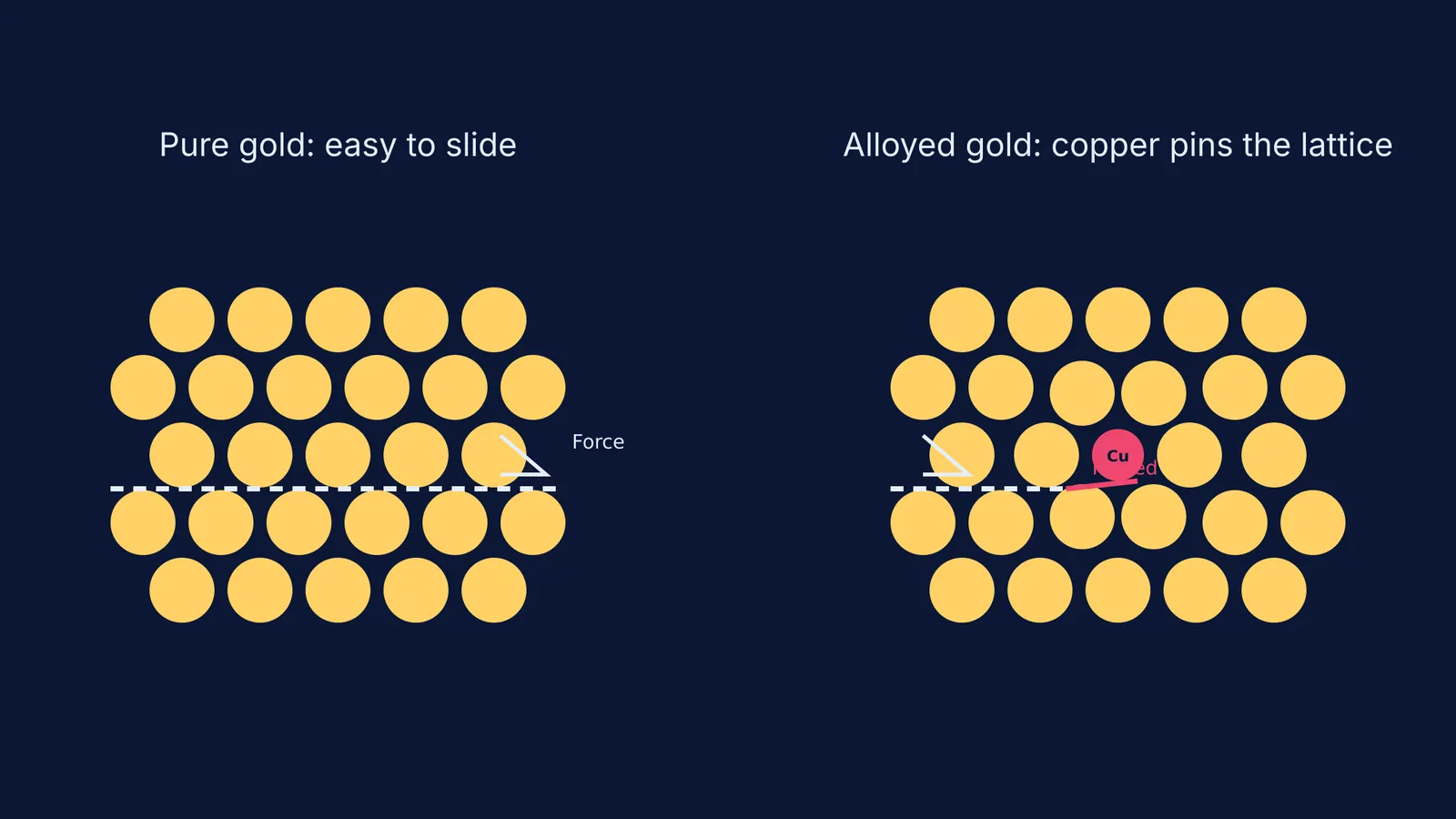
To understand why pure gold bends so easily, we have to zoom in on its atomic structure. In a solid block of pure gold, the atoms sit in a neat, highly regular geometric arrangement called a face-centred cubic (FCC) lattice. You can picture this as endless, perfectly stacked rows of identical yellow spheres.
When you press, strike or bend the metal, entire planes of these atoms can easily slip and slide past one another. In materials science, the microscopic boundary where this slipping happens is called a dislocation.
Because there is absolutely nothing in a pure gold crystal to stop these planes from sliding endlessly, the macroscopic metal yields to the slightest pressure. In fact, pure gold has a Mohs hardness of just 2.5, which is comparable to the hardness of a human fingernail. This means that a pure gold ring would scratch against a wooden desk and lose its circular shape just from the force of gripping a heavy door handle.
What does 22 carat actually mean?
To solve this problem, metallurgists rely on a system of fractions to mix gold with harder base metals. The word "carat" measures the purity of gold in fractions of 24.
24-carat gold is 24 out of 24 parts gold, which translates to 99.9% or higher in commercial purity standards.
22-carat gold means the alloy contains 22 parts gold and 2 parts other metals, making it 91.6% pure (which is why it is often stamped with a 916 hallmark).
By melting the pure gold and mixing in that remaining 8.4% of copper, silver or zinc (often studied to understand why it is not a transition element), jewellers create an alloy that is significantly harder and much more practical for daily wear. But why does adding such a relatively small amount of another metal change the physical properties of the gold so drastically?
How does copper make gold harder?
The answer lies in a metallurgical process called solid solution strengthening.
When copper is added to molten gold and the mixture is allowed to cool, it forms a substitutional solid solution. This simply means that the copper atoms take the place of some gold atoms in the repeating lattice. However, the rule of solid solutions states that the new solute atoms can differ in size from the original solvent atoms by up to 15%.
Because a copper atom is smaller than a gold atom, it does not fit perfectly into the space left behind. It pulls the neighbouring gold atoms slightly towards it, permanently distorting the neat rows of the crystal. This localized physical distortion creates what is known as a "strain field."
When a force is applied to the jewellery (like bumping your wrist against a table), the planes of atoms try to slide just as they do in pure gold. But when the slipping plane hits the strain field around a copper atom, it suddenly gets stuck. The copper atom and its distorted surroundings act like an atomic speed bump, permanently pinning the dislocation in place. Because the atomic planes can no longer slide easily across the lattice, the macroscopic metal feels much harder, stiffer and stronger to us.
Understanding how microscopic defects change macroscopic properties is a core part of the chemistry and physics syllabus, just like grasping energy bands in conductors and insulators. If you find it hard to picture how atoms move and slip in a crystal lattice, you can use the Fermi Simulation Lab, which provides interactive simulations for the ideas that are easier to see than to read. Seeing the strain field around a foreign atom can make the concept click instantly.
Which carat should you choose?
When buying gold, the choice of alloy depends entirely on what you want the metal to do. Understanding the underlying chemistry can save you from making a costly mistake:
24-carat: Best reserved for investment coins and bullion bars, where maintaining a strict geometric shape does not matter and maximum purity is the only goal.
22-carat: The historical and modern Indian standard for traditional jewellery, wedding bands and heavy chains. It offers the best compromise: retaining the rich, warm colour of pure gold while providing enough atomic pinning to survive being worn daily. However, it is still too soft to safely hold large, expensive gemstones.
18-carat: Essential for delicate engagement rings with diamond or gemstone settings. The much higher ratio of copper or silver locks the lattice even tighter, ensuring the fine metal prongs holding the stone will not easily bend and release the gem.
Next time you see a 916 hallmark stamped on the inside of a bangle, you will know exactly why it is there. It represents the perfect metallurgical balance between keeping the metal's natural lustre and adding just enough atomic speed bumps to make it last a lifetime.


