

On this page
It seems like an obvious question, but the answer requires diving into the quantum nature of materials. A windowpane lets sunlight pass freely, while a wooden door completely blocks it. The difference between the two lies in how their electrons and physical structures interact with incoming photons.
Why is glass transparent but wood is not?
The transparency of any solid material is governed by two rules: whether its electrons can absorb the energy of incoming light, and whether its internal physical structure scatters that light. Glass passes both of these tests, while wood fails both.
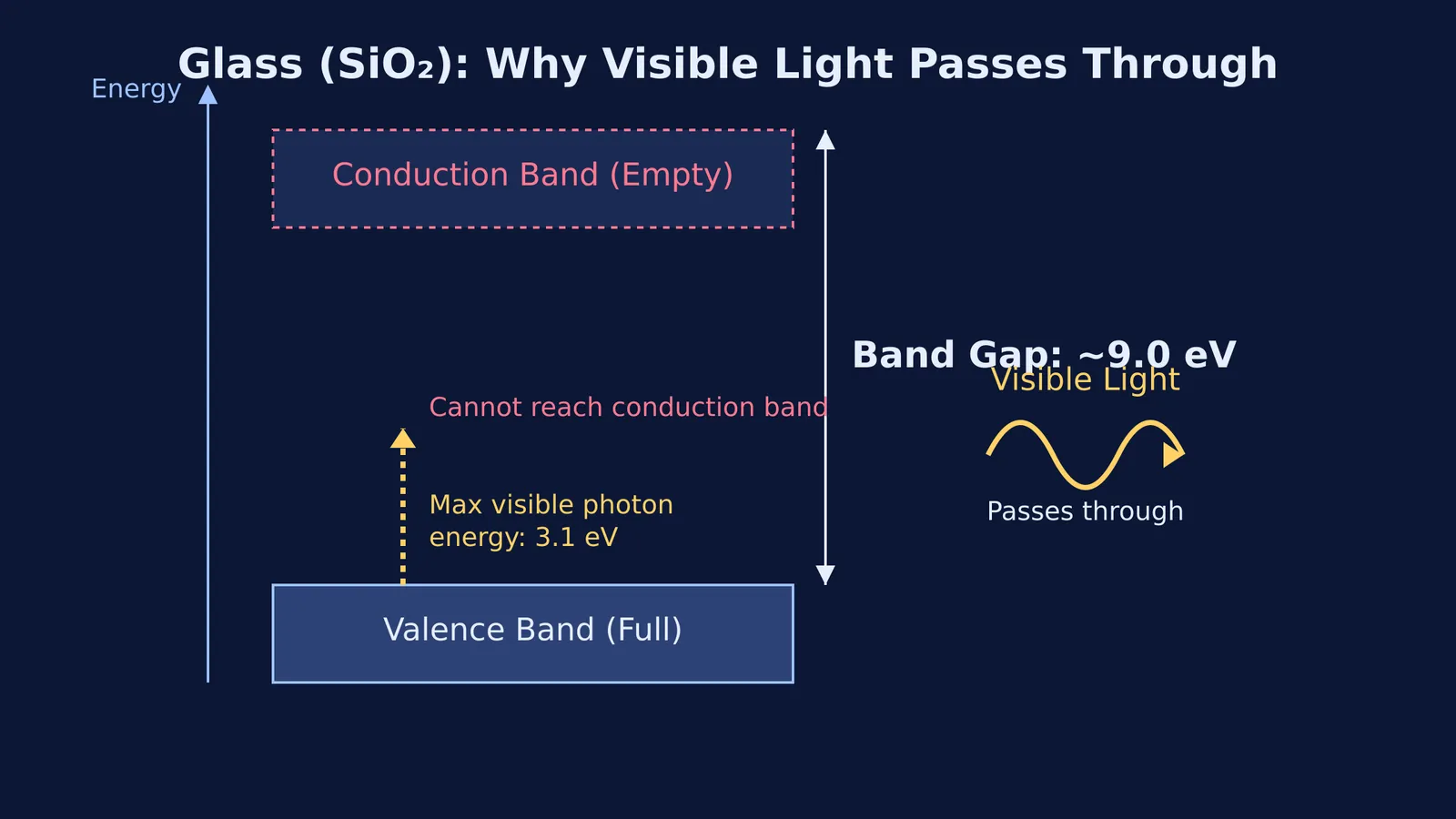
At the atomic level, electrons exist in specific energy levels. To jump from a resting state (the valence band) to a higher state (the conduction band), an electron must absorb a photon with exactly the right amount of energy. The distance between these two states is known as the band gap.
Why does light pass through glass?
Glass is primarily made of silicon dioxide (SiO₂). The band gap of silicon dioxide is approximately 9 eV Source.
Visible light photons carry energy ranging from 1.8 eV for red light to 3.1 eV for violet light Source. Because the maximum energy of a visible photon is significantly smaller than the energy required to bridge the band gap in glass, the electrons simply cannot absorb the light. The photons do not have enough energy to excite the electrons, so they pass straight through the atomic structure.
You might have noticed that while glass lets visible light through perfectly, you cannot usually get a sunburn sitting behind a closed window. Ultraviolet (UV) light carries more energy than visible light. High-energy UV photons possess enough energy to be absorbed by the electrons in the glass or by trace impurities within the silica. As a result, the glass acts as a barrier to these higher-energy waves, absorbing them and turning that energy into minute amounts of heat.
However, not absorbing light is only half the equation. Many crystalline solids do not absorb visible light, but they are still opaque or cloudy because they scatter it. Glass is an amorphous solid, meaning its atoms are frozen in a disordered, liquid-like state rather than a rigid crystal lattice. This lack of internal crystal grain boundaries means light travels in a straight path without bouncing off internal surfaces, resulting in clear transparency.
If you are reviewing solid-state physics and the role of the valence and conduction bands, our guide on energy bands: conductors, semiconductors and insulators compared explores how this gap size dictates material properties.
For students trying to picture how photons interact with crystal structures, the Fermi Simulation Lab has interactive simulations for the ideas that are easier to see than to read.
Why is wood opaque to light?
Wood blocks light for two entirely different reasons: absorption by its chemical components and scattering by its physical structure.
First, wood contains lignin, a complex polymer that binds its cells together. Lignin contains specific molecular structures called chromophores that are highly efficient at absorbing visible light Source. This absorption is what gives wood its characteristic brown or yellowish colour and stops light from passing through.
Even if you were to chemically remove the lignin—a process that turns the wood white—it would still not be transparent. Wood is highly porous, filled with microscopic channels. The cellulose that makes up the wood structure has a refractive index of approximately 1.53, while the air filling the pores has a refractive index of 1.0 Source.
When light hits the millions of boundaries between the cellulose and the air, the mismatch in the refractive index causes the light to bend, bounce, and scatter in random directions. The light is completely scattered before it can exit the other side. To understand how changes in optical density affect light paths, you can review light entering glass: what happens to speed, wavelength, frequency.
Interestingly, scientists have recently found ways to make wood transparent by reversing these two exact properties. By using chemical treatments to strip away the light-absorbing lignin, they remove the first optical barrier. Then, to solve the scattering problem, they fill the empty air pores with a transparent epoxy or polymer that shares the exact same refractive index as the cellulose (1.53). With the refractive indices perfectly matched, the light no longer "sees" the internal boundaries. It travels in a straight line, resulting in a block of wood that is as clear as glass, proving that transparency is simply a matter of managing absorption and scattering.
The transparency checklist
You can apply these exact physical principles to understand the optical properties of any material. Use this simple framework to evaluate why something is transparent or opaque:
The Energy Gap Test: Does the material have a band gap greater than 3.1 eV? If so, its electrons will not absorb visible light.
The Chromophore Test: Is the material free of complex, light-absorbing molecules? Glass passes this, while wood fails because of lignin.
The Scattering Test: Does it lack internal boundaries and refractive index mismatches? Glass passes because it is amorphous, while wood fails because it is a porous mix of cellulose and air.
By breaking down the problem into energy absorption and physical scattering, you can predict exactly how a photon will behave when it meets a solid surface.


