

On this page
If you have ever checked a calendar to plan your school holidays, you might have noticed a strange pattern: Christmas always falls on December 25, but the dates for Diwali and Holi bounce around every year. This shifting happens because the dates for most Indian festivals are determined by a complex astronomical timekeeping system rather than a fixed set of days.
Why do Diwali and Holi fall on different dates each year?
The answer lies in the sky. The Gregorian calendar—which dictates the standard January-to-December school year—is a solar calendar, measuring the 365 days it takes for the Earth to orbit the Sun once.
Indian festivals, however, follow a lunisolar calendar. This calendar schedules its months based on the phases of the Moon, while simultaneously tracking the Earth's position relative to the Sun to keep track of the seasons.
A single lunar month lasts about 29.5 days—the time it takes for the Moon to cycle from one New Moon to the next. A standard year of 12 lunar months adds up to approximately 354 days. Because 354 days is roughly 11 days shorter than the 365-day solar year, the lunar calendar slips backward by about 11 days every year compared to the Gregorian calendar.
This 11-day slip is why festival dates move earlier on the Gregorian calendar in consecutive years. But they don't slide backward forever.
How does the calendar stay aligned with the seasons?
If the lunar calendar kept losing 11 days a year, Diwali would eventually drift into the middle of summer. To prevent this, the lunisolar system uses a leap-month correction.
Approximately every 32.5 months (roughly every two and a half to three years), an entire extra month—called *Adhik Maas* or an intercalary month—is added to the calendar.
Adding this leap month acts like a reset button. It pauses the backward drift and pushes the upcoming festivals forward on the Gregorian calendar, ensuring that Holi always happens in the spring and Diwali in the autumn.
What are the moon phases behind the festivals?
Festivals are pinned to specific lunar days, known as *tithis*. A lunar month is split into two 15-day halves: the waxing phase (growing brighter) and the waning phase (growing darker).
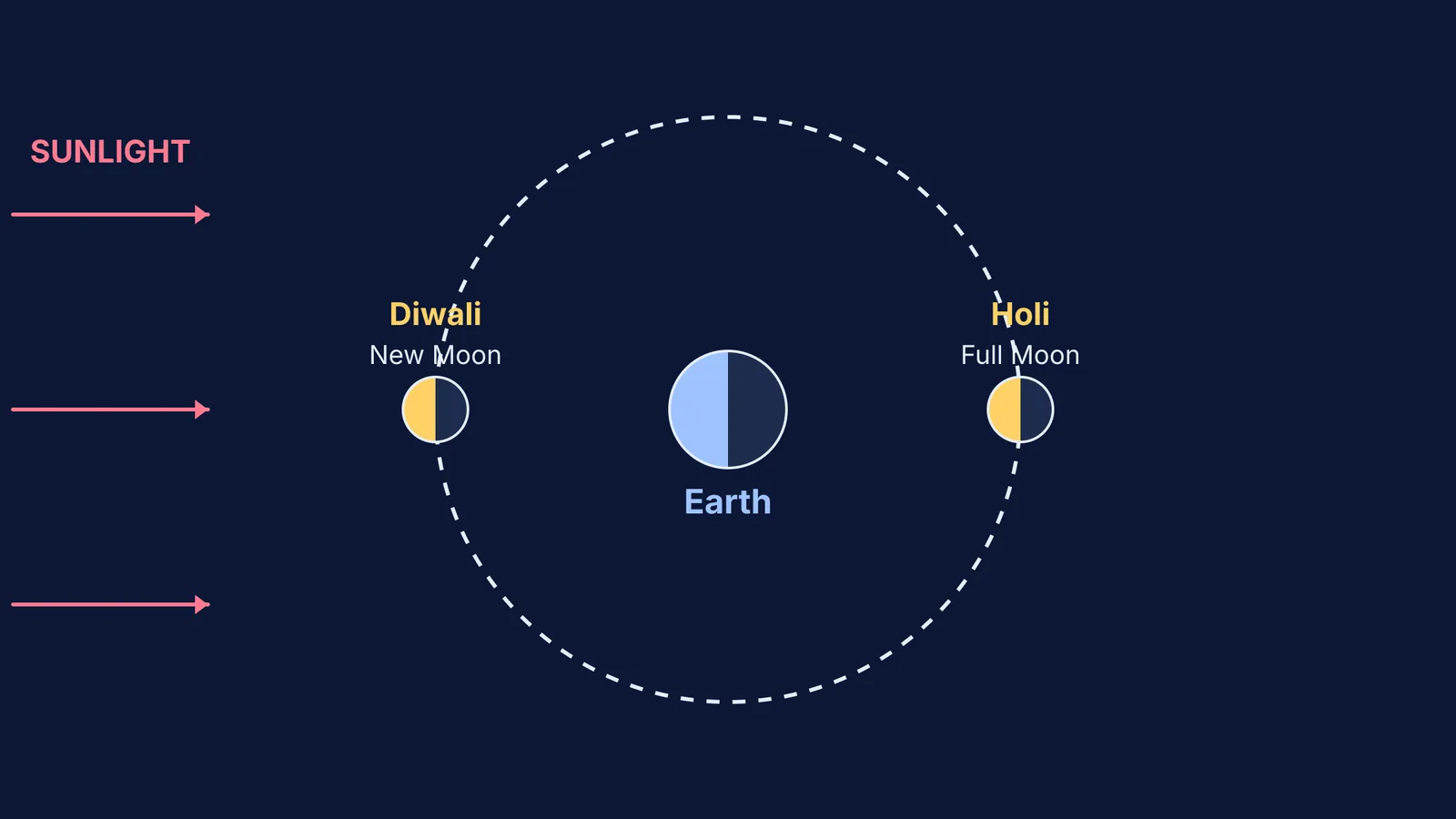
Holi is always celebrated on *Purnima*, the Full Moon night in the month of Phalguna. Because the Earth is positioned directly between the Moon and the Sun, the side of the Moon we see is fully illuminated.
Diwali is celebrated on *Amavasya*, the New Moon night in the month of Kartika. During a New Moon, the Moon sits directly between the Earth and the Sun, leaving the side facing us entirely in shadow.
This makes it the darkest night of the month, explaining the tradition of lighting *diyas* (lamps) to drive away the darkness. If you are studying the properties of light, you might also enjoy reading about the dispersion of white light by a glass prism.
If you are studying astronomy or physics for your exams, you can use these real-world examples to visualize orbital mechanics. For a deeper dive into planetary motion, reviewing Kepler's second law from angular momentum can help you solve exam problems. To explore the Earth-Moon-Sun system interactively, try out the Fermi Simulation Lab.
How can you remember orbital mechanics?
When you are preparing for exams, memorizing the differences between lunar and solar cycles can feel abstract. Try this simple checklist to use active recall for the concepts:
Identify the cycle: Ask yourself what the central body is. A solar year tracks Earth around the Sun (365 days). A lunar month tracks the Moon around Earth (29.5 days).
Calculate the mismatch: Multiply 29.5 days by 12 months. Compare that 354-day total to the 365-day solar year.
Explain the correction: Practice explaining *Adhik Maas* out loud as a biological or physical feedback loop—a mechanism added every 32.5 months to restore balance to a drifting system.
By connecting the dates of your favourite holidays to the physical motion of the planets, astronomy becomes a system you can observe right from your own calendar.


