

On this page
We have all seen exhaust fans placed near the ceiling, never near the floor. While it might seem like a mere convention, placing a kitchen fan high on the wall is an engineering decision driven strictly by the physics of gases and heat transfer. It all comes down to convection, density, and working with natural forces instead of fighting them.
Why does hot air rise?
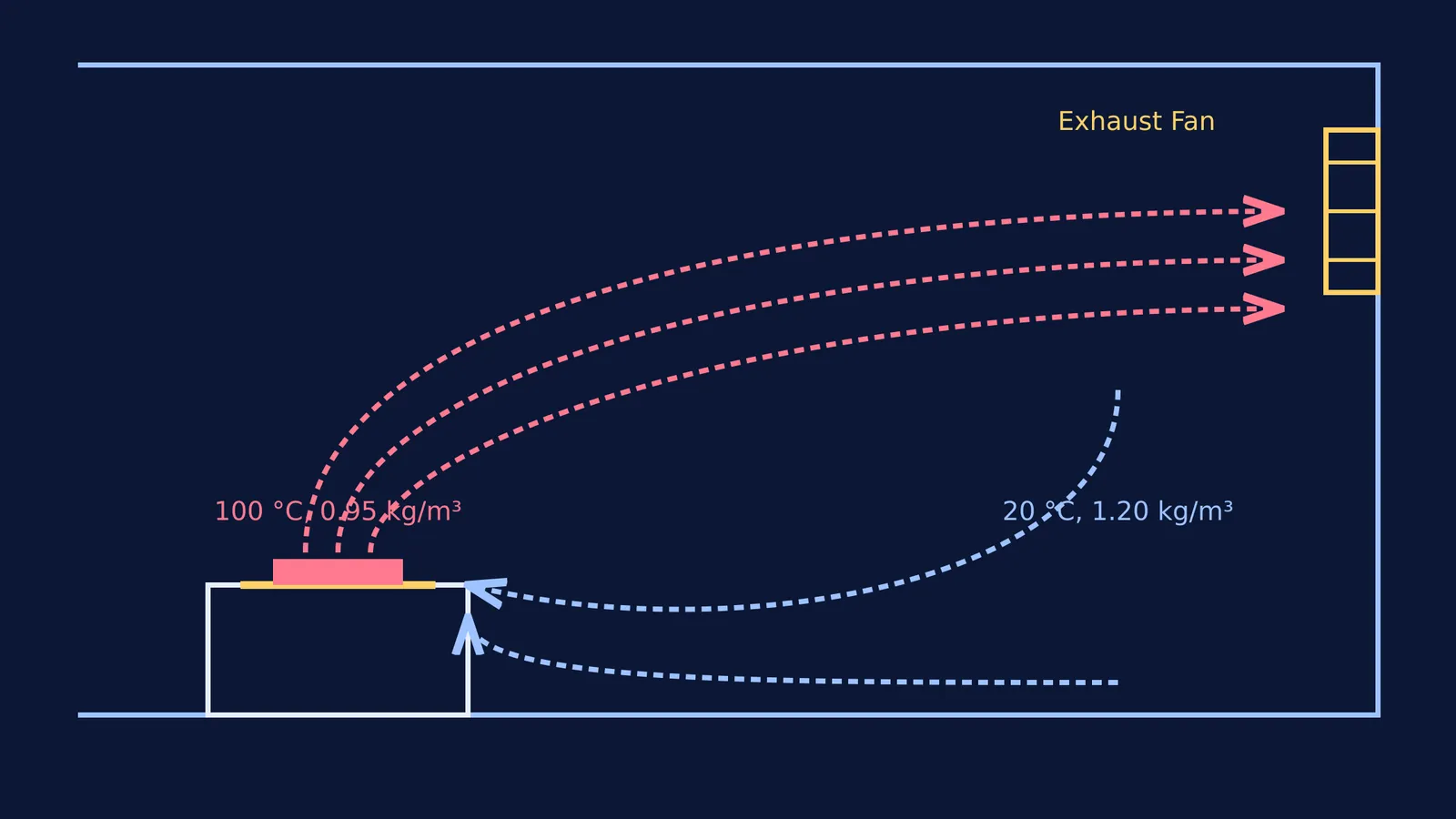
When you turn on a stove, you are not just cooking food; you are heating the air molecules directly above the burners. According to the ideal gas law, as a gas heats up at a constant pressure, its molecules gain kinetic energy. They move faster and push further apart, causing the gas to expand and its density to drop.
At a comfortable room temperature of 20 °C, the density of dry air is approximately 1.204 kg/m³ (Wikipedia). But as the air directly above a hot stove reaches 100 °C, its density falls to about 0.946 kg/m³.
Because this hot air is significantly lighter, it becomes buoyant. The cooler, denser air in the rest of the kitchen naturally sinks and pushes underneath the warm pocket, forcing the hot air upwards. This fluid motion, driven entirely by temperature and density differences, is called convection.
If you want to understand how gases behave mathematically when heated or expanded under different conditions, reviewing the free expansion of an ideal gas is a great next step.
What is the thermal plume above a stove?
As the heated air rises from the burners, it carries cooking by-products with it. Steam from boiling water, vaporised grease from frying pans, and smoke all get swept up in this ascending column of hot air, which engineers refer to as a thermal plume.
Research into kitchen ventilation shows that this plume rises quickly and behaves predictably based on the burner's heat capacity (Y. Shimanuki et al., 2019).
As the plume travels upwards, it expands like an inverted cone. If left unchecked, it eventually hits the ceiling, spreads outwards across the room, and transfers its heat to the walls. Once it cools, the air becomes dense again and sinks, creating a continuous convection loop that coats your entire kitchen in microscopic grease particles and cooking odours.
Why are kitchen exhaust fans fixed high on the wall?
An exhaust fan's job is to intercept and remove the thermal plume before it can cool down, increase in density, and sink back into your living space. By placing the fan high on the wall or directly on the ceiling, it sits exactly where the thermal plume naturally travels.
If an exhaust fan were placed low on the wall—near the floor or countertop—it would have to actively fight against buoyancy. The fan would need a massively powerful motor to overpower the rapidly rising plume and pull the hot air back down against gravity. By fixing the fan high, it simply assists the natural convection current, catching the pollutants at their highest concentration point with minimal electrical effort.
To see how heat, density, and fluid dynamics create these invisible currents, you can explore the Fermi Simulation Lab, which offers interactive simulations for the ideas that are easier to see than to read.
What about downdraft extractors?
Modern island kitchens sometimes use downdraft extractors—vents that pop up directly beside the stove and pull air downwards. Because these systems are placed low, they deliberately fight the physics of convection.
To overcome the natural upward velocity of the thermal plume, downdraft extractors require significantly stronger motors and higher suction speeds than traditional high-wall fans. They must pull the air forcefully enough to reverse its natural trajectory before it escapes into the room.
Keep the path clear: cross-drafts from open windows can blow the plume horizontally away from the fan before it reaches the ceiling.
Clean the filters: a blocked fan has to work harder against the natural air resistance of the room, reducing its ability to capture the plume.
Match the height: do not place the fan too high if you have very tall ceilings, or the plume may cool down and spread before it gets caught.
If you are exploring more advanced fluid mechanics, you can also look into how pressure differences in static fluids are measured using two immiscible liquids in a manometer.


