

On this page
You pull the throttle of your electric scooter on a freezing January morning, but it feels sluggish. By the time you reach school, the battery percentage has plummeted. Whether it is a shivering winter or a scorching 40°C summer, extreme weather is the enemy of lithium-ion batteries.
Why does an electric scooter give less range in cold or heat?
It all comes down to the rate of reaction and internal resistance. Inside a lithium-ion cell, lithium ions travel through a liquid electrolyte between the anode and cathode to store and release energy.
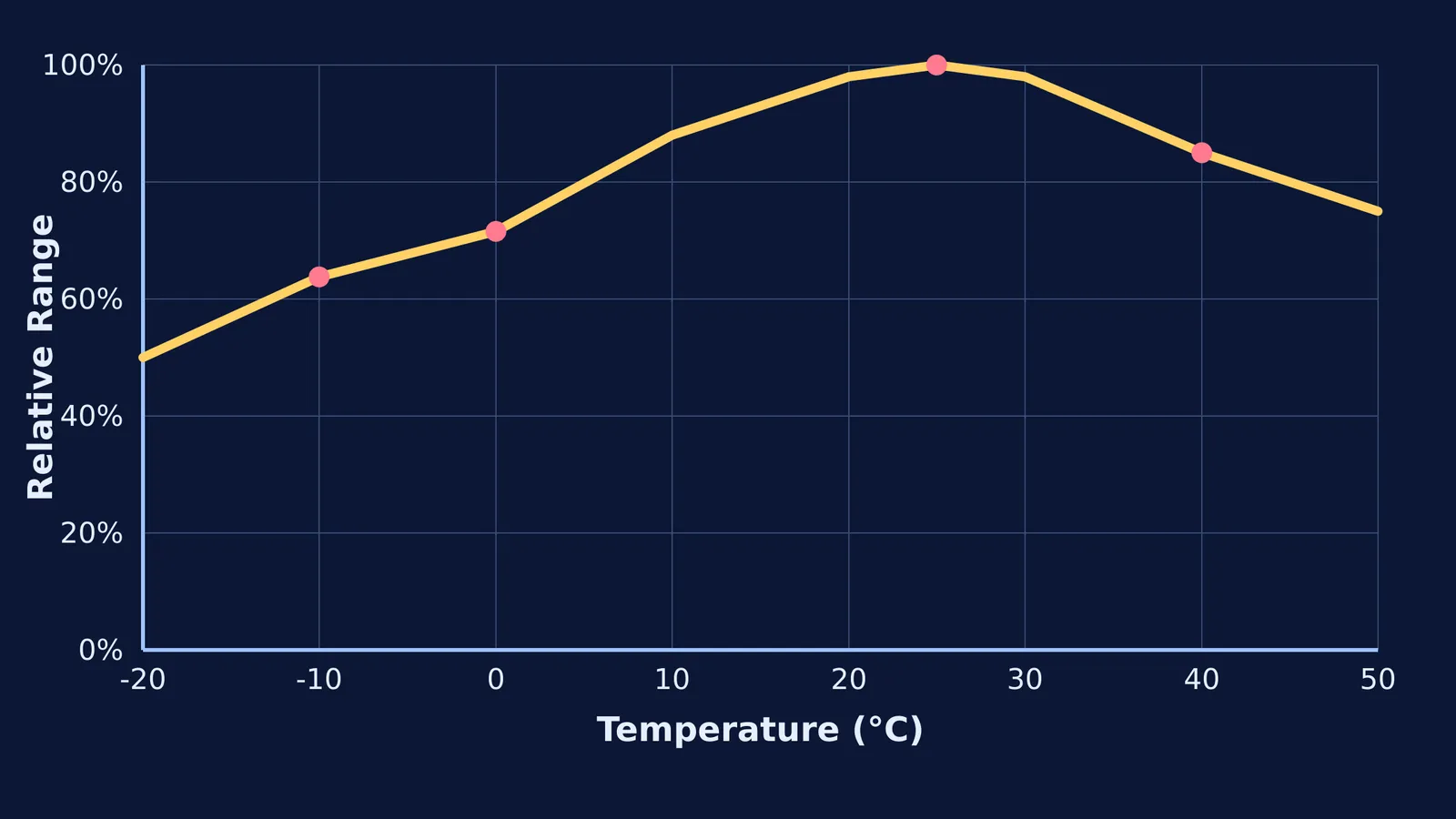
In the cold, this electrolyte becomes more viscous, or thicker. This physical change slows down the chemical reactions required to release energy, reducing the diffusion rate of the ions. Telemetry data shows that a typical e-scooter's range drops by 36.2% at -10°C. Even in larger electric cars, cold weather (20°F or -6°C) cuts the battery's inherent range by about 12% before the heater is even turned on.
At the same time, the battery's internal resistance spikes. When you accelerate, the motor demands a high current (*I*). Because cold weather increases the internal resistance (*R*), the battery experiences a significant voltage drop (*V = IR*). If the voltage drops below a certain threshold, the scooter's controller might misread the battery as nearly empty and shut down, even if there is plenty of chemical energy left. This is why your battery indicator might suddenly plunge when you go up a steep hill in the cold.
If you find these real-world applications of chemistry and physics fascinating, the Fermi Simulation Lab has interactive simulations for ideas that are easier to see than to read, letting you tweak variables like temperature and resistance to see how they affect a circuit.
What happens to lithium-ion batteries in hot weather?
Heat has a different, but equally frustrating, effect. When the temperature climbs above 38°C (100°F), the scooter's range and battery life suffer.
In moderate heat, chemical reactions actually speed up, lowering internal resistance. But in extreme heat, the protective Solid Electrolyte Interphase (SEI) layer on the anode grows too thick, permanently trapping lithium ions. This chemical degradation inside the battery accelerates significantly as temperatures rise.
To prevent a dangerous chain reaction called thermal runaway, the scooter's Battery Management System (BMS) steps in. It throttles the power output to cool the cells down, making the scooter feel artificially slow and reducing the usable range.
If you are studying energy and thermodynamics, see our post on Free expansion of an ideal gas: why work and ΔU are both zero. Or, to understand how resistance changes physically, check out Stretching a wire: how its resistance changes with length.
How can you protect your electric scooter battery?
Understanding the chemistry of your battery does not just help you in exams; it keeps you from being stranded halfway home. If you want your scooter to survive the extremes, follow this plan:
Warm it up inside: Store and charge your scooter indoors at room temperature before a cold ride.
Never charge a freezing battery: Charging a lithium-ion battery below 0°C can cause lithium plating, where metal deposits puncture the battery and cause permanent damage.
Avoid hot charging: After riding in extreme summer heat, let the battery cool down for at least 30 minutes before plugging it in.
Keep it under 100% in a heatwave: A battery degrades fastest when it is both hot and fully charged. If you leave it parked in the summer sun, aim for an 80% charge.


