

On this page
It happens every time you reach into your pocket: you pull out your earphones, and the wires have tied themselves into an impossible knot. In 2007, physicists Dorian M. Raymer and Douglas E. Smith tumbled strings in a box thousands of times and proved exactly why long strings behave this way. Their findings explain the mathematics of spontaneous knotting, and what you can do to stop it.
Why do earphone wires always get tangled in pockets?
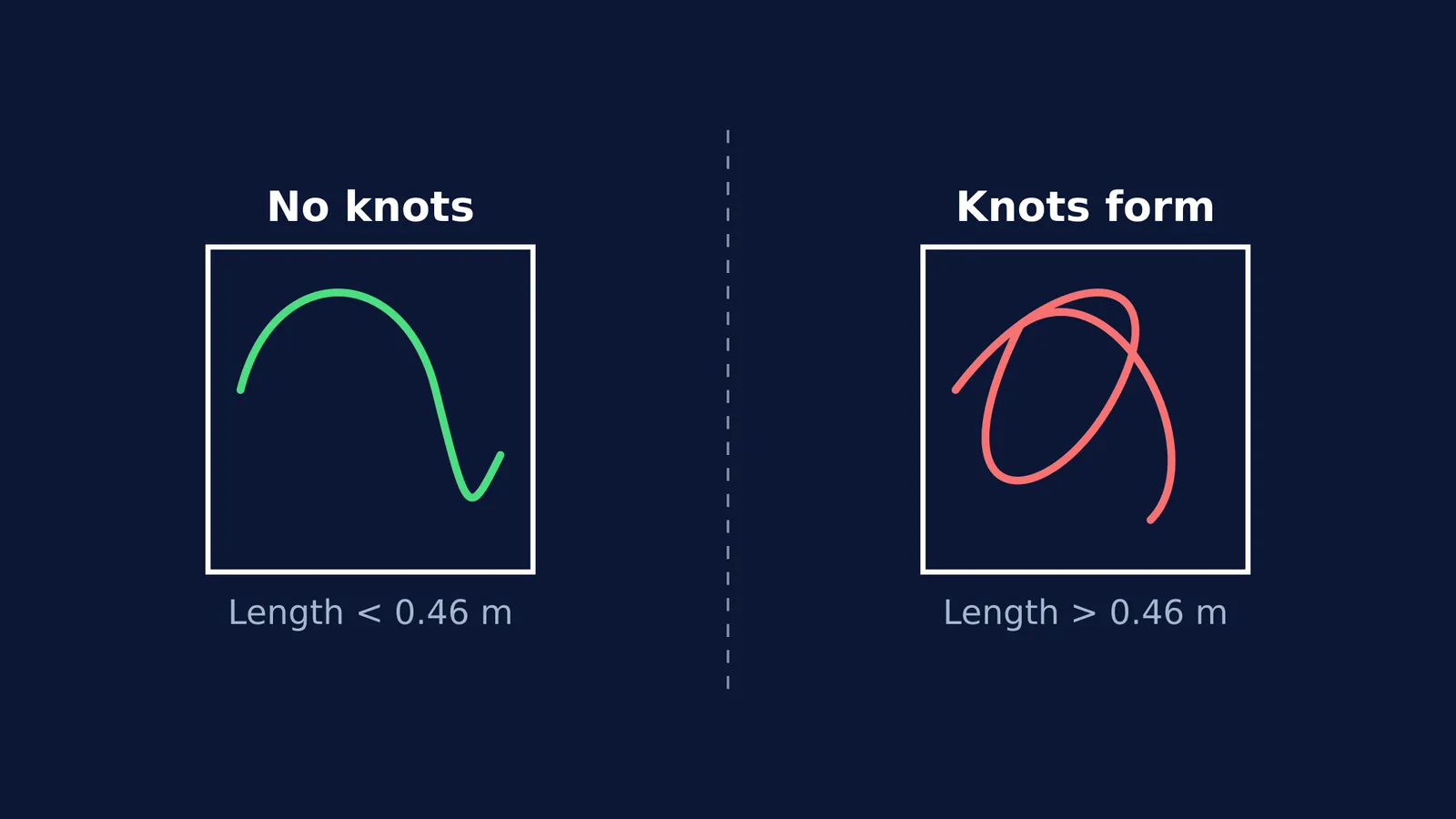
To understand spontaneous knotting, Raymer and Smith placed strings of various lengths into a cubic box and tumbled them at one revolution per second for ten seconds 1.
They repeated this experiment 3,415 times to build a robust statistical model of how cords behave in confined spaces 1. The results were unambiguous. Strings shorter than 0.46 metres never knotted 1. However, as the length of the string increased past this 0.46-metre threshold, the probability of a knot forming rose sharply before saturating just below 100% 1.
Standard wired earphones easily exceed this length. When you place earphones into your pocket and walk around, you are effectively recreating the tumbling box from the experiment.
What happens during random motion?
The researchers used mathematical knot theory to classify the tangles. Out of 3,415 trials, they observed 120 different types of prime knots, with some featuring up to 11 minimum crossings 1. Every possible prime knot with up to seven crossings was observed at least once 1.
The study proposed that a long, flexible string naturally forms a coiled structure when confined. As the box—or your pocket—tumbles, the free ends of the wire weave over and under these parallel coils in a series of random "braid moves" 1. Once the ends weave through the loops, pulling on the earphones simply tightens the braids into complex knots.
Studying permutations and random variables can often feel abstract. Solving probability problems compared to real-world scenarios or working out odds in favour and against builds intuition for how these models work.
How can you stop earphone wires from tangling?
The physics of spontaneous knotting also provides the solution. Since tangling depends on length, flexibility, and random motion, changing any of these variables will solve the problem.
Here is a practical checklist based on the study's findings:
Shorten the loose ends: The study found no knots below 0.46 metres 1. Use a small clip to secure the middle of the wire, effectively reducing the length of the free-moving sections below the threshold.
Increase the stiffness: A stiff wire resists forming the initial coils required for "braid moves". This is why many modern cables are braided or flat.
Eliminate the tumbling space: The "box" must be large enough to allow random motion. Wrapping your earphones tightly around a small card or storing them in a fitted case removes the space needed for the ends to weave through the loops.
For ideas that are easier to see than to read, the Fermi Simulation Lab offers interactive simulations that bring mathematical models to life.


