

On this page
When the ground begins to shake violently, your first instinct might be to sprint for the door. However, emergency management agencies worldwide—including the Centers for Disease Control and Prevention (CDC) in the United States and the National Disaster Management Authority (NDMA) in India—strongly advise against running. Instead, they teach a universal three-step protocol: Drop, Cover, and Hold On.
The science behind this drill is rooted in how modern buildings respond to seismic waves, and studying the data from past earthquakes reveals exactly where the biggest dangers lie.
What causes the most injuries during an earthquake?
When an earthquake strikes, the energy travels in distinct waves. The fast-moving Primary (P) waves arrive first, often sounding like a low rumble. They are followed by the slower, far more destructive Secondary (S) waves, which cause violent side-to-side and up-and-down shaking. (If you want to explore the physics of waves and vibrations that cause this motion, the Fermi Simulation Lab provides interactive simulations for the ideas that are easier to see than to read.)
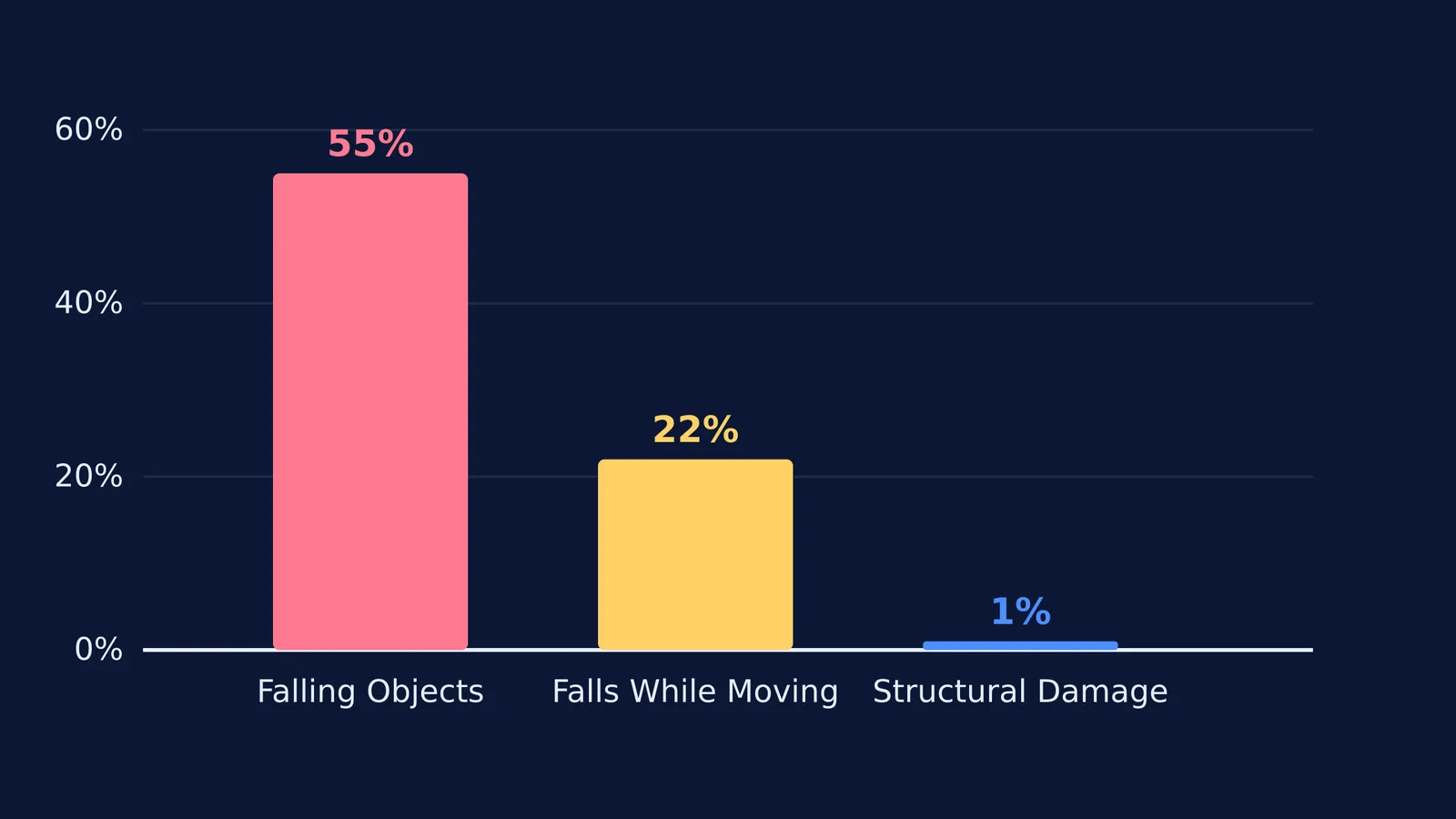
While images of collapsed buildings dominate the news, structural failure is relatively rare in regions with standard building codes. The far greater risk comes from "non-structural" hazards. A study of the 1994 Northridge earthquake by UCLA researchers found that 55% of all injuries were caused by falling furniture or objects. In stark contrast, only about 1% of injuries were attributed to structural damage.
Heavy bookcases, televisions, ceiling fixtures, and shattering window glass become dangerous projectiles. The entire purpose of taking cover is to place a physical barrier between your head and these falling hazards.
Why not run outside during an earthquake?
You might think that escaping a building is the safest option, but data suggests otherwise. According to the Occupational Safety and Health Administration (OSHA), injury statistics show that people who move as little as 10 feet during the shaking are the most likely to be injured.
The reasons for this are twofold:
The ground is moving: The violent acceleration of an earthquake makes walking nearly impossible. Attempting to run often results in falls, leading to sprains, fractures, and head injuries.
The exterior danger zone: The area immediately outside a building is incredibly dangerous. As the structure flexes, exterior features like brick facades, window glass, and architectural ornaments are often the first things to peel off and fall to the street below.
Understanding how energy propagates—such as the mathematics described by Charles Richter and the logarithm behind earthquake magnitude—highlights just how much force the ground is subjected to during a major event.
Why do earthquake drills teach drop, cover, and hold on?
The protocol is designed to keep you stable and protect your vital organs. Here is the mechanics of why each step matters:
Drop: By immediately dropping to your hands and knees, you prevent the earthquake from knocking you over. This low center of gravity keeps you stable and allows you to crawl short distances to nearby shelter.
Cover: Crawling under a sturdy table or desk protects your head and neck from falling debris. If no table is available, the NDMA advises dropping next to an interior wall, away from windows and tall furniture, and covering your head with your arms.
Hold On: Earthquakes are dynamic events. The shaking can cause your chosen shelter to slide or "walk" across the room. By holding onto a table leg with one hand, you ensure your cover moves with you.
This simple but effective method has saved countless lives. Just as Inge Lehmann and the Earth's inner core, explained with waves, helped us understand the deep structure of the planet, analyzing injury data has helped us understand how to survive its sudden shifts on the surface.
Next time you participate in a drill, remember that you are not preparing for the building to collapse; you are simply getting low to dodge the physics of falling objects.


