

On this page
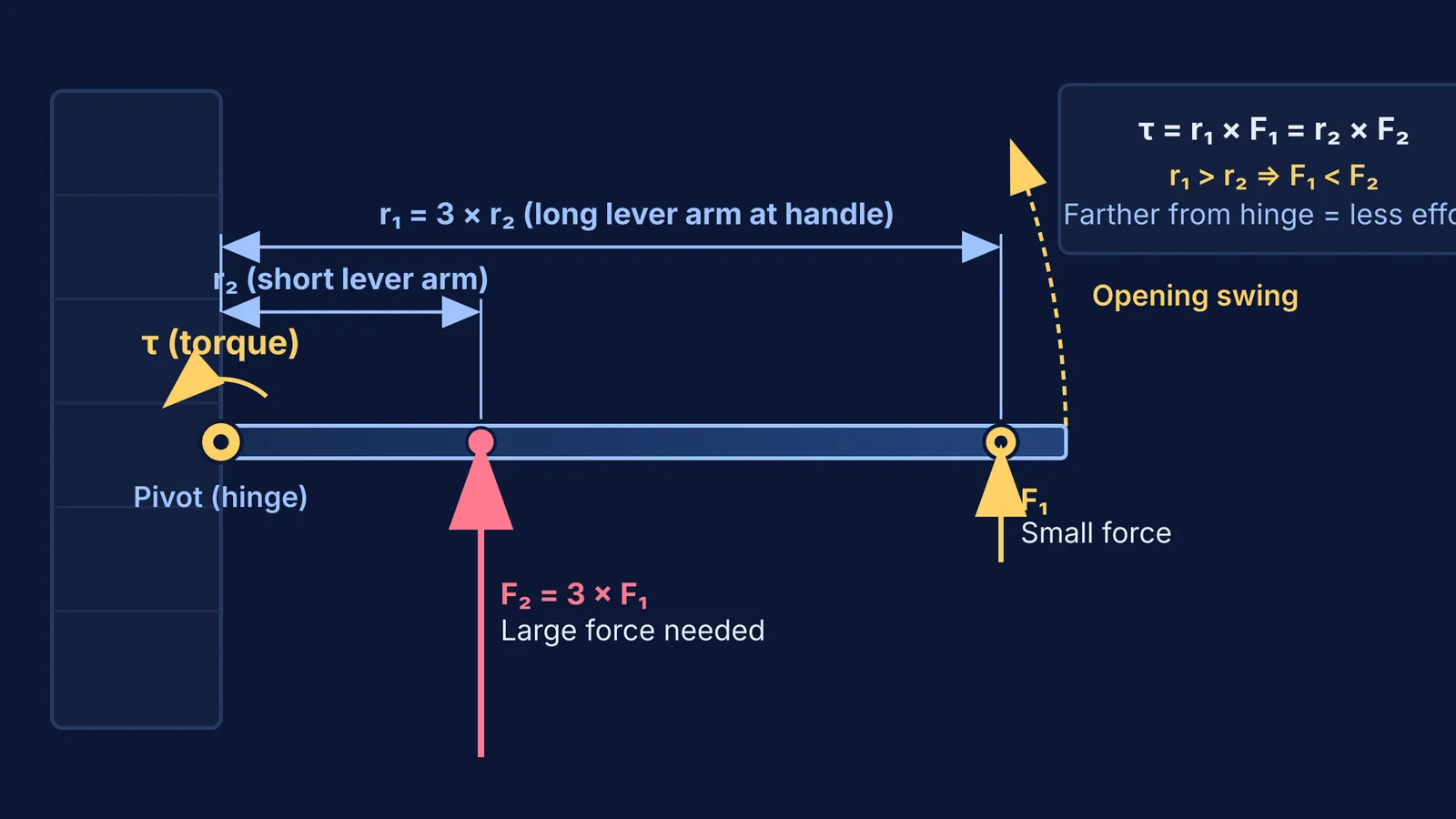
When you push open a heavy wooden door, you instinctively reach for the handle positioned near the outer edge, as far as possible from the hinges. If you have ever tried pushing a door near its hinged edge with your fingertip, you know the difference immediately: the door feels stubbornly heavy, requiring an exhausting shove to produce the slightest swing. This everyday observation is the classic physical demonstration of the moment of a force, known in physics as torque. By positioning the handle at the maximum possible distance from the axis of rotation, door designers ensure that a person can swing open a heavy panel with minimal effort.
What is torque and how does a door rotate?
A door mounted on wall hinges is constrained to move along a single rotational axis. Unlike a box sliding across a floor under translational force, a rigid body pinned along an axis cannot move forward or backward as a whole; it can only rotate around that fixed line. The rotational analogue of linear force is torque, denoted by the Greek letter τ (tau).
In introductory mechanics, the magnitude of torque produced by an applied force is defined by OpenStax University Physics Volume 1 as: τ = r × F × sin θ
In this formula, F is the magnitude of the applied force measured in newtons (N), r is the distance from the pivot axis to the point of force application measured in metres (m), and θ is the angle between the position vector and the force vector. The quantity r × sin θ represents the perpendicular lever arm, or moment arm. When you push perpendicularly against the door face, θ = 90° and sin 90° = 1, giving the maximum turning effect τ = r × F. If you were to push parallel to the door surface toward the hinges, θ = 0° and sin 0° = 0, producing zero torque no matter how hard you push.
Why does distance from the hinge make opening easier?
The rotational version of Newton's second law, detailed in OpenStax University Physics Section 10.7, states that the net torque acting on a rigid body equals its moment of inertia multiplied by its angular acceleration: τ = I × α
For a uniform rectangular door of mass M and width w rotating about an edge axis through its hinges, the moment of inertia is I = (1/3) × M × w². To start the door moving and overcome friction in the hinge pins, you must deliver a specific threshold torque. Because torque is the product of lever arm distance and force, distance and effort share an inverse relationship for any fixed rotational target: F = τ / r
Placing the handle at the outermost edge maximizes the value of r. As a result, the user exerts the smallest possible force F to produce the necessary torque τ. If the handle were relocated to the midpoint of the door, the lever arm would be cut in half, forcing you to push twice as hard. If placed right next to the hinge line where r approaches zero, the required force climbs toward infinity.
How much more force is needed near the hinges?
To see the mathematics in practice, consider a standard door with a width of 0.90 m, applying the rotational principles from OpenStax University Physics Volume 1. Suppose swinging the door open against inertia and hinge resistance requires a modest turning torque of 21.25 N m:
At the outer handle (r = 0.85 m): F = 21.25 N m / 0.85 m = 25 N (a gentle push easily delivered with two fingers).
At the middle of the door (r = 0.45 m): F = 21.25 N m / 0.45 m = 47.2 N (nearly double the effort).
Near the hinge (r = 0.10 m): F = 21.25 N m / 0.10 m = 212.5 N (an aggressive push requiring substantial body weight).
At the hinge line (r = 0.00 m): F = 21.25 N m / 0 m, which is impossible because the turning moment is strictly 0 N m.
In vector mechanics, torque is rigorously computed as the vector cross product of position and force, where the direction of the torque vector points vertically along the hinge line according to the right-hand rule. This same equilibrium principle governs the principle of moments used in balance beams and levers.
What common misconceptions do physics students make?
Physics education research shows that students frequently stumble when transitioning from linear forces to rotational torque. In an investigation of student understanding published in *Physical Review Special Topics - Physics Education Research*, researchers Lorenzo G. Rimoldini and Chandralekha Singh documented that students often conflate force with torque, mistakenly treating them as interchangeable quantities. Many learners assume that applying equal force to an object produces an identical physical effect regardless of where the force is applied, failing to account for the geometric role of the lever arm.
Other common rotational motion mistakes include confusing the radial distance r with the perpendicular lever arm r × sin θ, or assuming that an object in translational equilibrium cannot experience a net turning moment. Recognizing that rotation depends on both where you push and the angle at which you push is the essential conceptual leap in rigid-body mechanics.
How to practice rotational mechanics with interactive tools
Developing intuition for moments of force works best when you can manipulate variables and watch the system respond. Interactive simulations such as the PhET Torque simulation allow students to vary the applied force, change the lever arm distance on a rotating disc, and observe the immediate change in angular acceleration.
When working through rotational problems, exploring dynamic models helps connect algebraic formulas with physical movement. The Fermi Simulation Lab offers interactive simulations for ideas that are easier to see than to read, enabling learners to adjust force vectors and pivot distances in real time. For students working through rigid-body mechanics, the Fermi Problem Library provides worked problems with a step-by-step solver that explains the reasoning rather than printing an answer.


