

On this page
Have you ever wondered why a quick blast of aerosol deodorant feels freezing cold, even on a hot summer day? That chilling sensation is not because the can was stored in a fridge. It is a rapid demonstration of thermodynamics happening right on your arm.
What is the liquid inside the can?
If you shake a can of deodorant, you can hear liquid sloshing inside. This liquid is not just the fragrance or the active antiperspirant ingredients; it is mostly the propellant. Modern aerosol cans do not use ordinary compressed air. Instead, they use volatile hydrocarbons like n-butane, isobutane, and propane [[1]](https://en.wikipedia.org/wiki/Aerosol_spray).
Inside the sealed can, these chemicals are kept under high pressure, forcing them to remain in a liquid state. But their natural state at room temperature is very different. At standard atmospheric pressure, butane boils around −1 °C [[2]](https://en.wikipedia.org/wiki/Butane), and propane boils at a freezing −42 °C [[3]](https://en.wikipedia.org/wiki/Propane).
Why does a deodorant spray feel cold on skin?
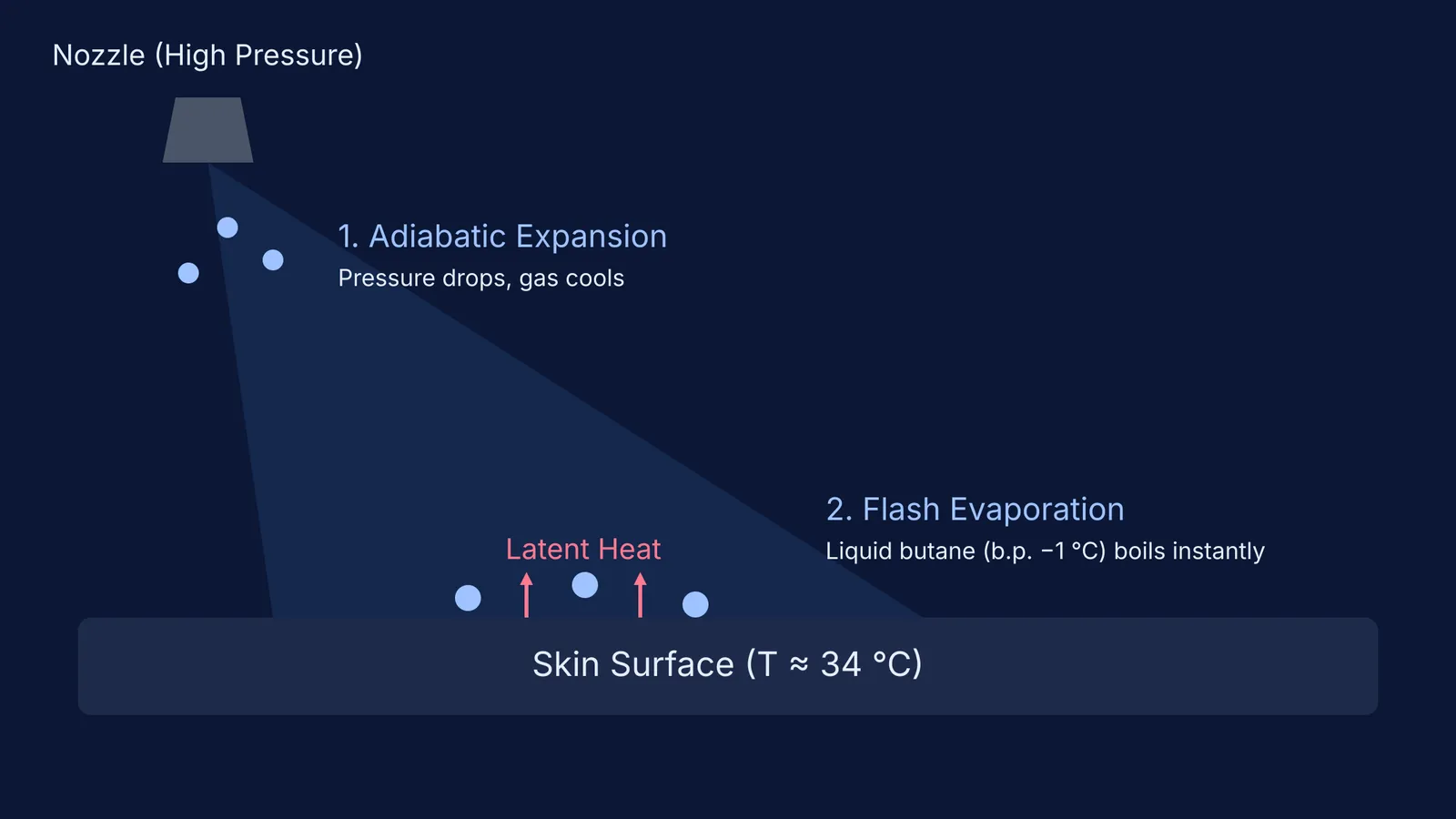
When you press the nozzle, you open a valve to the outside world. The pressure suddenly drops to normal atmospheric levels.
Because your skin is at roughly 34 °C [[4]](https://en.wikipedia.org/wiki/Skin_temperature)—far above the boiling points of butane and propane—the liquid propellant begins to boil the instant it makes contact. This process, known as flash evaporation, requires a massive amount of energy to break the intermolecular forces holding the liquid together. In physics, this required energy is called the latent heat of vaporisation.
Since there is no flame or hot plate to provide this energy, the evaporating liquid simply takes it from the nearest available source: you. The propellant rapidly absorbs thermal energy from your skin to fuel its phase change. As your skin loses heat, your nerves register a sharp, intense cold. You can learn more about how phase changes draw energy from their surroundings in our guide on Matter in our surroundings: states, evaporation and latent heat.
Why does a pump spray not feel as cold?
If you use a simple pump-action perfume or a water spray, it feels slightly cool, but nothing like an aerosol deodorant.
Pump sprays do not contain pressurised liquid propellants like butane. Instead, they use mechanical force to push a liquid—usually water or ethanol—through a tiny nozzle. While ethanol does evaporate quickly and provides a mild evaporative cooling effect, it boils at 78 °C [[5]](https://en.wikipedia.org/wiki/Ethanol). It is evaporating, not boiling, on your skin.
Because a pump spray is just room-temperature liquid evaporating naturally, it draws heat away relatively slowly. An aerosol, on the other hand, deposits a liquid that is actively boiling because your skin is more than 30 degrees above its boiling point. The rate of heat transfer is drastically higher, making the temperature drop much more severe.
Does adiabatic expansion chill the air?
A secondary effect chills the spray while it is still in the air. As the highly compressed propellant escapes the nozzle, it enters a lower-pressure environment and expands rapidly.
For the gas to expand, it must do work to push the surrounding air out of the way. Because this happens so quickly, heat does not have time to flow in from the surrounding room. This makes it an adiabatic expansion. The gas must use its own internal kinetic energy to do the work of expanding, causing its temperature to drop steeply before the mist even reaches your body. This concept is explored further in our breakdown of Isothermal and adiabatic processes: work done and PV diagrams.
If a student struggles to picture how pressure changes affect temperature, the Fermi Simulation Lab allows them to expand a gas in a virtual cylinder and watch the kinetic energy of the molecules fall in real time.
How can you teach this concept?
This everyday phenomenon is a perfect way to test a student's understanding of thermal physics. Here is a short checklist of questions to ask when discussing aerosol cooling:
Identify the states: What state of matter is the propellant inside the can, and what state is it in the air?
Find the energy source: When the liquid turns to gas, where exactly does the latent heat come from?
Compare boiling points: If water boils at 100 °C and butane boils around −1 °C, why does water not freeze your skin when it evaporates? (Answer: Water evaporates slowly over time, whereas butane boils instantly, extracting heat at a much faster rate).
By walking through these steps, the freezing blast of a deodorant spray turns from a bathroom mystery into a practical lesson in phase equilibrium and energy transfer.


