

On this page
When you look at a healthy coral reef in places like the Andaman Sea or the Gulf of Mannar, you see a vibrant underwater city. But these brilliant colours do not actually belong to the coral animal itself. They come from microscopic algae living inside the coral's tissues.
In recent years, divers and marine biologists have witnessed a startling change: vast stretches of reefs are turning completely white. This phenomenon, known as coral bleaching, is a direct response to heat stress in warming oceans. For students preparing for biology exams, understanding the precise mechanisms behind this ecological crisis connects the dots between symbiosis, environmental science, and the physics of temperature thresholds.
How do corals and algae live together?
To understand why corals turn white, you first need to look at how they live. A coral reef is built by thousands of tiny animals called polyps. Each polyp is a sac with a stomach and a ring of tentacles, much like a tiny sea anemone.
Inside the tissue of these polyps live single-celled algae called *zooxanthellae*. This relationship is a perfect example of mutualism. The coral provides the algae with a protected environment and the compounds they need for photosynthesis. In return, the algae produce oxygen and supply the coral with glucose, glycerol, and amino acids—which provide most of the coral's nutritional needs. These algae also give the coral its beautiful green, brown, and golden colours.
If you are exploring biological magnification in Class 10, you already know how fragile aquatic food webs can be. The coral-algae partnership is the foundational link that supports the entire reef ecosystem.
What triggers coral bleaching?
Corals are sensitive to temperature changes. They thrive in a narrow thermal window and live very close to their upper heat tolerance limit.
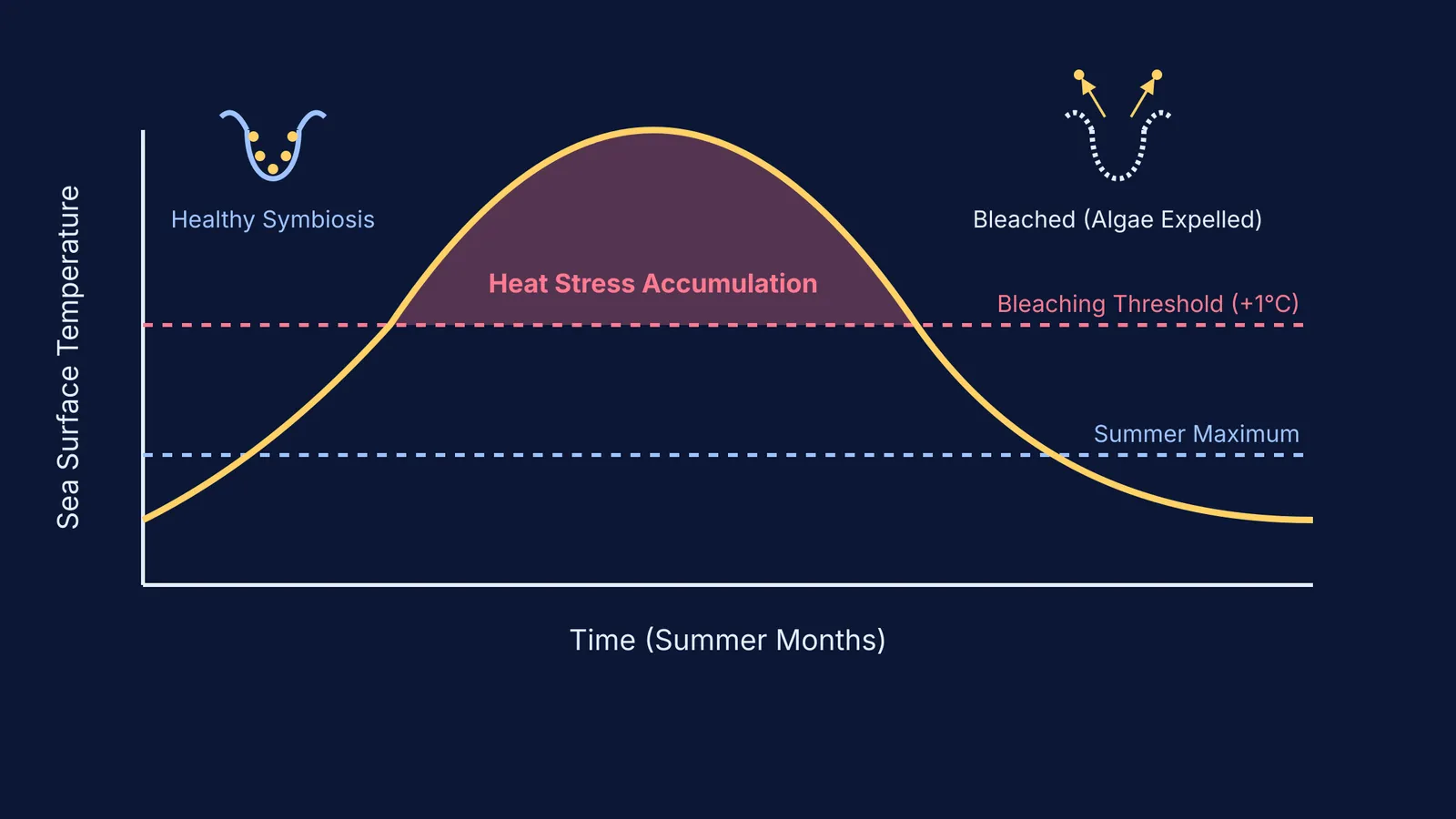
When the sea surface temperature rises just 1°C above the normal summer maximum—a metric tracked by NOAA's Coral Reef Watch—the biology of the coral breaks down. Under heat stress, the photosynthetic machinery of the zooxanthellae malfunctions. A mechanistic model of coral bleaching shows that excess light and heat cause these algae to generate toxic reactive oxygen species instead of food.
To survive this sudden internal toxicity, the coral polyp ejects the algae into the surrounding water. Without their colourful tenants, the coral's transparent tissue reveals the stark white calcium carbonate skeleton underneath. The coral has bleached.
Can bleached corals recover?
Bleached corals are not immediately dead. If the water cools down quickly enough, the polyps can recapture algae from the water column and slowly recover. However, without their primary food source, they are essentially starving. If the heat stress persists for weeks, the coral will die.
The global stakes are severe. According to the Intergovernmental Panel on Climate Change (IPCC), if global warming reaches 1.5°C above pre-industrial levels, 70% to 90% of tropical coral reefs will be lost. If temperatures rise by 2.0°C, more than 99% of reefs are projected to disappear.
Understanding these thresholds is critical. If you are struggling with how small numerical changes trigger large shifts in biological or chemical systems, like the temperature coefficient of a reaction rate, Fermi's Simulation Lab has interactive simulations for the ideas that are easier to see than to read.
How can you observe and report coral bleaching?
If you are studying marine biology or environmental science, you can actively track these changes. Here is a practical framework for understanding reef health data:
Check the Maximum Monthly Mean (MMM): Find the highest average summer temperature for a specific reef location.
Monitor the +1°C Threshold: Look for days where the water temperature exceeds the MMM by 1°C or more.
Calculate Degree Heating Weeks (DHW): This index adds up the heat stress over a 12-week period. According to NOAA, a DHW of 4 means significant bleaching is likely; a DHW of 8 indicates severe, widespread bleaching and mortality.
Link to Policy: Use these concrete numbers when writing essays or project reports on climate change. Hard data makes a stronger argument than general statements about "warm oceans."


