

On this page
Coconut oil behaves differently from most cooking oils in your kitchen, turning from a clear liquid in summer to a hard, white block in winter.
The secret to this seasonal shift lies in the shape of its fat molecules and how they interact when the ambient temperature changes throughout the year.
Why does coconut oil freeze in winter but not in summer?
The physical state of any fat depends directly on its melting point. Coconut oil is made up of 80% to 90% saturated fat (Harvard T.H. Chan School of Public Health). This exceptionally high level of saturation gives it a specific melting point of approximately 25 °C (78 °F).
When the room temperature drops below 25 °C during the cold winter months, the oil's molecules lose kinetic energy. Moving more slowly, they lack the energy needed to overcome the attractive forces pulling them together. They lock tightly into an orderly, solid crystalline structure, which we see as a firm white mass in the jar. In summer, room temperatures in many parts of the world naturally rise well above 25 °C. This ambient heat gives the molecules enough thermal energy to break their intermolecular bonds, allowing them to slide past one another and flow freely as a clear liquid.
What are saturated and unsaturated fats?
The reason coconut oil melts at 25 °C while other oils stay liquid comes down to the microscopic architecture of its carbon chains.
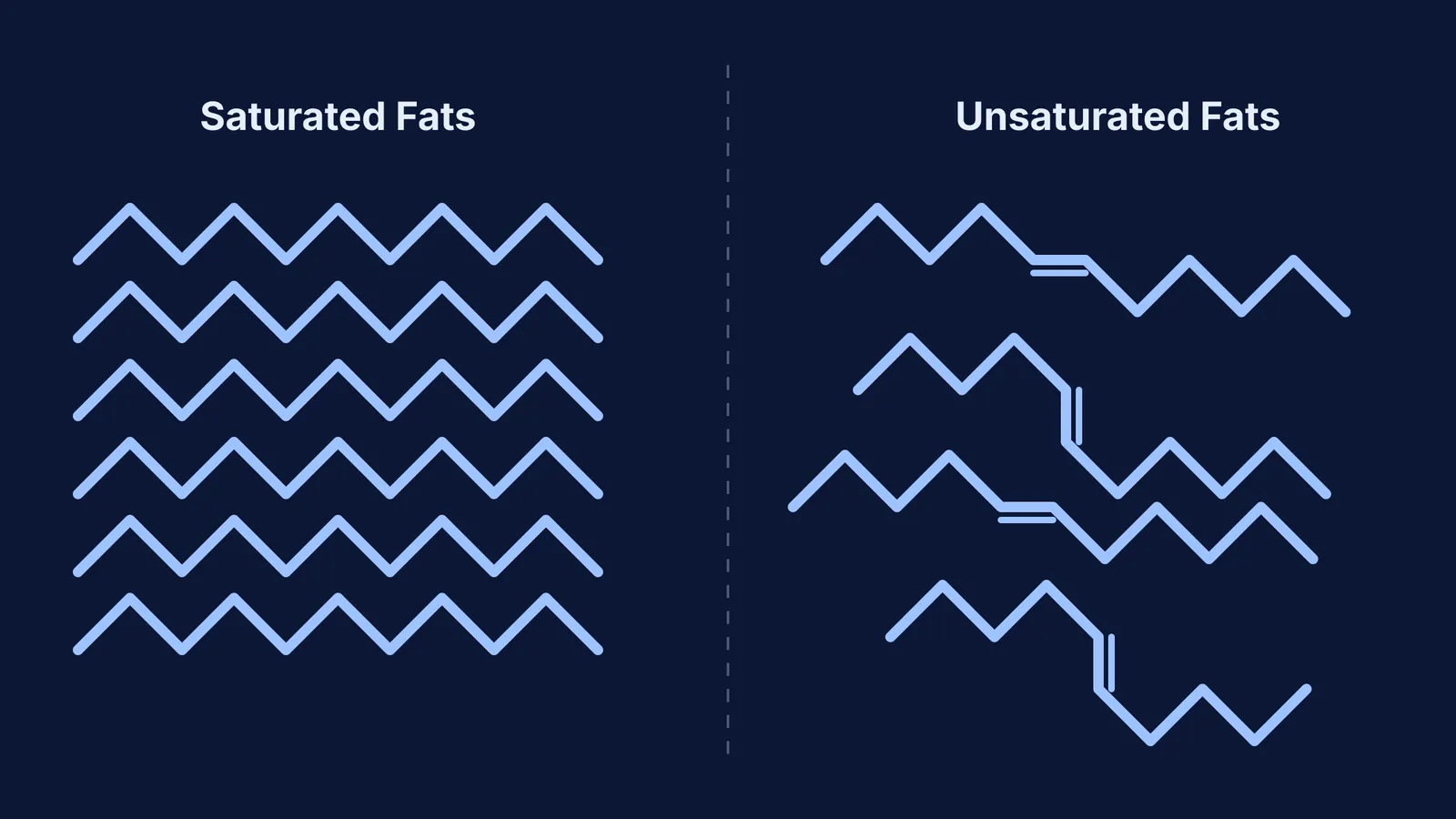
In dietary terms, fats are triglycerides: three fatty acid chains attached to a glycerol backbone. These chains are essentially long strings of carbon atoms. In a saturated fat, every carbon atom in the chain is fully "saturated" with hydrogen atoms, meaning there are absolutely no double bonds between the carbons. This chemical structure creates a completely straight, uniform hydrocarbon chain.
The primary fatty acid in coconut oil is lauric acid, a 12-carbon straight chain that makes up about 47% of the oil (Harvard T.H. Chan School of Public Health). Because these straight chains lack any bends or kinks, they can pack tightly together like neatly stacked bricks or a bundle of unsharpened pencils. This tight, orderly packing maximizes the surface area available for van der Waals forces, which significantly strengthens the intermolecular attraction between the chains. As a result, it takes a relatively high amount of thermal energy — reaching that 25 °C threshold — to melt them apart.
If you find it hard to picture how these molecular shapes dictate their physical state, the Fermi Simulation Lab has interactive simulations for ideas that are easier to see than read, letting you explore how different fatty acid structures fit together.
Why do other cooking oils stay liquid?
Most vegetable oils in your pantry, such as sunflower, canola, or olive oil, are rich in unsaturated fats. These fat molecules contain one or more double bonds between their carbon atoms.
Each double bond creates a rigid "kink" or sharp bend in the normally straight carbon chain. Because of these structural bends, unsaturated fat molecules simply cannot pack tightly together. Imagine trying to neatly stack a pile of crooked, bent branches; there will always be large gaps between them. Their loose, disordered arrangement results in much weaker intermolecular forces across the mixture. Consequently, they require very little heat energy to separate, keeping them in a liquid state even when the temperature drops near 0 °C on a cold winter day.
A quick rule of thumb for fats
You can often deduce a fat's fundamental chemical structure just by looking at how it behaves on your kitchen counter:
Solid at room temperature? It is likely very high in saturated fats with straight molecular chains (for example, coconut oil, butter, and ghee).
Liquid at room temperature? It is almost certainly high in unsaturated fats with kinked chains (for example, olive oil, mustard oil, and sunflower oil).
Applying this to chemistry exams
The relationship between molecular shape, packing density, and melting point is a core concept tested in competitive exams like JEE and NEET. It explains a wide variety of phenomena across both physical and organic chemistry, from why butter is solid to how you separate complex alkanes in a laboratory distillation column.
You will encounter these fundamental structural principles early on when naming carbon compounds in Class 10 and when practising how to draw electron dot structures of covalent molecules in Class 10. The shape of a molecule dictates its physical properties, which is why drawing the structure accurately is always the critical first step to solving these problems correctly and efficiently. Understanding this molecular geometry helps you predict the physical state and reactivity of unknown compounds.
If you get stuck on a homework question about intermolecular forces or fatty acid structures, Fermi's AI tutor can work out what you already know and build a plan for the session, drawing the figure on a virtual board and checking your understanding as it goes.


