

On this page
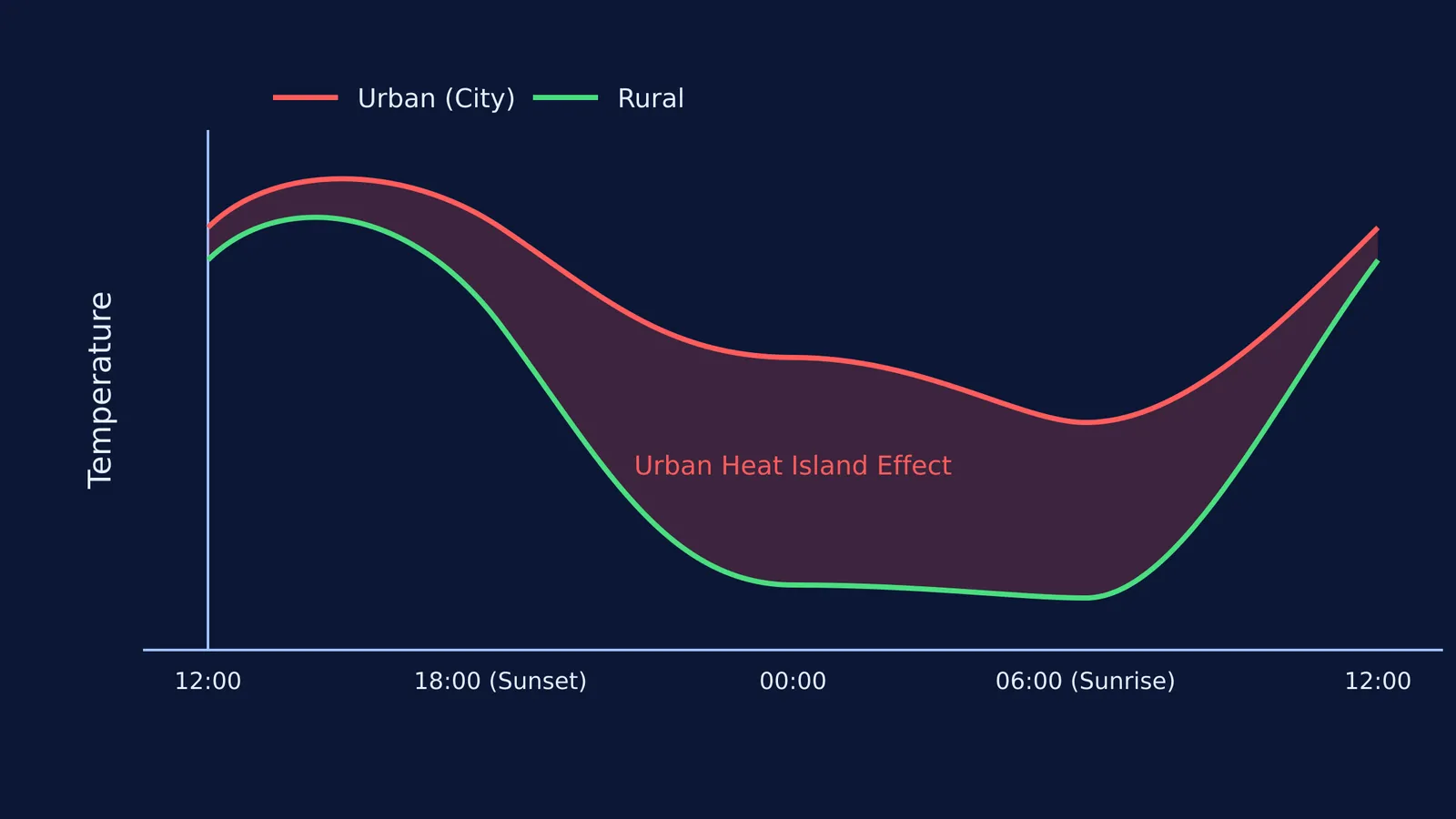
If you have ever stepped out of a city into the countryside on a summer evening, you have felt the sudden drop in temperature. While a grassy field cools off as soon as the sun goes down, a city block stays hot for hours.
This effect, known as the urban heat island, is more than just an illusion. According to the United States Environmental Protection Agency (EPA), nighttime temperatures in urban areas are roughly 2 to 5°F higher than in outlying areas, while daytime differences are between 1 and 7°F.
Why do cities hold onto so much heat when the sun is no longer shining? The answer lies in the physics of the materials we build with and the way water moves through an ecosystem.
What makes an urban heat island?
When the sun beats down on a surface, the material absorbs solar radiation. The peak temperature it reaches depends heavily on its thermal mass and albedo. Albedo measures how much sunlight is reflected back into space; dark surfaces like black asphalt roads and tar roofs have a low albedo, meaning they absorb most of the incoming solar energy.
Thermal mass dictates how much energy a material can store before its temperature stops rising. Concrete, asphalt, and brick are dense materials that hold a vast amount of thermal energy. Throughout a summer day, city roads and buildings act like giant heat batteries, absorbing energy hour after hour. Once the sun sets, the surrounding rural air cools down rapidly. However, the urban materials slowly release their massive store of energy as infrared radiation. This continuous release of heat keeps the city air warm long into the night, delaying the cooling process by several hours.
To understand how materials store energy, you can review the principles of calorimetry and heat transfer. If you find the continuous exchange of thermal radiation hard to picture, the Fermi Simulation Lab provides interactive simulations for the ideas that are easier to see than to read.
How does evaporation cool the countryside?
A rural village is covered in soil, trees and crops. These natural landscapes do not just reflect more sunlight; they actively cool the air using water.
Plants draw water from the soil and release it through their leaves in a process called transpiration. When the sun heats a field, much of that solar energy goes into turning liquid water into vapour. This requires a large amount of energy—explained in the physics of evaporation and latent heat—which means the energy is not available to raise the air temperature.
Cities replace these permeable, moist surfaces with hard, dry ones. Rainwater hits concrete and is immediately funnelled away by storm drains. Without moisture to evaporate, the sun's energy goes entirely into heating the solid materials.
How can we measure the temperature difference?
Scientists measure the urban heat island effect in two ways: surface temperature and atmospheric temperature.
Surface temperatures are read by satellites, such as those carrying the Landsat thermal bands, which map the heat radiating from roofs and roads. Air temperatures are measured by weather stations near the ground. While a dark roof can be up to 66°F hotter than the air on a summer day, it is the atmospheric temperature—the warm air trapped between buildings—that makes a city uncomfortable at night.
Why does this temperature difference matter for students and families? Persistently high nighttime temperatures mean that buildings cannot cool down naturally. This leads to higher electricity demand for air conditioning, increased energy bills, and poor sleep quality for those without artificial cooling. A city that cannot cool off at night remains uncomfortable and can even pose health risks during severe heat waves.
What can we do to cool cities down?
You cannot easily change the specific heat capacity of concrete, but urban planners can change how much of it is exposed to the sun. Here is a checklist of solutions that work:
Plant trees: adds shade and restores evaporative cooling.
Install green roofs: covers dark shingles with soil and plants to reduce surface temperatures.
Use cool pavements: replaces dark asphalt with lighter-coloured materials that reflect more sunlight.
Design ventilation corridors: creates open pathways in city grids to allow evening winds to sweep out the trapped heat.
These small changes alter the thermal resistance of a city, ensuring that less heat is stored during the day, giving the air a chance to cool when night falls.


