

On this page
You open your bag on the drive up to a hill station and the chips packet you bought in the plains is tight as a drum. Nothing got into it. What changed is the air outside.
Why do chips packets swell up in hill stations?
A packet of chips is a sealed bag holding a fixed amount of gas. At the factory, the air around the bag squeezes that gas, and the bag settles at the size where the push from inside matches the push from outside.
Air pressure comes from the weight of all the air above you. Climb a mountain and there is less air above you, so the outside push gets weaker. The gas inside is still pushing outward, and now nothing balances it, so it spreads out until the plastic walls go taut. Bring the packet back down and it goes soft and crumpled again.
How much lower is air pressure in the hills?
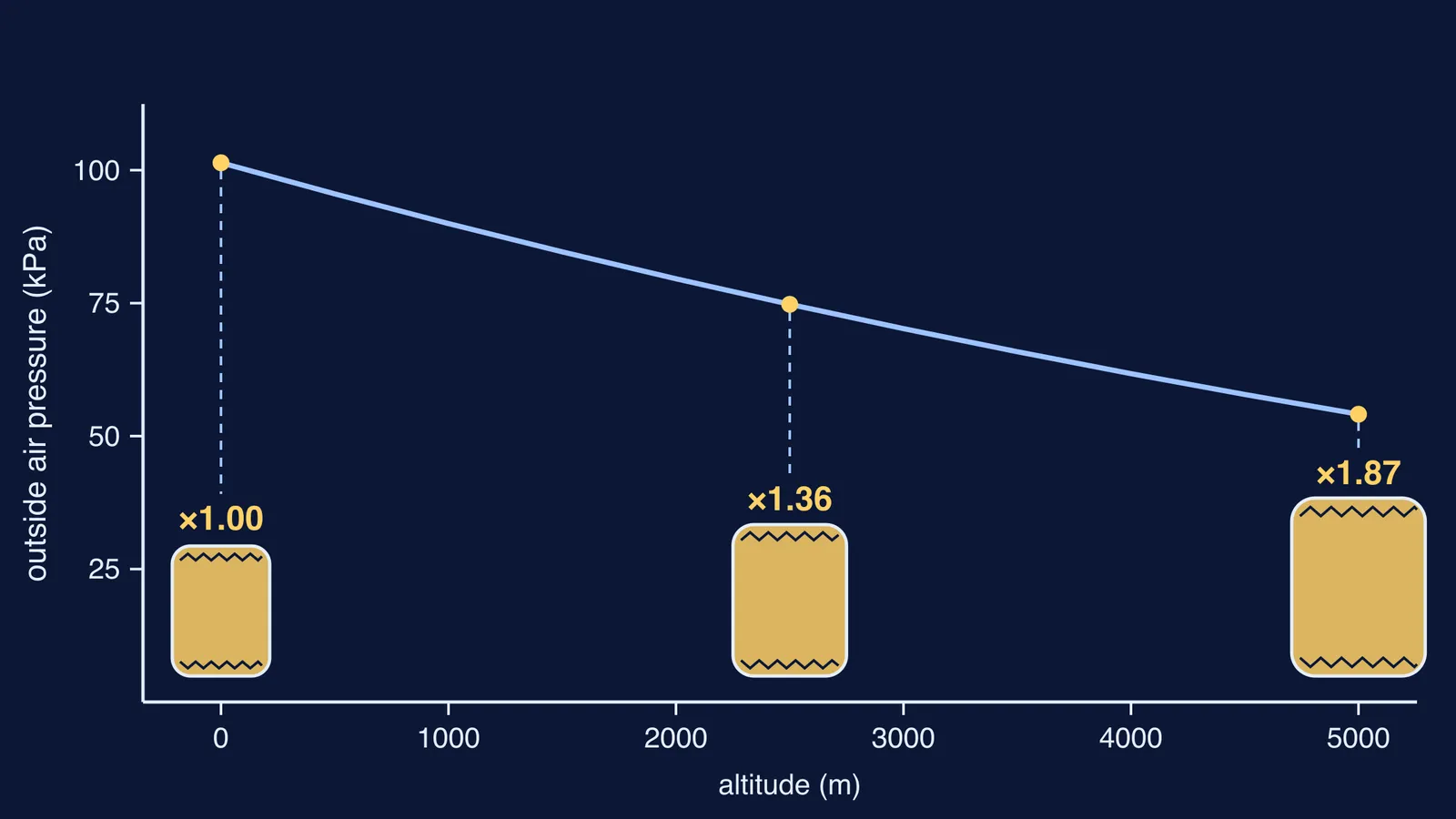
NASA's Glenn Research Center publishes a simple model of the lower atmosphere, valid from the ground up to 11,000 m (NASA Glenn, Earth atmosphere model). In it, temperature is T = 15.04 − 0.00649h in °C, and pressure is p = 101.29 × [(T + 273.1) / 288.08]^5.256 in kilopascals, where h is the height in metres. Plugging in a few heights gives these values for an average day:
Sea level: about 101 kPa
1,000 m: about 90 kPa
2,300 m: about 77 kPa
3,500 m: about 66 kPa
5,000 m: about 54 kPa
For a sense of scale, Leh district lies at altitudes from 2,300 m to 5,000 m above sea level, according to the Leh district administration. At the top of that range, the outside air presses only a little more than half as hard as it does at the beach. Real weather shifts these numbers a little from day to day.
What does Boyle's law have to do with it?
Boyle's law says that for a fixed amount of gas at constant temperature, pressure times volume stays the same: pV = constant (NASA Glenn, Boyle's law). If the pressure on the gas falls, its volume has to rise to keep the product the same.
The hills are also colder, and cold gas takes up less room. Boyle's, Charles's and Gay-Lussac's laws combine into one equation, pV = nRT, where T must be an absolute temperature in kelvin (NASA Glenn, equation of state). For a sealed packet, n and R don't change, so p₁V₁/T₁ = p₂V₂/T₂.
How much does a packet expand at 3,500 m?
Say a packet sealed near sea level holds 1 litre of gas at 101 kPa, and you carry it up to 3,500 m, where the NASA Glenn model gives about 66 kPa.
Ignore temperature first. V₂ = V₁ × p₁/p₂ = 1 × 101/66 ≈ 1.53 litres, about half as much room again.
Now add the cold. Say the packet was sealed at 30 °C (303 K) and it is 5 °C (278 K) up here. V₂ = 1 × (101/66) × (278/303) ≈ 1.40 litres.
The cold takes back only a small part of the expansion, so the drop in pressure wins.
A real packet can only grow until its plastic is taut. After that the gas stays a little compressed, so the pressure inside ends up higher than the pressure outside. That difference is what you feel when you squeeze the packet.
Why are chips packets filled with nitrogen, not air?
Packets are often flushed with nitrogen to keep oxygen away from the oil in the chips, which helps them stay fresh. A 2018 study in Food & Function found that nitrogen flushing extended the shelf life of potato crisps by about two weeks in accelerated shelf-life tests (Agarwal et al., 2018). For the hill question, the type of gas does not matter. Nitrogen and air both behave almost like an ideal gas at everyday pressures, so both follow Boyle's law.
How can you test this on your next trip?
Before you set off, photograph one sealed packet next to a pen for scale.
At each stop, note the elevation (most map apps show it) and photograph the packet again.
Use the NASA formula to predict the volume ratio at each height, then compare it with your photos. Expect the packet to stop growing once it is taut.
If you want to see pressure and volume trade off before you work the numbers, the Fermi Simulation Lab has interactive simulations for ideas that are easier to see than to read. If a gas-law problem keeps going wrong at the same step, the Fermi Problem Library has worked problems with a step-by-step solver that explains the reasoning rather than printing an answer.
Next time a packet puffs up on a mountain road, you'll know why.


