

On this page
Watching a flat disc of rolled dough swell into a taut, spherical ball over an open burner is one of the most familiar sights in an Indian kitchen. Yet this everyday cooking step is also a remarkable demonstration of fundamental physics. Within a few seconds, heat transfer, phase transitions, gas expansion, and polymer elasticity work together to lift the dough into a puffed sphere.
For students preparing for competitive exams like JEE and NEET, the puffing of a chapati (or phulka) offers a tangible model for concepts in thermodynamics and materials science. When you understand why a chapati inflates, textbook formulas about vapour pressure and elastic membranes become far easier to picture.
Why does a chapati puff up on the flame?
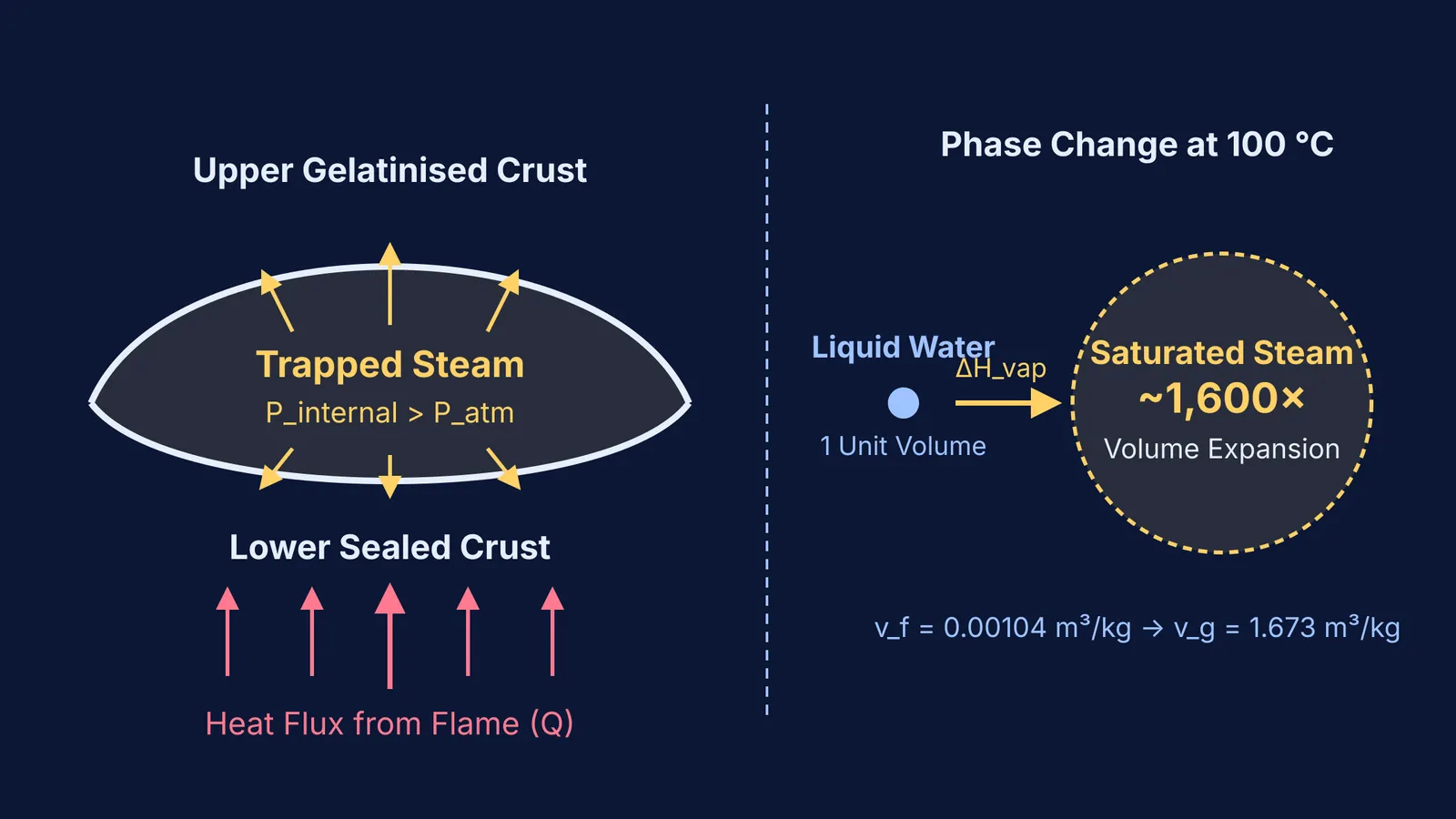
A chapati puffs because water trapped inside the dough rapidly vaporises into steam, creating internal gauge pressure between two partially cooked outer layers. In 1986, cereal scientists P. Haridas Rao, K. Leelavathi, and S. R. Shurpalekar standardized objective measurements for chapati dough consistency using a water absorption meter (Rao et al., 1986). When a properly hydrated and partially baked chapati meets intense heat, it balloons into two distinct layers (laminae).
This inflation cannot happen on raw dough alone. The traditional two-step cooking technique—first searing both surfaces lightly on a flat griddle (tawa), then transferring the disc directly onto an open flame—prepares the dough to act as a pressure vessel. The tawa creates two dry, semi-permeable crusts while leaving the central core moist. When you flip the chapati onto the flame, intense thermal radiation and convection drive the remaining moisture past its boiling point. Because the steam generates faster than it can diffuse outward through the crusts, it forces the top and bottom laminae apart. To explore how heat drives vaporization and changes of state in standard curricula, see our guide to converting PV, PT and VT graphs of ideal gas processes.
How does water turning to steam inflate the dough?
The driving force behind the puff is the colossal volume expansion that accompanies a liquid-to-gas phase change. Liquid water molecules are held close together by intermolecular hydrogen bonds. Transforming liquid water into steam at standard atmospheric pressure requires absorbing the latent heat of vaporisation (approximately 2,257 kJ/kg), as listed in Engineering ToolBox thermodynamic property tables. Once vaporised, the molecules move freely, demanding vastly more space.
According to these tables, the specific volume of liquid water at 100 °C is 0.001044 m³/kg, whereas saturated water vapour occupies 1.673 m³/kg at 101.325 kPa. Dividing these values shows that water expands by roughly 1,600 times its liquid volume upon boiling. Even a microscopic fraction of a millilitre of liquid water yields hundreds of cubic centimetres of steam.
As the flame delivers heat, the temperature of the trapped steam can exceed 100 °C. Following Charles's law and the ideal gas equation (PV = nRT), any additional rise in temperature further expands the trapped gas or increases its internal pressure if the dough resists stretching. For an analysis of how temperature and phase transitions appear on experimental heating curves, review our breakdown of heat in isobaric and isochoric processes.
What happens to the starch and gluten during cooking?
If wheat flour were simply a porous powder, steam would escape through microscopic gaps without inflating anything. The chapati inflates because kneading creates an elastic, gas-trapping matrix. Wheat flour contains two primary storage proteins: glutenin, which gives dough elasticity and tensile strength, and gliadin, which provides viscosity and extensibility. When kneaded with water, they combine to form gluten.
A structural study by Jiwan S. Sidhu, Wilfried Seibel, and Dietrich Meyer (Sidhu et al., 1990) used scanning electron microscopy to examine starch in unleavened Indian flatbreads. They discovered that while starch granules in the dry outer crust remain largely undeformed, moisture and heat inside the dough cause starch granules to gelatinise into a continuous matrix. This gelatinised starch network glues the protein strands together, creating an airtight seal.
Research on Indian wheat cultivars by Anil Panghal, Navnidhi Chhikara, and B. S. Khatkar (Panghal et al., 2019) demonstrated that flour with balanced gluten strength consistently achieves a puffed height between 5.2 cm and 6.2 cm. Flour with a weaker gluten network may fail to stretch and trap steam effectively; if it is excessively rigid, the dough refuses to stretch.
If visualizing phase transitions, molecular collisions, and thermal expansion feels abstract on paper, the Fermi Simulation Lab offers interactive simulations for the ideas that are easier to see than to read.
Worked example: how much water does a chapati need to puff?
You might assume that puffing an entire chapati requires boiling a significant portion of the water inside it. We can test this assumption with a straightforward physics calculation.
Suppose a fully inflated chapati forms an oblate spheroid with a diameter of 15 cm (radius r = 7.5 cm) and a peak puffed height of 6 cm (semi-minor axis c = 3 cm). The volume V of an oblate spheroid is:
V = (4/3) × π × r² × c V = (4/3) × π × (7.5 cm)² × 3 cm ≈ 707 cm³ (0.707 litres)
At 100 °C and standard atmospheric pressure, steam has a specific volume of approximately 1,673 cm³/g. To calculate the mass of liquid water required to generate 707 cm³ of steam:
Mass of water = 707 cm³ / 1,673 cm³/g ≈ 0.42 g
A standard 40 g dough ball rolled to a 2 mm thickness contains roughly 35% to 40% moisture, or about 14 g to 16 g of water. Inflating the entire chapati requires vaporising just 0.42 g of water—less than 3% of the liquid already present in the dough. To see how pressure, volume, and molar quantities interact in related exam problems, explore our guide to free expansion of an ideal gas.
When practicing thermodynamic calculations involving gas expansion and heat transfer, the Fermi Problem Library provides worked problems with a step-by-step solver that explains the reasoning rather than printing an answer.
Why might a chapati stay flat?
Understanding the physics of steam trapping helps explain why chapatis sometimes fail to puff:
Uneven rolling: If a rolling pin creates uneven thickness, thin patches tear under initial steam pressure, releasing gas before the entire disc can separate.
Tawa too cold: If the griddle is below 200 °C, the surface dries out slowly without gelatinising starch, allowing water vapour to leak gradually rather than flash-expanding.
Skipping dough resting: Resting the dough for 20 to 30 minutes allows wheat proteins to fully hydrate and relieve internal stresses, providing the extensibility needed to balloon smoothly.
Micro-punctures: Flipping with sharp tongs can puncture the skin. Because pressure equalises through the opening, the internal pressure drops to atmospheric level immediately.


