

On this page
If you fill a glass with water, cover it with a piece of stiff cardboard, and carefully turn it upside down, something counter-intuitive happens. The water does not fall out. The card stays stuck to the rim of the glass, seemingly defying gravity.
This classic experiment is often performed in school science classes. It looks like magic, but it is a perfect demonstration of the invisible forces that surround us every day. When you understand the physics behind it, you begin to see how fluids and pressure interact in the real world.
Why doesn't water fall from an upside down glass with a card?
The secret to this trick is the invisible ocean of air we live in. Air has mass, and the weight of the Earth's atmosphere presses down, up and sideways on everything. We call this atmospheric pressure.
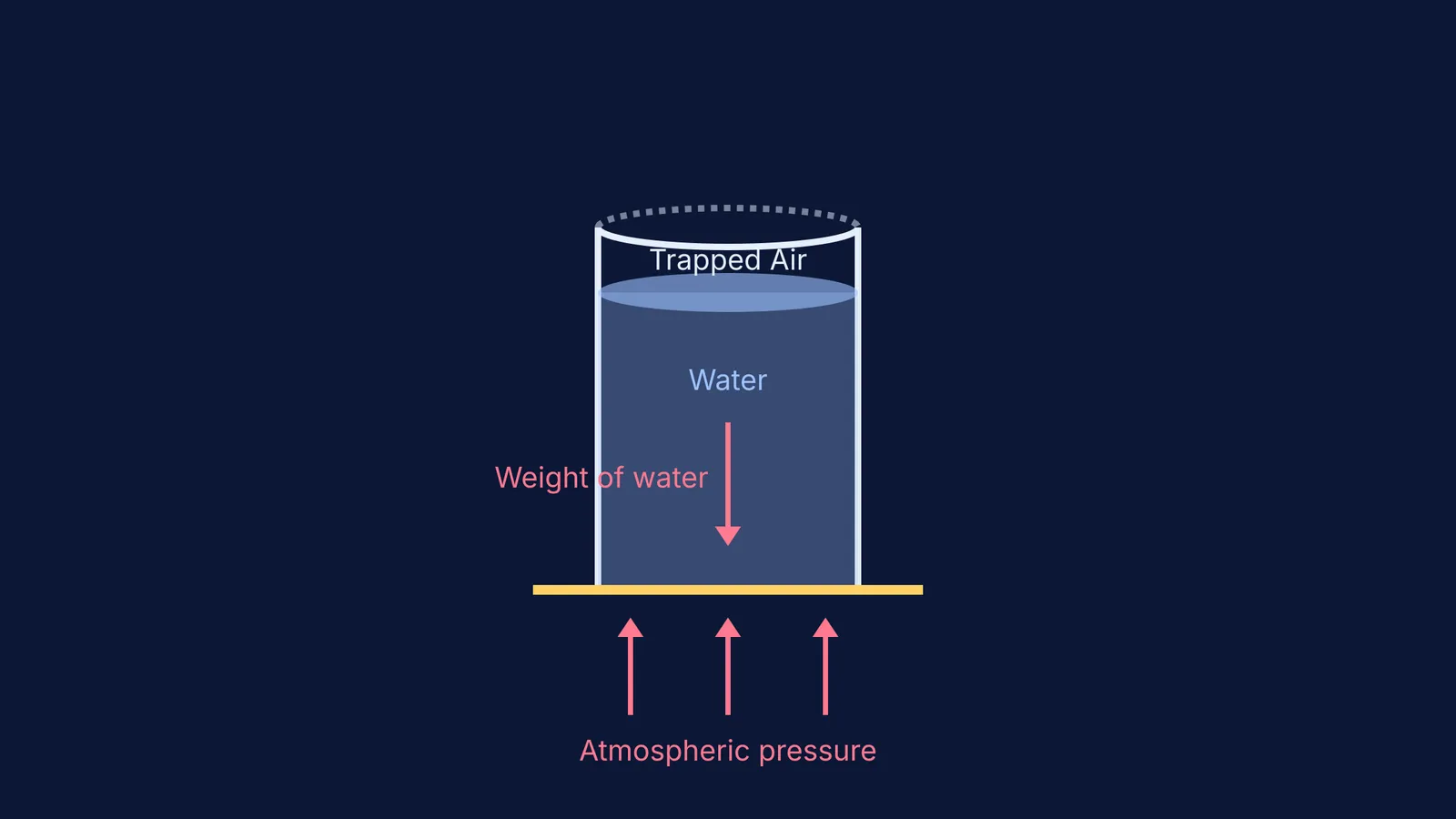
At sea level, this pressure is roughly 1 kg/cm². This force is constantly pushing in all directions. When the glass is upside down, the atmospheric pressure pushes upward against the bottom of the card.
Inside the glass, gravity pulls the water downward, which exerts a hydrostatic pressure on the card. However, because the upward push of the atmosphere is so strong, it easily overcomes the downward push of a few centimetres of water.
How does atmospheric pressure hold the card?
You might wonder what happens if the glass is only half full. If you try the experiment, it still works. The card stays in place even when there is a large pocket of trapped air inside the glass.
When you flip a partially filled glass, the water rests on the card, and the weight of the water causes the card to sag outward by a tiny fraction of a millimetre. This slight bowing movement increases the volume of the trapped air at the closed top of the glass.
According to Boyle's Law, when a gas expands into a larger volume while its temperature stays constant, its pressure drops. The air pressure inside the glass becomes slightly less than the atmospheric pressure outside.
This creates a vital pressure difference. The outside air pushes up harder than the trapped air and water push down, so the card stays put. If the card were perfectly rigid and could not sag at all, the trapped air would not expand, its pressure would not drop, and the weight of the water would force the card off the rim.
Surface tension also plays a crucial supporting role. Water molecules are cohesive, meaning they like to stick together. This creates a microscopic "skin" around the wet edge of the glass, maintaining the delicate airtight seal and stopping air from rushing in.
Why does the upside-down glass experiment sometimes fail?
If you decide to try this at home, it might take a few attempts to get it right. Here are the main reasons the trick sometimes fails:
The card bends too much: If you use flimsy paper, it will warp under the water's weight. The seal will break, and air will enter. Always use a rigid piece of cardboard or a thick, glossy index card.
Moving too slowly: When turning the glass, you must be quick and smooth. Hesitating halfway allows air to slip past the rim.
Not filling the glass completely: While the experiment works with a partially full glass, starting with a brim-full glass makes it much easier. There is almost no trapped air to compress or expand, so the seal forms immediately.
Air bubbles on the rim: If the rim is dry or has gaps, the seal will not form. Wetting the rim slightly before placing the card helps the water's surface tension lock it into place.
Where else do we see pressure differences?
The same principles that keep the card stuck to the glass govern many everyday devices and natural phenomena. Whenever there is a difference in pressure, fluids will move or exert force to try and equalise it.
Drinking through a straw: When you suck on a straw, you are not actually pulling the liquid up. Instead, you are removing air from the straw, lowering the pressure inside. The higher atmospheric pressure resting on the surface of your drink pushes the liquid up the straw and into your mouth.
Breathing: Your lungs act like the trapped air in the glass. When your diaphragm pulls downward, it increases the volume of your chest cavity. This lowers the internal pressure, allowing the higher atmospheric pressure outside to push air into your lungs.
Suction cups: Pressing a rubber suction cup against a smooth wall forces the air out from underneath it. When the cup tries to spring back to its original shape, the tiny pocket of remaining air expands, dropping its pressure. The much stronger atmospheric pressure outside pins the cup securely to the wall.
Understanding atmospheric pressure takes the mystery out of these everyday actions. The upside-down glass trick is just a dramatic way of showing what the air around us is doing all the time.
If you want to explore more physics ideas without spilling water on your floor, the Fermi Simulation Lab lets you interact with fluid mechanics and pressure visually. If you ever find yourself struggling to set up equations for hydrostatic pressure, Fermi's AI tutor can work out what you already know and build a plan for the session, guiding you step-by-step.
You can also read more about Pascal's law in hydraulic machines or see how two immiscible liquids in a manometer balance out their pressures.


