

On this page
You start with thick, spoonable curd, add some water, and churn it. What remains is chaas (traditional buttermilk)—a liquid so thin it flows like water. This transformation is not just dilution; it is a dramatic shift in the mixture's colloid structure.
Why does milk turn into a solid gel?
Milk contains suspended proteins called casein micelles, which are spherical clusters of thousands of individual protein molecules bound together by calcium and phosphate ions. In fresh milk, these micelles are highly stable. They possess a negatively charged, "hairy" outer layer composed of kappa-casein that repels other micelles, keeping them evenly dispersed in the liquid. When bacteria ferment milk into dahi, they consume lactose and produce lactic acid, driving the pH down from its neutral starting point to 4.6. This specific value is the isoelectric point of casein, the exact pH where the proteins lose their net negative charge. As the repulsive forces vanish, the protective kappa-casein layer collapses and the micelles stop repelling each other.
Without this repulsion, the casein proteins bind together into a continuous three-dimensional network, trapping water and large fat globules inside fixed pores. This microscopic structure makes curd a hydrogel—a highly viscous, semi-solid colloid that holds its shape. For more on classifying different states of matter, see Is matter around us pure? Mixtures and separation in Class 9.
How does churning break the protein network?
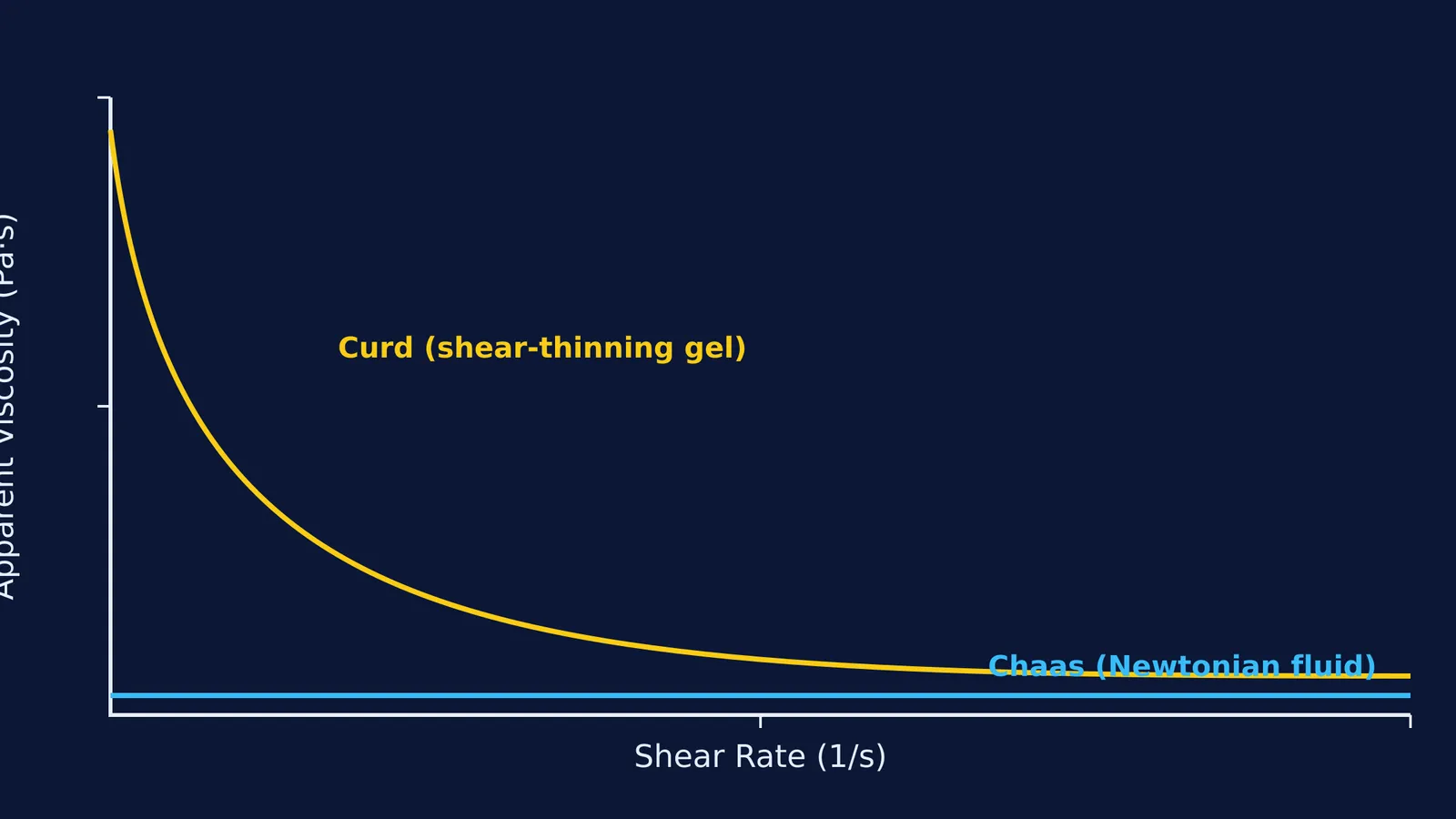
The traditional process of making chaas involves vigorous whisking or churning (manthana) using a wooden churner. This continuous, rotational action applies intense shear force to the solid curd. In fluid dynamics, curd is classified as a non-Newtonian, shear-thinning material. This means its internal resistance is not constant; its viscosity drops drastically when subjected to mechanical stress. The agitation physically shatters the interconnected protein scaffold, tearing the delicate casein chains into much smaller, isolated clusters.
Once the continuous network is destroyed, the fluid can no longer trap water effectively. The colloid rapidly shifts from a solid-like gel to a freely flowing liquid sol. Without an intact structural matrix, the fragmented protein clusters easily slide past one another, causing a massive, permanent drop in viscosity.
What role does fat play in curd?
Churning does more than just break proteins; it extracts fat through a mechanical process called phase inversion. In whole-milk curd, fat globules exist as microscopic droplets suspended within the water matrix. They act as physical "fillers" that reinforce the overall strength and stiffness of the gel. However, as the curd is continuously agitated, the protective milk fat globule membrane—a fragile envelope of phospholipids surrounding each droplet—ruptures under the strain.
The raw fat spills out, exposing its hydrophobic core. To escape the surrounding water, the free fat droplets stick together, clumping and coalescing into large, solid masses of butter. When this butter is skimmed off the top to leave traditional buttermilk, the remaining liquid loses a massive source of its structural volume.
The chaas left behind contains water, broken casein, and fragments of the ruptured fat membrane. These leftover membrane fragments act as natural emulsifiers, giving chaas its smooth mouthfeel despite the near-total loss of butterfat. If you are identifying these biological components in a laboratory, Tests for carbohydrates, fats and proteins in the chemistry lab outlines the standard reagents used.
Why does chaas flow like water?
Adding cold water during the churning process dilutes the mixture further. This increases the physical distance between the surviving protein clusters so they cannot easily collide and re-aggregate. Here is the step-by-step physical breakdown from milk to chaas:
Acidification: Bacteria lower milk's pH to 4.6, neutralizing casein proteins.
Gelation: Proteins aggregate into a 3D network, trapping fat and water to form thick curd.
Shearing: Churning applies mechanical force, shattering the rigid protein network into isolated clusters.
Phase inversion: Fat globule membranes rupture, allowing fat to coalesce into butter.
Separation: Butter is removed, leaving behind chaas—a thin, protein-fragmented liquid.
Understanding how structural changes alter physical properties is a recurring theme in physical chemistry. If you need to visualize how molecules arrange themselves in different states, the Fermi Simulation Lab offers interactive models that bring these microscopic interactions to life. The shift from a rigid protein structure to a free-flowing suspension is what ultimately leaves chaas refreshing, light, and perfectly pourable.


