

On this page
If you leave a slice of bread on the counter, it soon turns tough and crumbly. Most people assume the bread is simply drying out, losing its moisture to the air. But if you seal that same loaf in an airtight plastic bag, it still goes hard.
The real culprit behind stale bread is not evaporation, but a molecular transformation inside the bread crumb itself.
Why does bread go stale and hard?
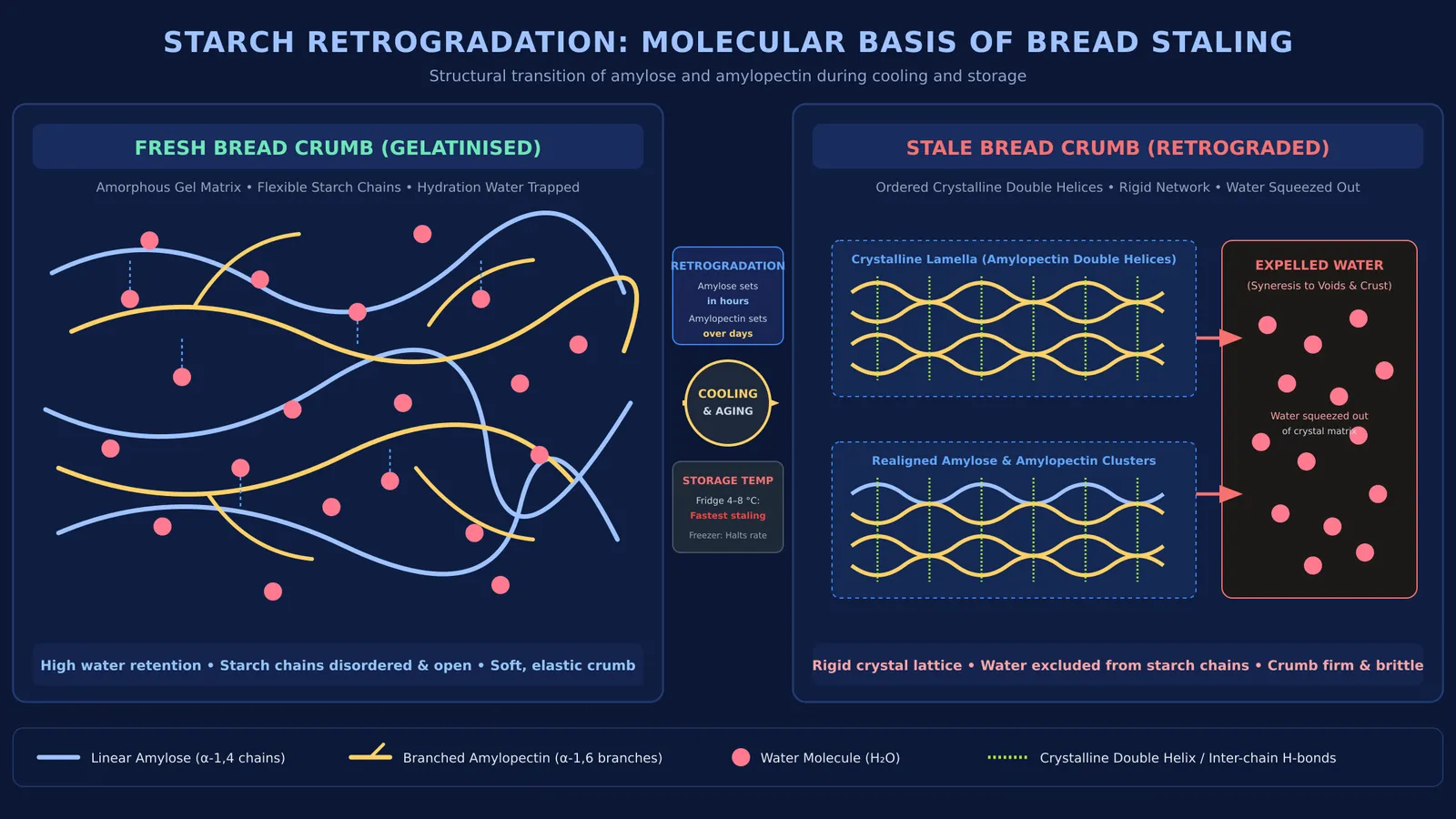
Bread is largely made of starch, a complex carbohydrate built from thousands of glucose units joined together. During baking, the heat and water cause the starch granules in the flour to swell and burst, a process called gelatinisation. The rigid starch molecules unfold, tangle together, and trap water, which gives fresh bread its soft, springy texture.
As soon as the bread leaves the oven and begins to cool, those starch molecules begin to realign into an ordered crystalline structure. As they pack closely together into rigid crystallites, they squeeze out the water previously trapped in the amorphous network. This recrystallisation is known as starch retrogradation.
Because the starch network becomes rigid, the bread feels hard and brittle. A 2021 study by Alpers et al. tested this by tracking loaves stored in airtight plastic bags at room temperature. Over ten days, the firmness of mixed-type sourdough bread increased to 330% of its initial value, while pan wheat bread increased to 390%. The moisture had not escaped the bag; the bread simply rearranged its internal structure.
How do amylose and amylopectin drive staling?
Starch contains two different types of polymer chains, and they retrograde at different speeds. This explains why bread changes texture rapidly on the first day, and then slowly over the next week.
Amylose is a straight, linear chain of glucose units linked by alpha-1,4-glycosidic bonds. Because its unbranched structure is simple and flexible, amylose molecules realign and crystallise quickly—often within hours of baking. This rapid setting gives the freshly baked loaf enough structural firmness so that you can slice it without the crumb collapsing.
Amylopectin is a large, highly branched molecule with alpha-1,6 branch points every 20 to 30 glucose units. Its complex, bulky architecture means its short outer branches take much longer to reassociate into double helices. Amylopectin crystallisation happens slowly over several days and is the primary driver of long-term crumb firming.
Understanding how these chains behave is a key part of organic chemistry. You can read more about the underlying structure of carbohydrates in our post on Walter Haworth and the ring structures of sugars.
Does the fridge make bread go stale faster?
It seems intuitive to put bread in the refrigerator to keep it fresh, just as you would with dairy or fresh produce. However, starch retrogradation is strongly temperature-dependent.
The recrystallisation of amylopectin occurs most rapidly at temperatures just above freezing, between 4 °C and 8 °C. Storing a loaf in the refrigerator accelerates starch retrogradation significantly compared to room-temperature storage. In the 2021 study by Alpers et al., refrigerated loaves kept in plastic bags reached 398% of their initial firmness for sourdough and 424% for pan wheat bread after ten days, firming much faster than those stored at room temperature. To halt staling completely, you must lower the temperature well below freezing, as a standard domestic freezer slows molecular mobility and stops crystal nucleation.
Can you reverse staling by heating bread?
Because staling is driven by physical recrystallisation rather than a permanent chemical breakdown, it can be temporarily reversed. When you heat a stale slice of bread above 60 °C in an oven or a toaster, the thermal energy disrupts the hydrogen bonds holding the amylopectin crystals together. The retrograded crystals melt, allowing the starch molecules to return to an amorphous state and reabsorb interstitial water, which temporarily restores the crumb's soft, springy texture.
However, this refreshed state is short-lived. Once the heated bread cools back to room temperature, the starch chains recrystallise even faster than during the original cooling phase, especially if some of the loaf's moisture was lost as steam during toasting.
When studying polymers in chemistry, it can be challenging to visualise how linear and branched chains differ in packing density and mobility. The Fermi Simulation Lab provides interactive simulations for the ideas that are easier to see than to read, letting you observe how polymer chains pack and interact. You can also explore how these same glucose building blocks behave in different tests in our guide to reducing and non-reducing sugars: why sucrose fails Tollens' test.


