

On this page
When you mix cyclohexene with bromine in carbon tetrachloride, the reddish-brown colour discharges instantly at room temperature. Bromine adds rapidly across the double bond via an exothermic electrophilic addition, as documented in OpenStax Organic Chemistry. With benzene, nothing happens. Despite having six pi electrons, benzene refuses to decolourise bromine water. To make it react, you must add a Lewis acid catalyst such as iron(III) bromide, producing bromobenzene and bubbling hydrogen bromide gas rather than an addition dibromide.
The contrast stems from aromaticity. As the IUPAC definition of aromaticity explains, benzene possesses a planar ring of six sp² hybridized carbons with delocalised pi electrons. As derived in Erich Hückel's 1931 quantum mechanical analysis, a planar ring with 4n + 2 pi electrons (where n = 1) achieves an exceptionally stable closed-shell electronic configuration known as the aromatic sextet. Ordinary alkenes undergo electrophilic addition to alkenes because converting a weak pi bond into two strong sigma bonds releases substantial enthalpy. In benzene, however, addition breaks the continuous cyclic conjugation that stabilizes the molecule.
What is the thermodynamic cost of breaking aromaticity?
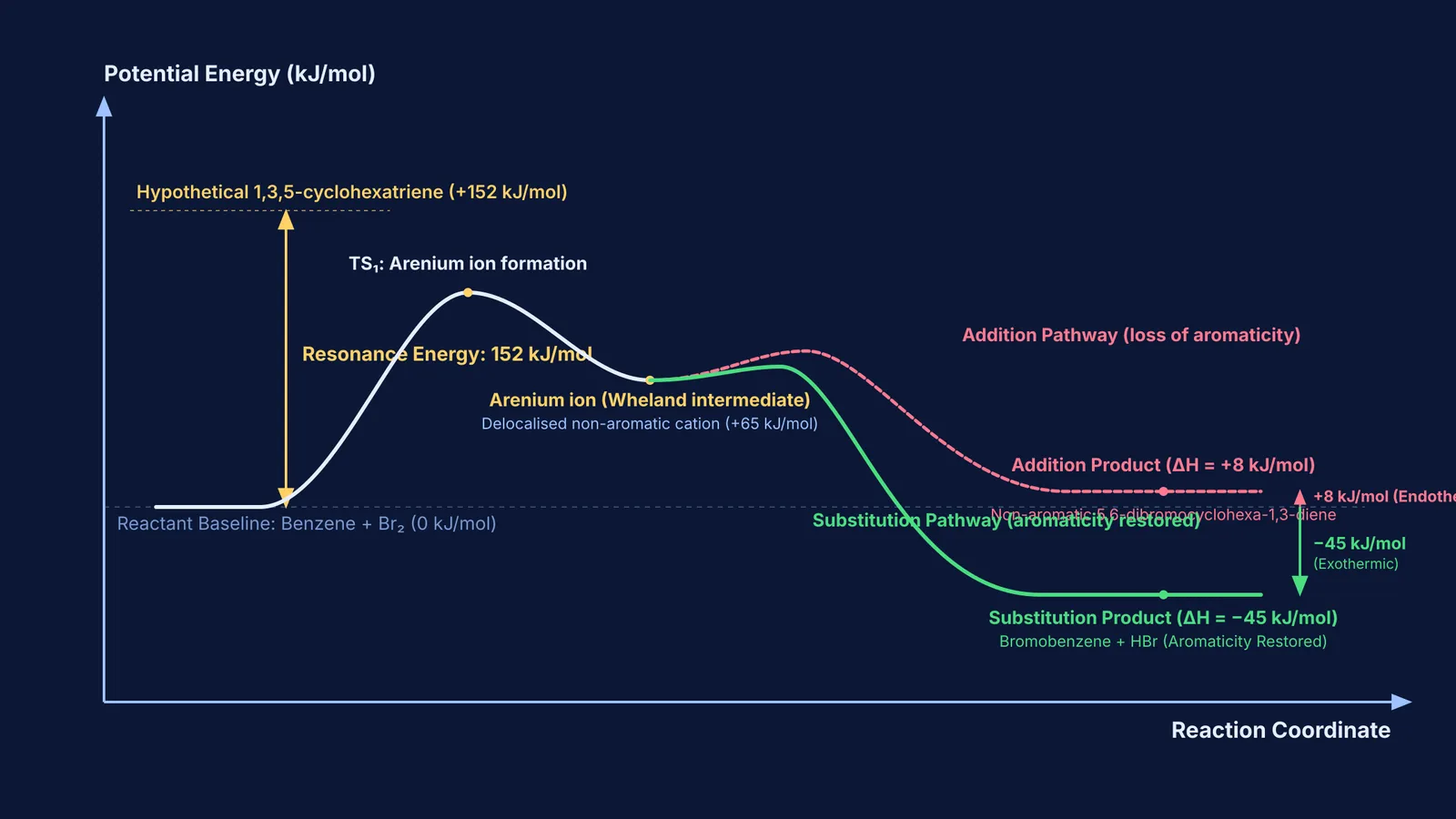
The stability of benzene is quantified by its resonance energy, defined by the IUPAC definition of resonance energy as the energy difference between the delocalised molecule and its most stable hypothetical localized structure. In their landmark study, Kistiakowsky and colleagues in 1936 measured the experimental enthalpy of hydrogenation of cyclohexene as −119.5 kJ/mol. If benzene were simply 1,3,5-cyclohexatriene with three isolated double bonds, hydrogenating all three would release −358.5 kJ/mol. Yet experimental hydrogenation of benzene releases only −208.1 kJ/mol, as catalogued in the NIST Chemistry WebBook. Benzene is 150.4 kJ/mol (approximately 152 kJ/mol, or 36 kcal/mol) lower in enthalpy than a hypothetical triene.
This 152 kJ/mol gap is the aromatic stabilization energy that any addition reaction must overcome. When two atoms add across one double bond, two adjacent ring carbons become sp³ hybridized. Breaking the uninterrupted cyclic overlap reduces the system to a non-aromatic 1,3-cyclohexadiene derivative. Reviewing the rules for ranking resonance structures shows why delocalisation across a complete ring creates stability far greater than open conjugated chains.
How does electrophilic aromatic substitution preserve the ring?
Benzene's pi cloud attracts electrophiles, but the reaction proceeds through a two-step sequence that favours substitution:
Generation of the electrophile: A Lewis acid catalyst generates a potent electrophile, such as Br⁺ from Br₂ and FeBr₃.
Attack on the pi cloud: Benzene donates two pi electrons to form a sigma bond with the electrophile. This yields the arenium ion (or Wheland intermediate), first modelled by George Wheland in 1942, where four pi electrons are delocalised over five carbons and one carbon is sp³ hybridized.
Rapid proton loss: Instead of a nucleophile attacking the carbocation, a weak base abstracts the proton from the sp³ carbon. Both C−H electrons return to the ring, restoring all six sp² carbons and regenerating the aromatic sextet.
If the intermediate underwent nucleophilic addition instead, it would form 5,6-dibromocyclohexa-1,3-diene, permanently sacrificing aromaticity. For students bridging gaps in reaction mechanisms, the Fermi Concept Library covers every concept in physics, chemistry, biology, mathematics and computing, each with its own lesson and its place in the map.
Why is addition endothermic while substitution is exothermic?
The difference between pathways is evident in their reaction energetics. As explained in OpenStax Organic Chemistry, electrophilic aromatic substitution is exergonic because the product retains aromatic stability, whereas hypothetical addition is endergonic because the ring's resonance stabilization is permanently lost. Standard gas-phase thermochemical data catalogued in the NIST Chemistry WebBook show that brominating benzene by substitution has an overall enthalpy change of ΔH° ≈ −45 kJ/mol (−10.8 kcal/mol). Breaking one aromatic C−H bond and one Br−Br bond is offset by forming a C−Br bond, an H−Br bond, and recovering the 152 kJ/mol resonance stabilisation.
By contrast, the 1,2-addition of bromine across benzene has an enthalpy change of ΔH ≈ +8 kJ/mol. Forming two C−Br bonds cannot compensate for the loss of 152 kJ/mol of aromatic resonance energy. Because addition is endothermic, any addition adduct rapidly reverts to the carbocation intermediate. Deprotonation drops into a deep thermodynamic well, making substitution irreversible under ordinary conditions.
When can benzene be forced to undergo addition?
Benzene can undergo addition only under severe conditions:
Free-radical chlorination: Under strong ultraviolet light, benzene adds chlorine radicals to form 1,2,3,4,5,6-hexachlorocyclohexane (lindane).
Catalytic hydrogenation: Over a nickel catalyst under high temperature and pressure, benzene hydrogenates to cyclohexane, releasing 208.1 kJ/mol of heat as catalogued in the NIST Chemistry WebBook.
Birch reduction: Sodium in liquid ammonia with an alcohol reduces benzene to non-conjugated cyclohexa-1,4-diene.
Under standard conditions, electrophilic aromatic substitution dominates. Directing groups and ring activation are covered in electrophilic substitution in benzene. To master organic mechanisms, the Fermi Problem Library has worked problems with a step-by-step solver that explains the reasoning rather than printing an answer.


