

On this page
When human fingers grip a pull-up bar, forearm muscles must continuously fire. The physiological cycle of muscle contraction and cross-bridge cycling consumes adenosine triphosphate (ATP), causing rapid fatigue. Bats, however, spend months hanging inverted without burning muscular energy, thanks to a mechanical ratchet inside their feet.
How do bat feet lock without muscle effort?
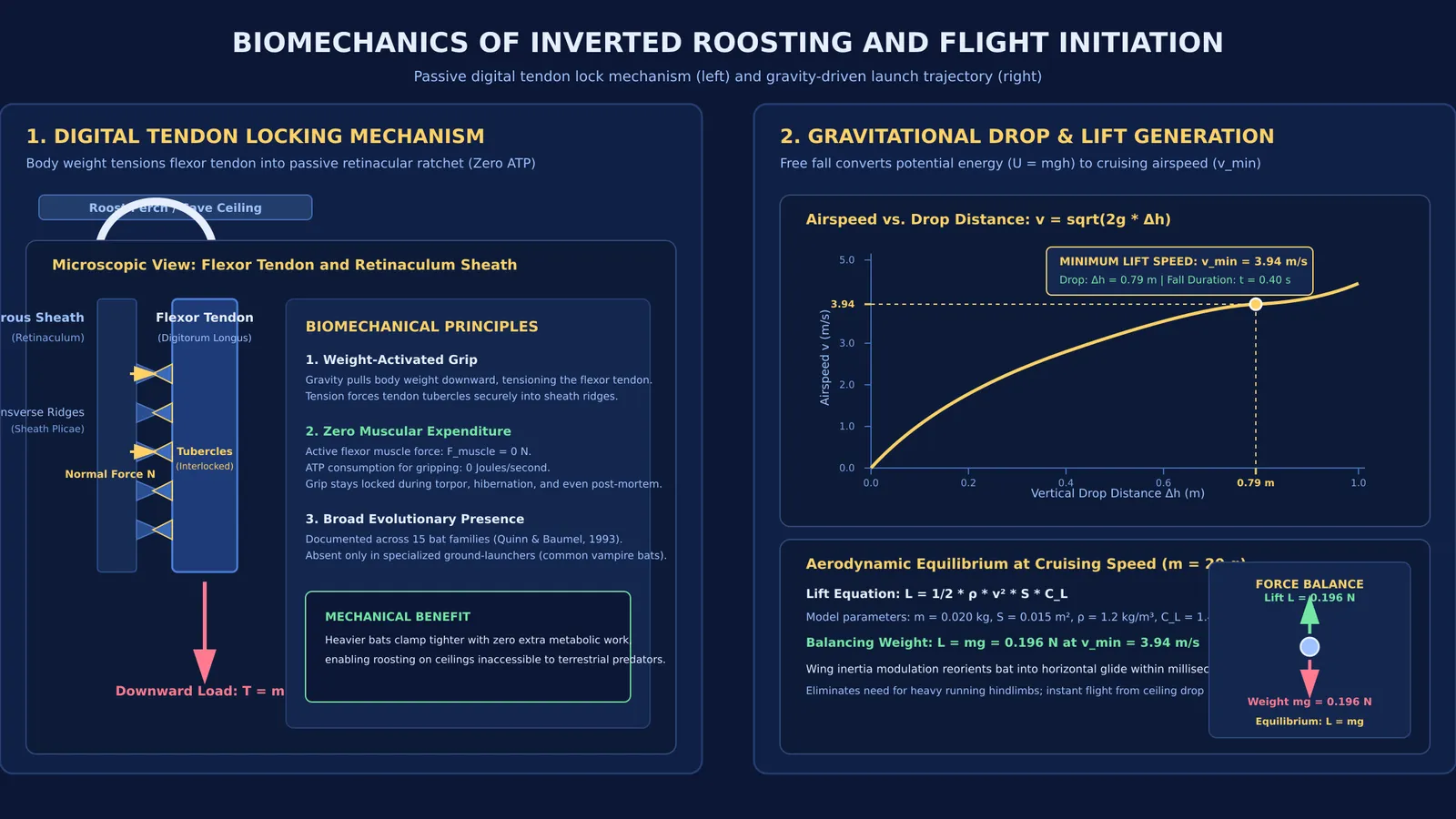
A hanging bat does not actively clench its toes. Instead, its grip relies on a passive digital tendon locking mechanism (TLM). Inside each toe, the flexor digitorum longus tendon runs through a fibrous sheath called the retinaculum.
In the Journal of Morphology, Thomas Quinn and Julian Baumel documented that across 15 chiropteran families, the underside of this tendon features microscopic tubercles that engage transverse ridges inside the fibrous sheath. William Schutt Jr. confirmed in Cells Tissues Organs that this passive digital ratchet prevents digits from extending, conserving muscular energy during roosting and hibernation. When a bat roosts, hanging body weight pulls the tendon taut, wedging the tubercles into the ridges and locking the claws shut.
Because gravity supplies the clamping force, active muscular effort drops to zero. A bat can enter prolonged torpor with minimal metabolic expenditure, or even die while roosting, and its grip remains locked to the ceiling.
Why can't bats take off from the ground like birds?
Most birds launch into flight with their hindlimbs, using strong leg extensor muscles to supply the overwhelming share of take-off velocity before their wings complete a downstroke. Bats cannot jump into the air this way due to three flight-related trade-offs:
Reduced leg bones: To minimize wing loading, bats evolved slender limb bones that cannot bear heavy ground-launch impacts.
Backward-rotated hindlimbs: A bat's hindlimbs are rotated outward and backward so the knees bend dorsally. This orientation supports flight membranes (the plagiopatagium and uropatagium) between the limbs, but prevents the legs from delivering an upward jump.
Ground wing strike: On flat ground, elongated finger bones strike the surface during downstrokes, preventing forward airspeed.
The exception proves the rule. Common vampire bats (*Desmodus rotundus*) can launch from the ground, but William Schutt and colleagues showed in the Journal of Experimental Biology that they push off with folded wings rather than legs. Their pectoral muscles generate peak vertical forces 9.5 times their body weight in roughly 30 milliseconds to reach 2.38 m/s. All other bats lack this forelimb spring.
Connecting skeletal angles to aerodynamic forces makes mechanics intuitive. The Fermi Simulation Lab provides interactive simulations for ideas that are easier to see than to read, allowing students to explore how launch speeds and force vectors shape flight trajectories.
How does dropping under gravity generate instant flight speed?
Hanging upside down turns gravity into a launch engine. To take off, a bat contracts its foot extensor muscles to disengage the tendon tubercles and drops into vertical motion under gravity. In free fall, gravitational potential energy (U = mgh) converts into kinetic energy (K = ½ mv²), accelerating downward at g = 9.8 m/s².
Kinematic work by Attila Bergou and colleagues in PLOS Biology showed that bats adjust the inertia of their muscular wings during the drop to roll into horizontal alignment within milliseconds. A worked example shows how quickly this drop generates aerodynamic lift (L = ½ ρ v² S C_L):
Consider a microbat with mass m = 0.020 kg (20 g), wing area S = 0.015 m², air density ρ = 1.2 kg/m³, and maximum lift coefficient C_L = 1.4.
Balancing weight (L = mg) requires minimum speed: v_min = √[(2mg) / (ρ S C_L)] = √[(2 × 0.020 × 9.8) / (1.2 × 0.015 × 1.4)] ≈ 3.94 m/s.
In free fall, the required vertical drop is: Δh = v_min² / (2g) = (3.94)² / (2 × 9.8) ≈ 0.79 m.
The fall time is: t = √(2Δh / g) = √(2 × 0.79 / 9.8) ≈ 0.40 s.
In less than 80 centimetres of drop and 0.4 seconds, the bat reaches cruising airspeed and glides away. Landing is equally controlled: Daniel Riskin and colleagues in the Journal of Experimental Biology showed cave bats execute gentle two-point landings with impact forces of only 0.8 body weights by stalling upward at the ceiling.
These dynamics also clarify how body orientation shifts the centre of gravity and centre of mass during flight transitions.
Why doesn't blood rush to a bat's head while hanging upside down?
When a tall mammal hangs inverted, a long column of blood exerts substantial hydrostatic pressure (ΔP = ρ g h) toward the brain, causing rapid venous pooling and facial congestion. Bats avoid this hydrostatic challenge through physical scaling and vascular adaptations:
Minimal hydrostatic height: Craig White and Roger Seymour demonstrated in Evolution that mammalian blood pressure scales directly with the vertical distance between heart and head. In a microbat measuring only several centimetres in length, the vertical distance from heart to brain is just 2 to 3 centimetres. The resulting hydrostatic pressure gradient is less than 5 mmHg—a tiny fraction of a human's column and easily managed by normal cerebral autoregulation.
Venous valves and active venomotion: One-way valves in cranial and wing veins prevent retrograde pooling. Furthermore, Ranjeet Dongaonkar and colleagues in the American Journal of Physiology showed that bat venules exhibit spontaneous rhythmic contractions, or venomotion, that actively pump venous blood back toward the heart against gravity.


