

On this page
Put a ripe banana in the fridge overnight and its skin comes out grey or almost black. Peel it, though, and the fruit inside is usually pale and firm. That gap is a neat lesson in how cells keep chemicals apart.
Why do bananas turn black in the fridge?
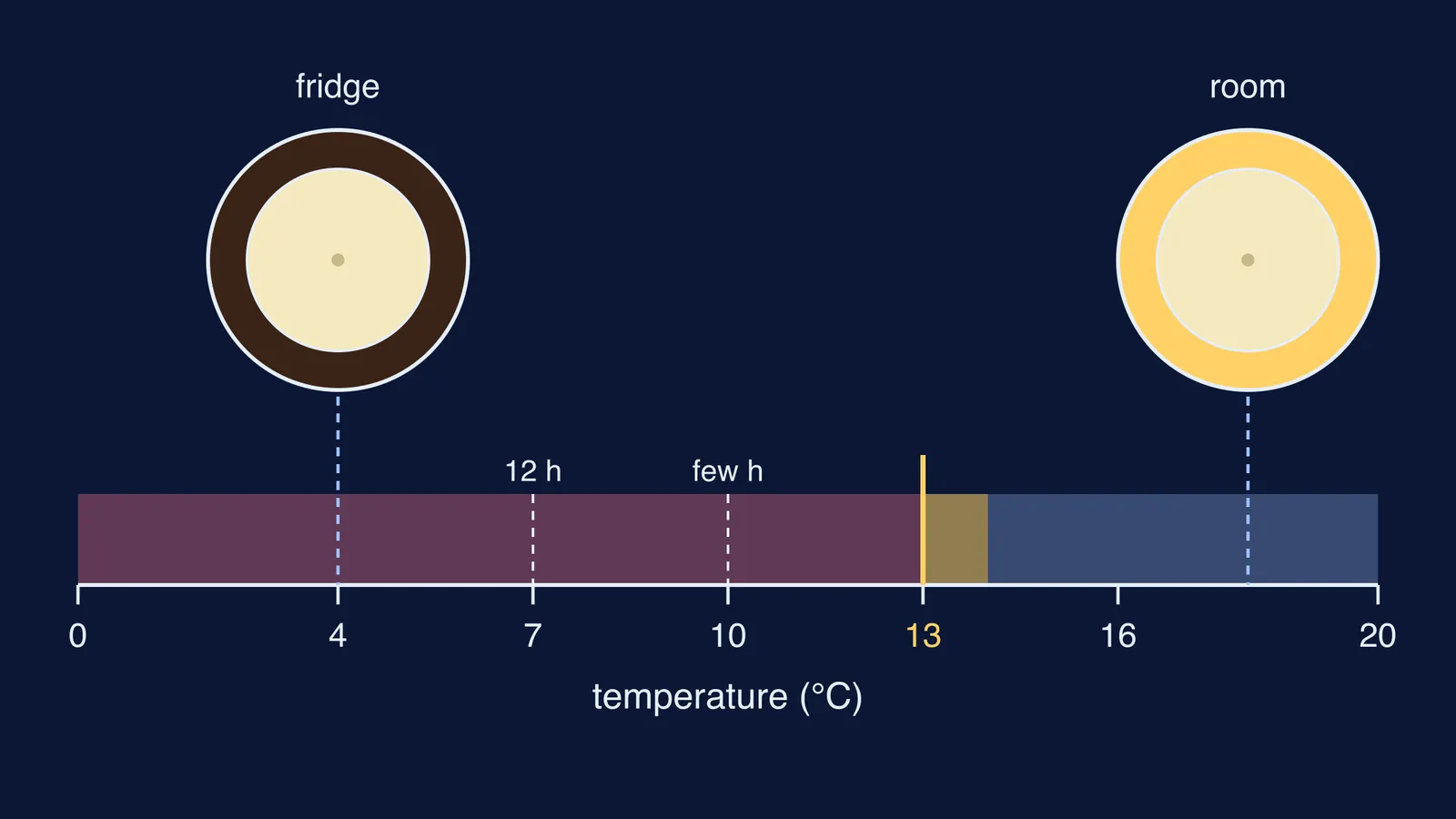
Bananas are a tropical fruit. The WFLO Commodity Storage Manual entry on bananas, reviewed by postharvest scientist Adel Kader of UC Davis, says bananas are chilling-sensitive and that temperatures below 13 °C should be avoided. A study in Frontiers in Plant Science draws the same line: banana fruit shows chilling injury below 13 °C.
Your fridge is far colder than that. The US Food and Drug Administration advises keeping a refrigerator at or below 4 °C, about nine degrees under the banana's limit.
The damage is called chilling injury. For green bananas being shipped, the WFLO manual says temperatures below 13 °C may cause it within 2 to 24 hours, depending on variety, ripeness and how cold it is. It adds that a few hours at 10 °C may dull the peel slightly, and 12 hours at 7 °C generally causes enough injury to affect whether the fruit can be sold. In the Frontiers study, bananas stored at 4 °C had a browning index above 80% after 6 days.
What happens inside the peel cells?
A plant cell is divided into compartments, each wrapped in a membrane. Two matter here.
Polyphenol oxidase (PPO) is an enzyme kept inside plastids, the same family of organelles as chloroplasts.
Phenolic compounds, the raw material PPO works on, are stored mainly in the vacuole.
A 2017 study in Frontiers in Plant Science describes this split and what happens when it is destroyed: the enzyme meets its substrates and oxidises them into quinones, which go on to form brown melanin pigments. It is the same chemistry that browns wounded plant tissue.
Cold is what breaks the walls. A 2023 study in Foods explains banana chilling injury using a low-temperature lipid phase transition in cell membranes: the fatty layer stiffens and stops working properly, so compartments leak. In that study, bananas kept at 6 °C showed a dip in PPO activity over the first two days, then a sharp rise. Enzyme, substrate and oxygen meet, and the peel browns.
Is a banana that went black in the fridge safe to eat?
Usually, yes. The WFLO manual describes chilling as mainly a peel injury in which certain cells are killed and then darken. A food-storage explainer on Eat or Toss, drawing on University of Florida postharvest professor Jeff Brecht, reports that the peel is more sensitive to cold than the ripe fruit beneath it.
A dark skin is not the same as rot. If the flesh is mushy, mouldy or smells sour, throw it out. The WFLO manual also notes that green bananas chill more easily than ripe ones, and a chilled ripe banana turns dull brown when it warms up and marks easily.
So where should you keep bananas?
The Eat or Toss explainer says a ripe banana can stay at its best for a couple of extra days in the fridge, though the peel darkens, while an unripe one should not go in at all because it will not ripen properly.
Green or green-tipped: keep it at room temperature so it can ripen.
Ripe, eating it soon: the counter is fine.
Ripe, needs to last a little longer: the fridge is acceptable. Judge it by its flesh, not its peel.
Try it: a two-banana experiment
This takes two days and makes a good short class project.
Take two bananas of the same ripeness from the same bunch.
Put one in the fridge and leave the other on the counter. Write down the time.
Photograph both at 12, 24 and 48 hours, in the same light.
At 48 hours, peel both and compare the skins and the flesh side by side.
Before you peel, write a prediction. Afterwards, explain what you saw using six words: membrane, vacuole, plastid, enzyme, phenolic, oxygen.
If you can explain the dark skin and pale flesh with those six words, you have understood compartmentation.
Membranes and enzymes are hard to picture from a textbook diagram alone. The Fermi Simulation Lab has interactive simulations for ideas that are easier to see than to read, and the Fermi Concept Library gives each concept in biology and chemistry its own lesson, so you can look up cell organelles or enzymes when the experiment raises a question.
Next time someone at home throws out a black banana straight from the fridge, peel it first.


