

On this page
We've all heard the kitchen wisdom: if you want a green banana to turn yellow in time for breakfast, put it in a brown paper bag. But why does this work? The answer lies in the chemistry of plant hormones.
Why do bananas ripen faster in a paper bag?
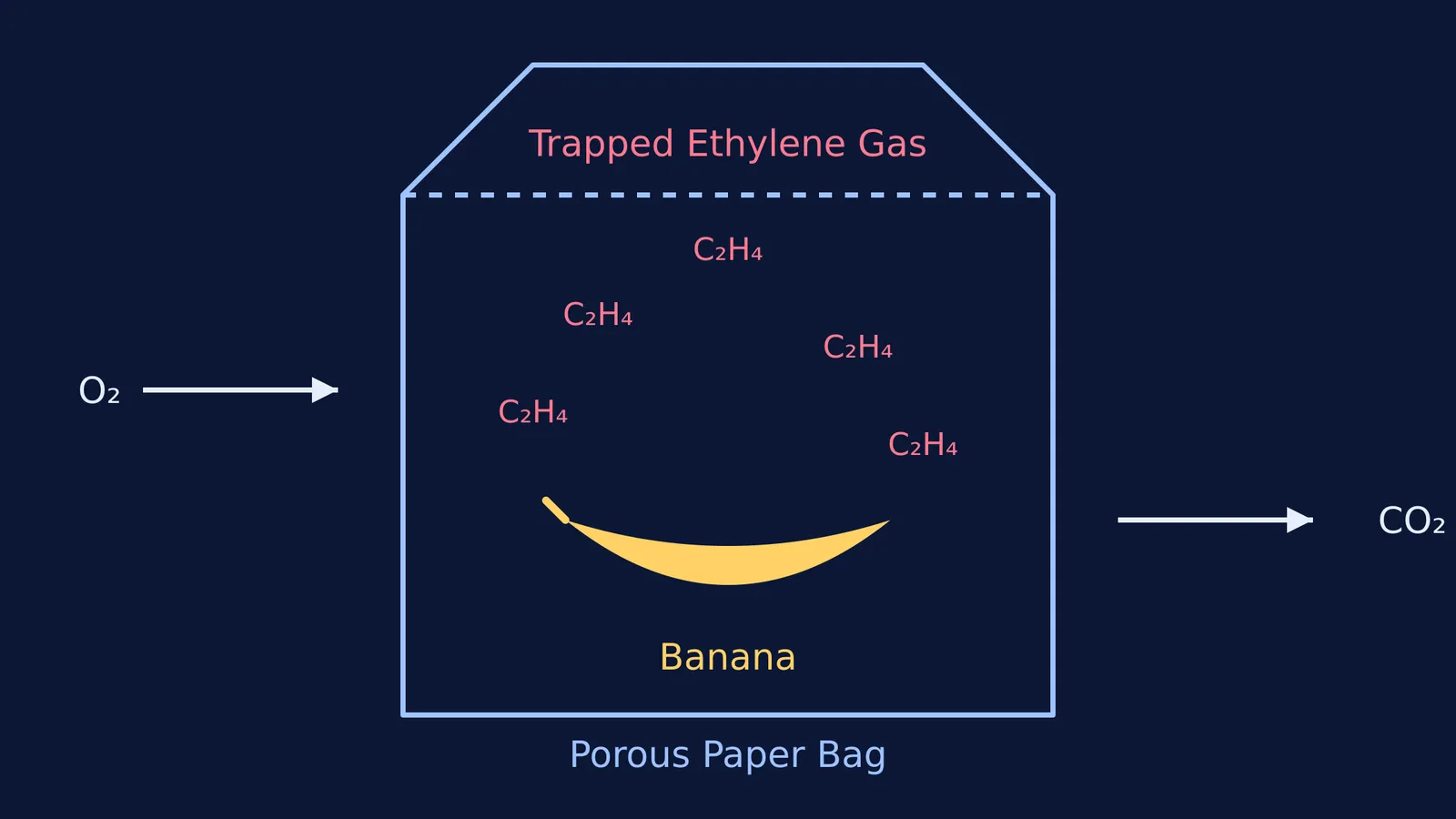
Bananas are classified as climacteric fruits, meaning they continue to ripen after they are harvested. To do this, they produce ethylene gas, a natural plant hormone that signals the fruit's cells to start the chemical changes of ripening. In the open air on a kitchen counter, this gas easily floats away. Covered fruit ripening bowls or bags are used to increase the concentration of ethylene and carbon dioxide gases around the fruit. The trapped accumulation of ethylene promotes and accelerates the ripening process.
What is ethylene gas and how does it work?
Ethylene is a colourless, flammable gas with the chemical formula C₂H₄ and is the simplest alkene. It acts as a powerful signalling molecule in biology. In Class 10 Science, students learn about "Control and Coordination," which introduces plant hormones—also known as phytohormones—like auxins, gibberellins, and cytokinins. While auxins are discussed in topics like Phototropism, geotropism and other tropic movements in Class 10, ethylene stands out because it regulates the ripening and flowering of many plants as a gas. Worldwide production of ethylene exceeded 225 million tonnes in 2022, making it an incredibly important chemical both in agriculture and industry, according to its production statistics.
When ethylene binds to receptors in the fruit's cells, it turns on genes that produce specific enzymes. Enzymes like polygalacturonase convert insoluble pectin into a soluble form, degrading the cell wall structure and making the fruit soft. Meanwhile, amylases break down the fruit's dense starch reserves into simple, water-soluble sugars like fructose and glucose. Finally, the green chlorophyll in the peel breaks down, revealing the bright yellow pigments underneath. (For more on how signalling works at the cellular level, see our guide on How hormones act: membrane receptors vs intracellular receptors.)
When studying these biochemical pathways, a textbook description can sometimes feel abstract. The Fermi Simulation Lab provides interactive simulations for the ideas that are easier to see than to read, helping students picture how gas molecules diffuse and trigger reactions.
Why not use a plastic bag?
If trapping the gas is the goal, you might wonder if a sealed plastic bag would work even better. The problem is that the ripening process requires oxygen. As the fruit breathes (cellular respiration), it consumes oxygen and releases carbon dioxide and moisture.
Paper is naturally porous. It allows oxygen to enter while letting excess moisture escape, maintaining an ideal environment for the enzymes to do their work. A sealed plastic bag traps too much moisture and locks out oxygen. Without oxygen, the banana's cells cannot respire properly, and the trapped moisture encourages mould growth, leading to rotting instead of ripening.
The home ripening framework
To perfectly ripen a banana for a lunchbox or a smoothie, follow this simple timeline:
Choose the bag: Use a clean, brown paper lunch bag. Avoid plastic or tightly sealed containers.
Add the fruit: Place 1 to 3 green bananas inside. For an overnight boost, add one fully ripe apple.
Fold and store: Fold the top of the bag over once or twice. Leave it on the kitchen counter at room temperature (around 20 °C); do not put the bag in the fridge, as cold temperatures halt the enzymes.
Check daily: Open the bag every 24 hours. Once the peel is yellow with a few brown speckles, remove the banana and eat it, or move it to the fridge to pause further softening.
By understanding the chemistry of ethylene, you can turn a slow biological process into a predictable kitchen experiment.


