

On this page
The ballpoint pen is a common staple of exams, homework and everyday writing. However, if you have ever tried to write on a wall or while lying in bed, you know the pen quickly runs dry. The culprit behind this annoying interruption is not a broken pen, but the simple physics of how ink flows.
How does gravity feed the ball?
A ballpoint pen dispenses highly viscous, oil-based ink by the rolling action of a tiny, hard sphere. This ball is usually made of tungsten carbide, a material chosen for its extreme hardness and durability over time (Wikipedia). As the ball rolls across your paper, it acts as a buffer between the outside air and the internal ink reservoir.
To keep writing smoothly, the back of the tungsten carbide ball must stay completely coated in ink. Standard pens rely entirely on gravity to pull the ink downward toward the ball. This is why you hold a pen pointing down when writing on a desk: the constant gravitational force feeds the heavy ink straight into the socket.
What causes the air gap?
Standard ballpoint ink is highly viscous, often behaving more like a thick paste containing 25% to 40% dye rather than a standard flowing liquid (Wikipedia). This extreme thickness is completely necessary to stop the pen from leaking out into your pocket and ruining your clothes.
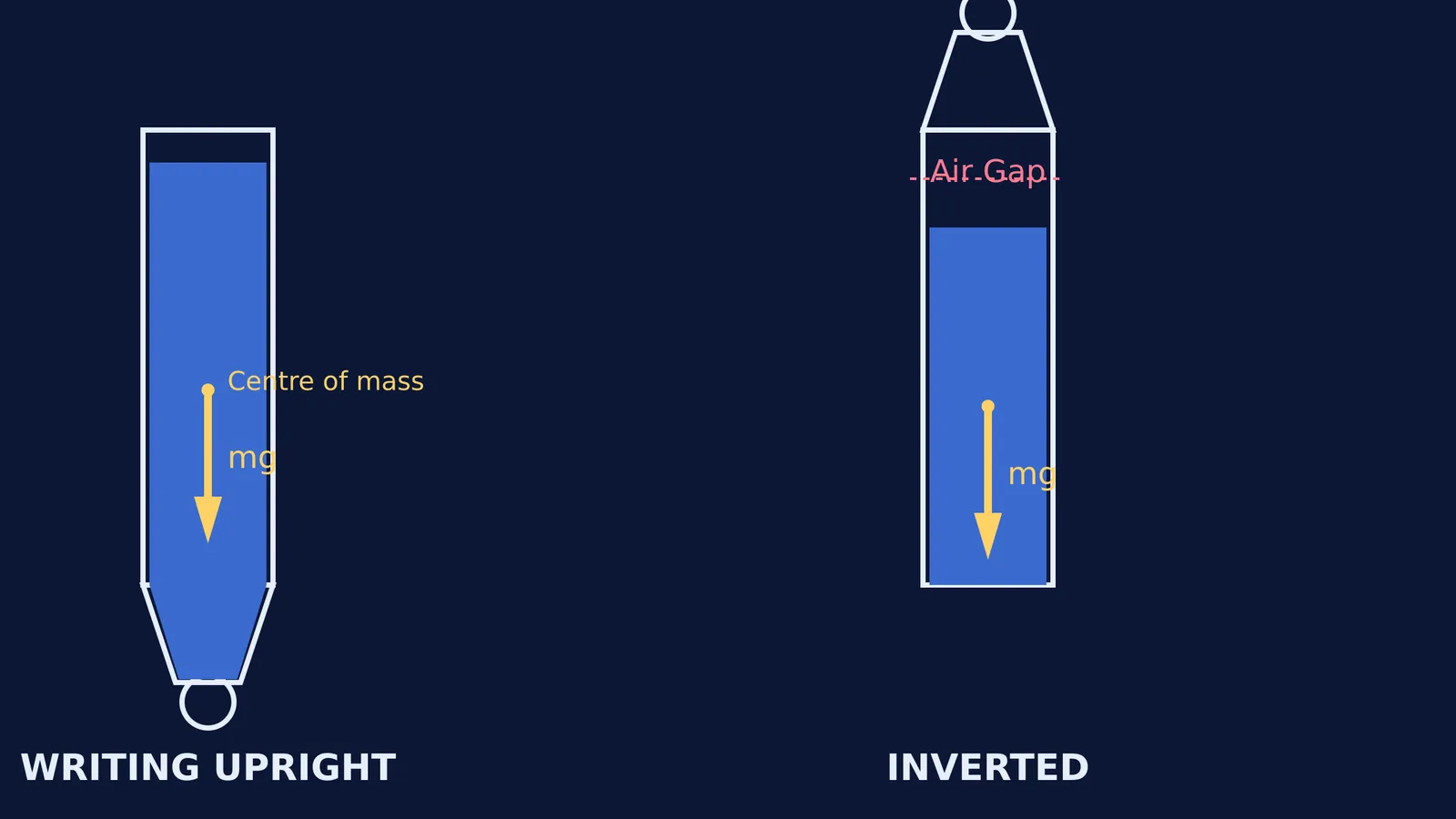
However, when you turn the pen upside down, that exact same gravitational force pulls the heavy ink column away from the tip. As the viscous ink slowly slides backward down the tube, an air gap forms between the ink column and the ball. Once the ball is spinning in the trapped air rather than in the ink, it cannot transfer any colour to the paper, and the pen instantly stops writing.
What about capillary action?
Standard pens also rely on capillary action—the ability of a liquid to flow into narrow spaces without the assistance of external forces. The tiny gap between the ball and the socket is extremely tight, acting as a functional capillary tube.
In true microgravity environments like the International Space Station, a standard ballpoint pen can actually write for a short time. This happens because the tiny capillary forces inside the narrow gap are slightly stronger than the absent gravitational pull (Wikipedia). However, back on Earth, the downward pull of gravity on the heavy ink column is much stronger than the tiny upward capillary force at the tip. When you write upside down, gravity wins the tug-of-war, pulling the ink down the barrel and starving the ball.
Why does the ball size matter?
The engineering of a ballpoint pen tip requires incredible precision from the manufacturer. The tiny steel or tungsten carbide ball is housed in a socket with a microscopically tight gap. If this gap is too tight, or if the ink is too thick, the pen will simply not flow at all. On the other hand, if the gap is too loose, the pen will leak or smear ink all over your notebook.
When you write upside down, the heavy ink must try to fight through this tight tolerance against the strong pull of gravity. The tight seal that prevents leaking also means air cannot easily swap places with the ink. As the ink slides back down the barrel, it creates a slight vacuum near the ball, further stopping any residual ink from flowing out to the paper.
Are gel pens different?
If you frequently use a gel pen, you might notice that it feels significantly different when writing. Gel pens use pigments suspended in a water-based gel made of specific biopolymers like xanthan gum, rather than a traditional oil-based paste (Wikipedia).
This specific gel ink has a high viscosity when resting undisturbed in the tube, but the physical stress of the rotating ball makes the ink thinner and runnier just at the point of contact on the paper. To stop this thinner ink from rapidly flowing backward when the pen is upside down, gel pens include an "ink follower"—a highly viscous, translucent plug sitting right at the back of the ink tube. While this plug perfectly prevents leaking, the gel pen will still eventually run dry if gravity pulls the main ink body away from the ball.
How do pressurized pens write upside down?
To write continuously at any angle, you need a steady force that is significantly stronger than gravity to feed the ink. The Fisher Space Pen, originally patented by Paul C. Fisher in 1966 under US Patent 3,285,228, solved this exact problem by fully sealing the ink cartridge and pressurising it (Wikipedia).
The Space Pen uses compressed nitrogen gas at 310 kPa (nearly 3.1 atmospheres) to maintain pressure. A sliding float sits between the pressurised nitrogen gas and the ink column. This means the compressed gas constantly pushes the ink toward the ball with a strong force, regardless of the pen's orientation or the presence of Earth's gravity.
When studying fluid dynamics, visualising how viscosity, pressure and gravity interact can be tricky. The Simulation Lab offers interactive simulations for ideas that are easier to see than to read, such as how changing these variables affects fluid flow.
Understanding these fluid forces can also clarify other physical systems where pressure and liquids interact. For example, similar principles apply to Pascal's law in hydraulic machines, where pressure is transmitted through an enclosed fluid, and to the technique of measuring unknown densities using two immiscible liquids in a manometer.


