

On this page
When you cry on Earth, gravity pulls the liquid down your cheeks. In the microgravity environment of the International Space Station, things happen differently. Instead of streaming down your face, tears pool together exactly where they are produced. Because there is no downward force to pull them away, they simply accumulate into a growing sphere of liquid. The visual result is striking, but it also demonstrates fundamental physical principles that normally go unnoticed.
Why can astronauts not cry normally in space?
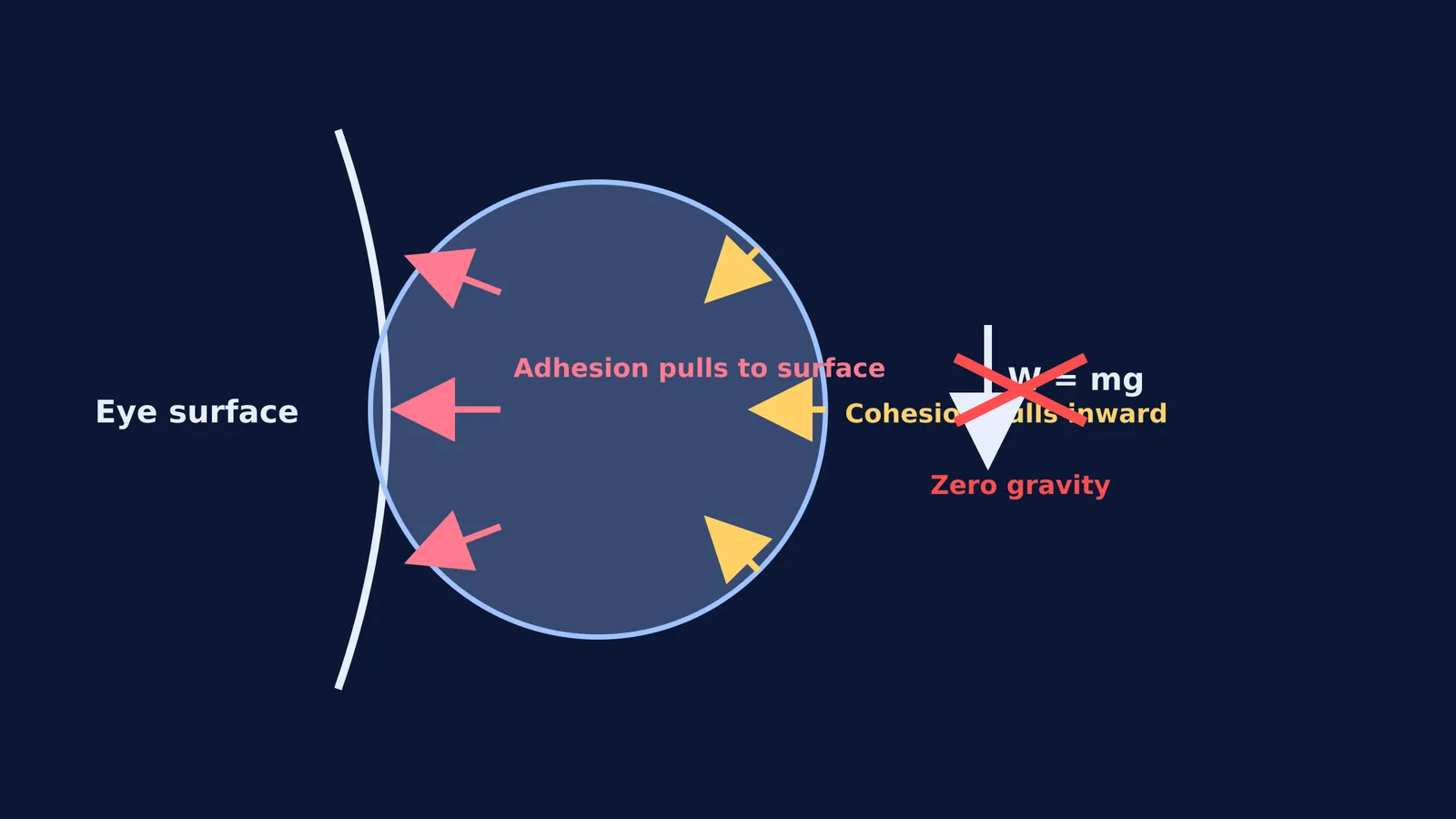
On Earth, the weight of the fluid quickly overcomes the forces holding a tear to the eye, causing the drop to roll down your cheek. Gravity is the dominant force acting on liquids in our everyday lives. In space, gravity's influence is effectively zero. This lack of weight allows two other molecular forces to run the show.
The first is cohesion: water molecules are highly attracted to one another. The second is adhesion: the liquid clings to the surface of the skin and the eyeball. Without a downward pull, these forces combine to stick the tear to your face, making it impossible to shed a tear normally. As the tear glands continue to produce fluid, the tear simply grows in volume, forming a wobbly, gelatinous dome of saltwater.
How does surface tension take over?
Surface tension is the cohesive force that minimises a liquid's surface area, pulling it into a spherical shape. This happens because the molecules at the surface of the liquid are pulled inward by the molecules below them. Pure water has a high surface tension. However, human tears are a complex mixture of water, oils, and proteins that act as surfactants.
These natural surfactants lower the surface tension of human tear fluid. On Earth, this lower surface tension is crucial. It helps the tear film spread evenly across the eye to keep it lubricated, rather than beading up like water on a freshly waxed car. In space, however, it means the blob of tears clings stubbornly across the eyelid instead of breaking off. If you read about Agnes Pockels and the kitchen trough that measured surface films, you will recognise how thin films of surfactants drastically change how fluids behave.
What happens if you cry during a spacewalk?
If an astronaut keeps crying, the ball of liquid just gets larger. Because of the adhesive properties of the fluid, it tends to track along the skin. Eventually, it can cross the bridge of the nose and cover the other eye, acting like a thick, distorted liquid lens that blurs vision entirely.
This is a serious safety hazard, particularly when astronauts are working outside the spacecraft in the vacuum of space. During a 2001 spacewalk (Space.com), Canadian astronaut Chris Hadfield was temporarily blinded when an anti-fog solution irritated his left eye. The resulting tears formed a large ball of liquid that eventually migrated across his nose and covered both eyes. Because he was sealed in a pressurised spacesuit, he could not reach in to wipe the tears away. He had to vent oxygen from his suit to help the water evaporate so he could see his surroundings again. The incident highlighted just how dangerous a simple fluid problem can become when gravity is removed from the equation.
Checklist: Solving microgravity fluid problems
When tackling physics problems in a zero-g environment, keep these four rules in mind:
Set g to zero: Weight (W = mg) disappears from your free-body diagram. This is the same principle you use when calculating the period of SHM through a tunnel across the Earth at the planet's exact centre.
Look for surface tension: Without gravity, the surface energy dominates. Fluids will pull themselves into spheres to minimise their surface area.
Check adhesion: The fluid will stick to any surface it touches if the contact angle is less than 90°.
Conservation of mass: The volume of the fluid remains constant. If tears are added, the radius of the spherical blob increases according to V = 4/3 πr³.
Visualising fluid dynamics and forces like surface tension without gravity can be difficult if you only ever read equations on a page. The Fermi Simulation Lab provides interactive simulations for the ideas that are easier to see than to read. By running a simulation yourself, you can see exactly how the physics plays out in orbit and better grasp why seemingly weak intermolecular forces suddenly take charge.


