

On this page
Have you ever watched a trail of ants marching across a pavement and wondered how they know exactly where to go? There is no leader directing traffic and no map. Instead, the colony solves a complex geometry problem using nothing but chemistry and time.
The secret to this behaviour is a chemical feedback loop. When you understand how ants optimise their routes, you also gain a surprisingly accurate model for how human learning works.
Why do ants walk in a straight line?
Ants communicate using volatile chemicals called pheromones. When a scout ant finds food, it presses its abdomen to the ground on the way back to the nest, leaving a scent trail. Other ants detect this with their antennae and follow it to the food source.
If there is only one path, they follow it. But in nature, there are always obstacles.
How does the shortest path win?
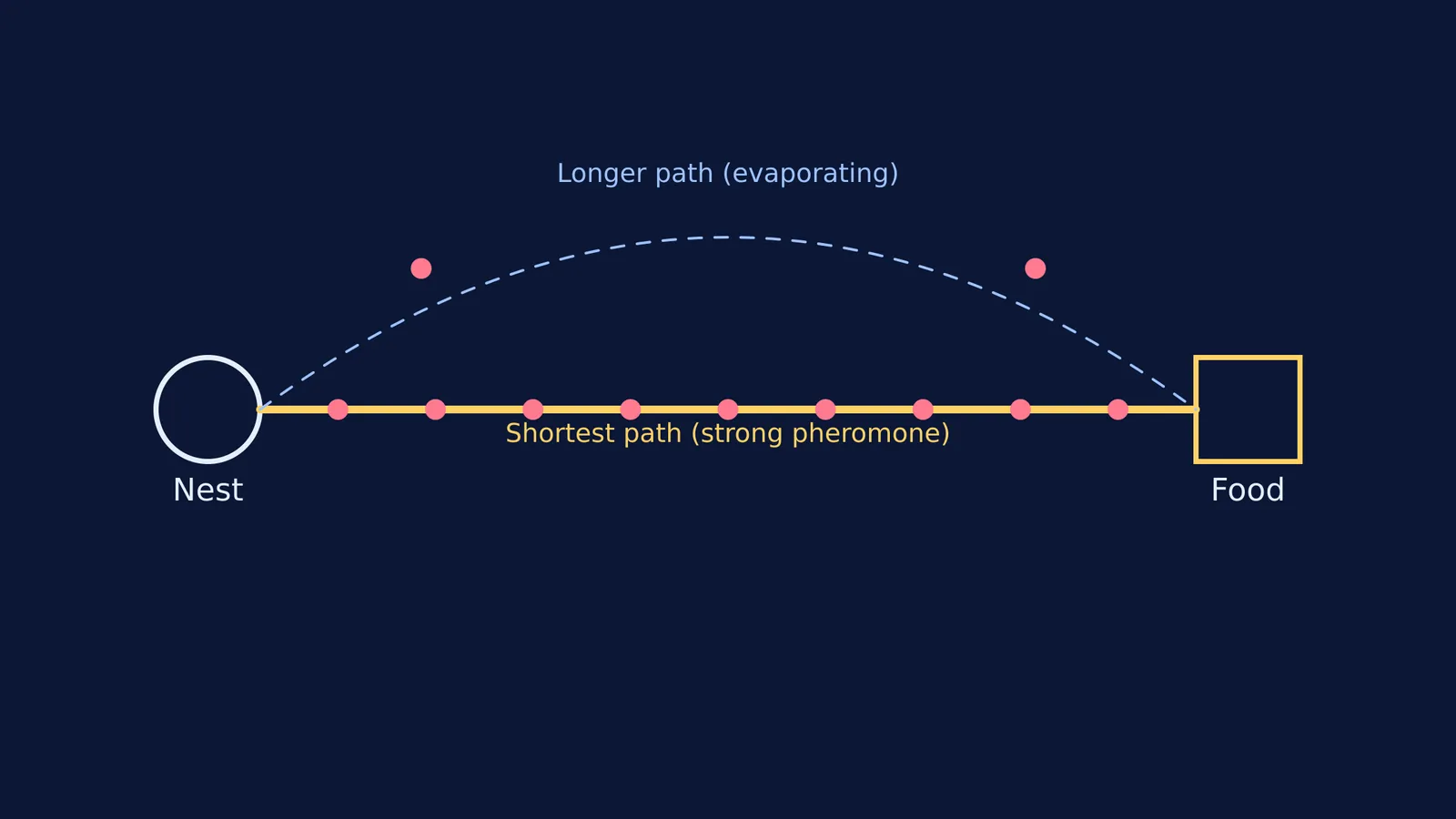
In 1992, researchers Beckers, Deneubourg, and Goss demonstrated how ants optimise their paths in the "double bridge" experiment https://doi.org/10.1016/s0022-5193(05)80686-180686-1). When ants are given a choice between a short branch and a long branch to reach food, they initially choose randomly. However, an ant taking the shorter route completes its round trip faster.
Because the trip takes less time, pheromone is deposited more frequently on the short path. As the scent grows stronger, it attracts more ants, which in turn lay down even more pheromones. Meanwhile, the scent on the longer path evaporates. The mean lifetime of the *Lasius niger* trail pheromone is approximately 47 minutes, meaning neglected paths vanish quickly https://doi.org/10.1016/s0022-5193(05)80686-180686-1). This positive feedback loop concentrates all traffic onto the shortest, straightest possible line between the nest and the food.
Why is active learning like an ant colony?
This biological reinforcement is an elegant analogy for how the human brain learns. When you encounter a new concept or try to solve a problem, your brain fires electrical signals along neural pathways.
These pathways are insulated by a fatty substance called myelin, which acts much like an ant's pheromone trail. The more frequently a specific neural circuit fires, the more myelin wraps around the axon. This insulation can speed up electrical signals by up to 300 times, making recall faster and more reliable https://www.technologynetworks.com/neuroscience/articles/myelin-and-myelination-what-is-it-and-why-do-we-need-it-359966.
Just as a neglected ant trail evaporates, a neural pathway that is not used will weaken. This is why reading a textbook chapter once (a single trip) is rarely enough to remember it. You need the repeated, successful trips of active recall to build a strong trail in your mind.
A landmark 2014 meta-analysis by Freeman and colleagues analysed 225 studies of STEM education and found that active learning dramatically outperforms passive listening https://doi.org/10.1073/pnas.1319030111. Students in traditional lecture courses were 1.5 times more likely to fail than those in classes using active learning. To read more about how doing the work shifts outcomes, see What the 2014 Freeman active learning meta-analysis found.
Active learning works because it forces the brain to repeatedly fire and myelinate the correct circuits, rather than just passively receiving information. Nobel laureate Carl Wieman: why a Nobel physicist moved beyond the lecture has extensively documented how deliberate, active practice transforms student performance.
To see how emergent, self-organising behaviours like this work in biology and physics, you can explore the Fermi Simulation Lab, which features interactive simulations for the ideas that are easier to see than to read.
How can you build strong trails for exams?
If you want to study as efficiently as a colony of ants, you need to structure your sessions to reinforce the right paths.
Scout the route first: When learning a new topic, do a quick pass of the material. Do not worry about memorising everything on the first trip; just establish the general direction.
Forage for yourself: Close the book and try to solve a problem from scratch. If you are stuck on a problem and trying to build that initial pathway, the Fermi Problem Library has worked problems with a step-by-step solver that explains the reasoning rather than printing an answer.
Reinforce the shortest path: When you find a successful method, practice it repeatedly. Correcting your mistakes ensures your brain myelinates the correct logic, not the errors.
Do not let the trail evaporate: Space out your revision. Returning to a topic a day, a week, and a month later acts like a fresh deposit of pheromones, keeping the neural pathway strong for your exams.


