

On this page
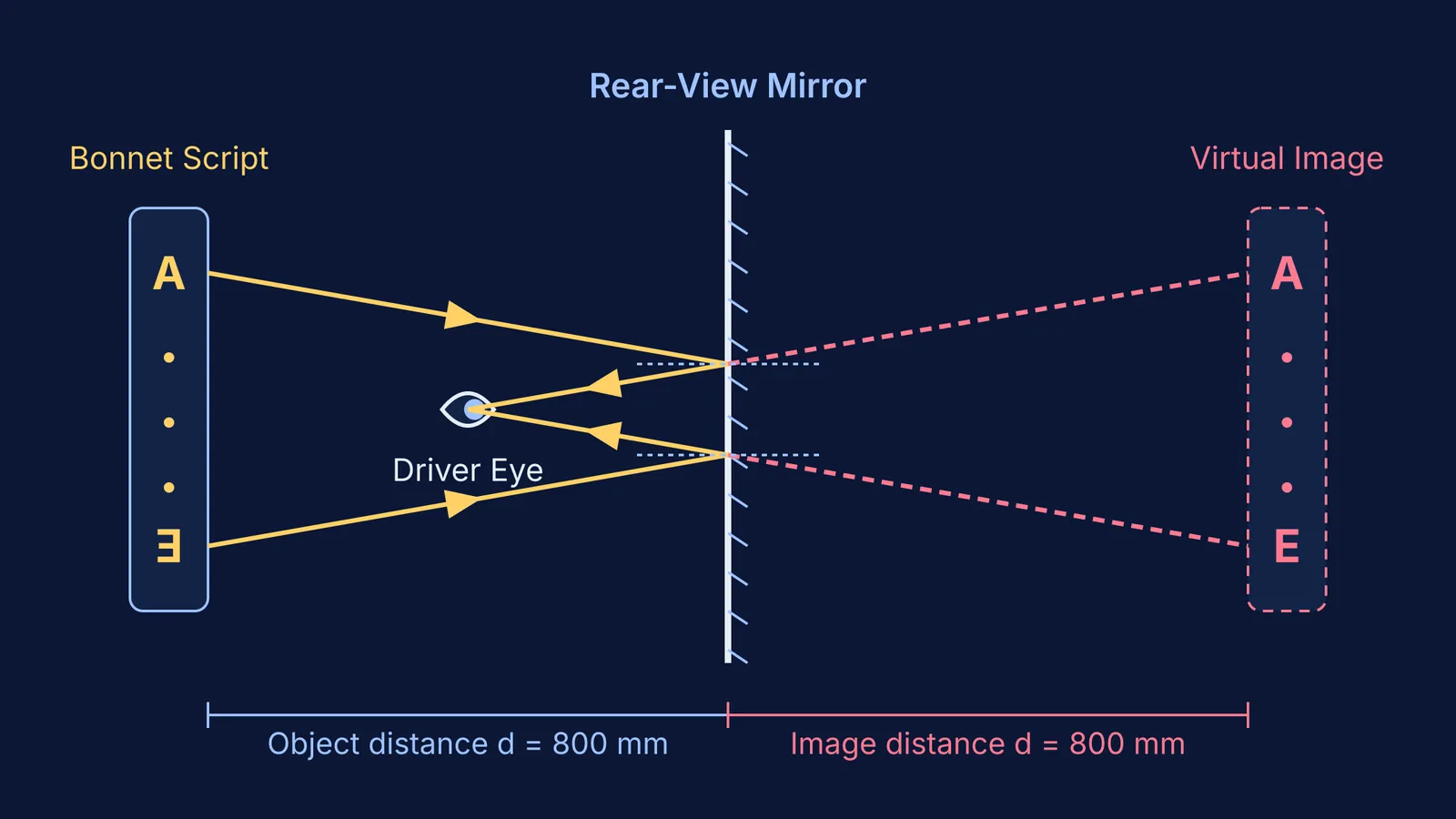
When you look at the front hood of an emergency vehicle, the word appears as "ƎƆИA⅃UᙠMA". This reversed lettering is an optical design choice based on the law of reflection. In India, the Ministry of Road Transport and Highways mandates this layout under AIS-125 (Part 1), the National Ambulance Code formulated by the Automotive Research Association of India. The code requires the front word to be displayed in mirror-image format with letters at least 100 mm tall using retro-reflective material.
When a motorist travels ahead of an ambulance, they monitor following traffic through a rear-view mirror. Optical reflection reverses the perceived order of shapes across the mirror normal. Because the ambulance script is already inverted on the bonnet, the mirror's reflection reverses it a second time, presenting the word "AMBULANCE" in standard left-to-right order. Section 194E of the Motor Vehicles Act prescribes a fine of ₹10,000 for failing to draw aside for emergency vehicles, making quick recognition vital on crowded roadways.
Does a mirror flip left-to-right or front-to-back?
Introductory textbooks often describe reflection as swapping left and right, but the physical reality is different. A flat mirror reflects every incident light ray such that the angle of reflection equals the angle of incidence. If we place a mirror in the xy-plane at z = 0, a source point at coordinates (x, y, z) produces a virtual image at (x, y, -z). The x and y coordinates do not change sign. The mirror reverses only the z-axis, which is the depth direction normal to the reflecting surface.
The apparent "left-right swap" is a psychological projection rather than an optical transformation. As psychologist Yohtaro Takano demonstrated in Psychonomic Bulletin & Review, human observers mentally rotate their bodily coordinates around a vertical axis by 180° to align with their reflection. Further analysis by Michael C. Corballis in Psychonomic Bulletin & Review showed that our bilateral symmetry leads us to perceive this depth inversion as a horizontal flip. If you hold a printed card toward a mirror, you must turn it around its vertical edge to face the glass, and that mechanical turning is what inverts the text.
To help students build intuition for how ray paths reflect in three dimensions, the Fermi Simulation Lab provides interactive simulations for the ideas that are easier to see than to read.
Why do vehicles use convex mirrors instead of flat glass?
While drivers rely on plane mirrors for domestic grooming—governed by principles like the minimum mirror height to see your full image—automobiles rely primarily on convex mirrors for rear-viewing. A convex mirror curves outward, diverging reflected rays. This curvature offers two distinct advantages for road safety:
It produces a virtual, erect, and diminished image for all object distances, ensuring the ambulance never appears inverted upside-down.
It provides a wider field of view than a flat mirror of the same aperture, reducing blind spots across adjacent lanes.
Convex mirrors preserve front-to-back reversal along each surface normal. The driver still observes the pre-inverted "ƎƆИA⅃UᙠMA" converted back into readable English text. Unlike concave mirror image positions, which invert images upside-down outside the focal point, convex surfaces keep images upright at every distance.
What letters stay unchanged under lateral inversion?
In optics curricula outlined by the Central Board of Secondary Education, questions frequently evaluate which alphabet characters exhibit lateral inversion. The apparent change depends on the letter's symmetry relative to a vertical line of reflection:
Symmetrical capital letters: 11 English letters possess vertical bilateral symmetry and remain identical in their mirror images: A, H, I, M, O, T, U, V, W, X, and Y.
Asymmetrical capital letters: 15 English letters lack vertical symmetry and clearly reverse: B, C, D, E, F, G, J, K, L, N, P, Q, R, S, and Z.
In AMBULANCE, the letters A, M, and U are vertically symmetrical, while B, L, N, C, and E are asymmetrical. Even if all letters in a word were symmetrical—such as in "MAX"—the letters would still appear in reversed reading order unless the whole sequence is printed backwards. Examining how ray angles change under surface rotation connects directly to rotating a plane mirror by θ, where rotating the boundary shifts the reflected beam by 2θ.
How should students solve lateral inversion questions?
Questions on lateral inversion frequently appear in the Central Board of Secondary Education Class 10 board examinations and competitive physics tests. When solving these problems on paper, follow this three-step verification method:
Step 1: Trace the surface normal. Determine the orientation of the reflecting plane and reverse only the coordinate axis perpendicular to that plane.
Step 2: Invert the letter sequence. Reverse the sequence of letters from right to left before checking individual glyph shapes.
Step 3: Flip asymmetric glyphs individually. Test each letter against a vertical line of symmetry; leave symmetric glyphs intact and flip asymmetric ones across their vertical centerline.
When revising ray optics and mirror formulas, the Fermi Problem Library provides worked problems with a step-by-step solver that explains the reasoning rather than printing an answer.


