

On this page
Look into the bowl of a shiny soup spoon, and you will see your face staring back upside down. Turn the spoon over, and you are suddenly the right way up, but strangely stretched.
This kitchen drawer experiment is a classic introduction to optics, demonstrating exactly how spherical mirrors manipulate light.
Why does a spoon show your face upside down?
The inner surface of a spoon acts as a concave mirror. A concave mirror curves inwards like the inside of a sphere, causing parallel rays of light to converge at a single point called the principal focus.
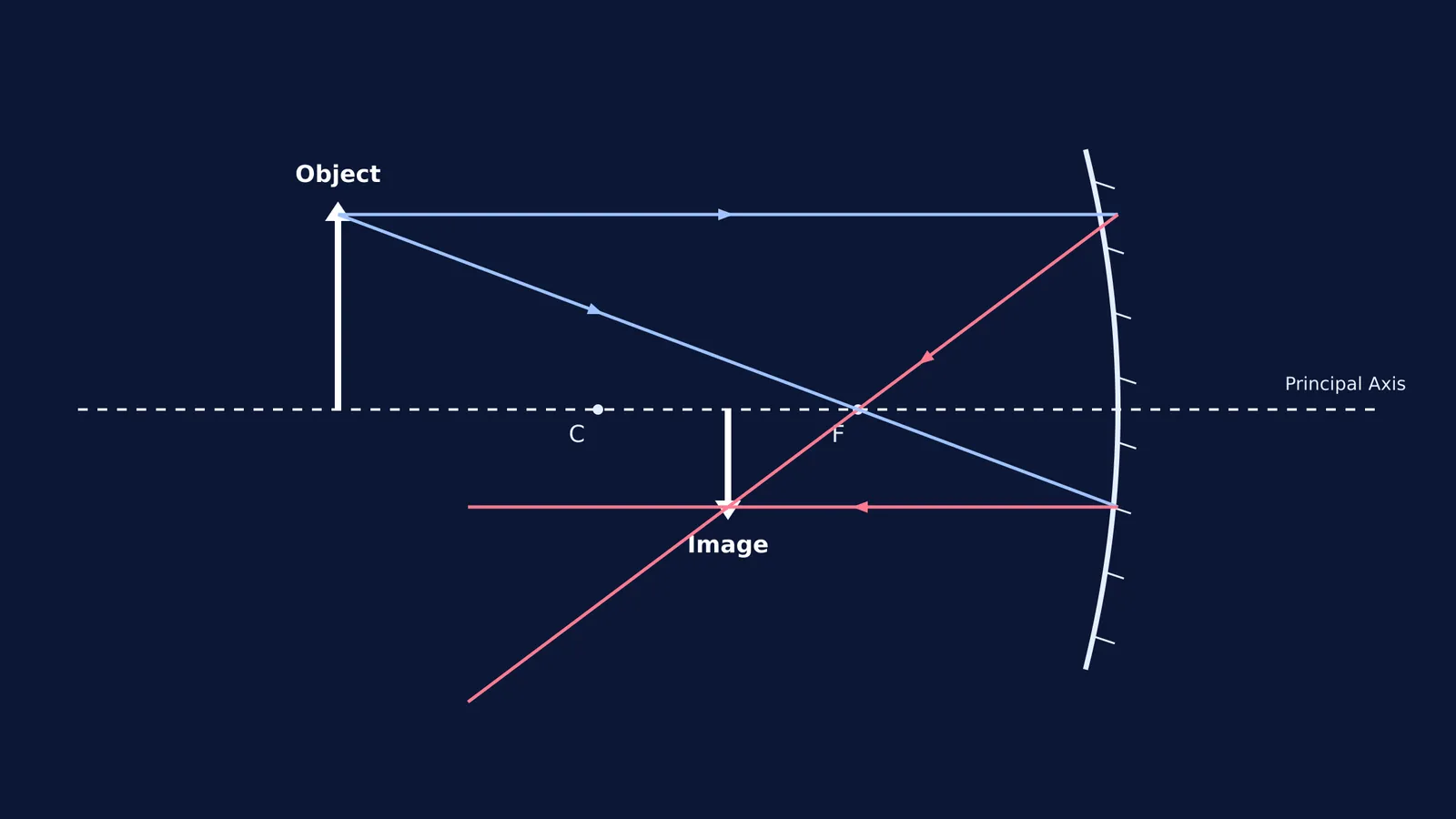
When you look into any spherical mirror, the type of image you see depends entirely on where you stand compared to that focal point. According to the rules of curved mirrors, a concave mirror forms a real, inverted image whenever the object is placed beyond its focus.
Because a spoon is a deeply curved mirror, its focal length is very short. When you hold a spoon comfortably to look at yourself, your face is at an arm's length away. This means you are standing well beyond the focal point and even beyond the mirror's centre of curvature.
As light travels from your face to the spoon, the top and bottom rays reflect off the curved surface at different angles. These reflected rays are angled inwards so sharply that they cross over each other before they reach your eyes. The light from your chin reflects upwards, and the light from your forehead reflects downwards. Because the rays cross, the image flips upside down.
What happens when you bring the spoon very close?
If you hold the spoon at arm's length and slowly bring it closer to your face, the image will remain upside down and gradually grow larger. It stays inverted until you cross a critical optical boundary: the focal point.
If you can get your eye extremely close to the spoon's surface—closer than its short focal length—you are now standing between the mirror and its principal focus. At this tiny distance, the physics of the reflection changes completely. The reflected light rays no longer converge and cross; instead, they diverge outwards as they leave the mirror.
Your brain assumes that light always travels in straight lines, so your eye traces these diverging rays backwards, creating an apparent image situated behind the surface of the spoon.
This new image is virtual, erect (upright), and magnified. You use this exact optical principle when looking closely into a shaving mirror or a makeup mirror. These are also concave mirrors, but they are manufactured with a very gentle curve to create a long focal length. As long as you stand within that focal length, you see a helpful, enlarged, upright image of your face.
If you are having trouble picturing how light rays cross or diverge to form these different images, the Fermi Simulation Lab lets you drag an object back and forth in front of a curved mirror and watch the rays redraw themselves in real time.
How does the back of the spoon work?
When you flip the spoon over, you are looking at its outer, bulging surface. This side acts as a convex mirror.
Unlike a concave mirror which gathers light, a convex mirror diverges light rays outwards, scattering them. Because the reflected rays always spread apart, they can never cross to form a real image. A convex mirror always forms a virtual, erect, and diminished (smaller) image, regardless of how far away the object is.
This is why your reflection on the back of a spoon is always the right way up, but you look miniature. Because the image is compressed, the mirror can pack a much wider view of the room into the same surface area. This property gives convex mirrors an exceptional field of view, making them highly useful as rear-view mirrors in cars, blind-spot mirrors at tricky traffic junctions, and security mirrors in shops.
How can you test this at home?
You can test these optical properties yourself in a few seconds using the simplest scientific apparatus available:
Hold a large, shiny soup spoon at arm's length and look into its inner curved surface. Note that your face is inverted and smaller than normal.
Slowly move the spoon towards your face. The image will remain inverted but will start to magnify. Just before it touches your nose, the image will blur and suddenly flip upright.
Turn the spoon around and look at the bulging back. Notice that your face is perfectly upright, and you can see a wide, panoramic reflection of the room behind you.
This simple piece of cutlery beautifully demonstrates the exact same optical rules that govern reflecting telescopes, vehicle mirrors, and the six image positions of a concave mirror taught in school physics. And while curved mirrors manipulate the size and orientation of your reflection, flat mirrors obey their own distinct geometry, such as the minimum mirror height needed to see your full image.


