

On this page
If you pour hot water into an empty plastic bottle, swirl it around, pour it out and quickly seal the cap, something strange happens. Over the next few minutes, the bottle begins to creak and buckle, eventually crushing inwards as if squeezed by an invisible hand.
This classic experiment is a staple of science classrooms because it perfectly demonstrates how temperature, volume and the weight of the Earth's atmosphere interact. Here is the physics of what is pushing on the plastic, and why it happens when the air inside cools down.
The crushing bottle experiment: what actually happens?
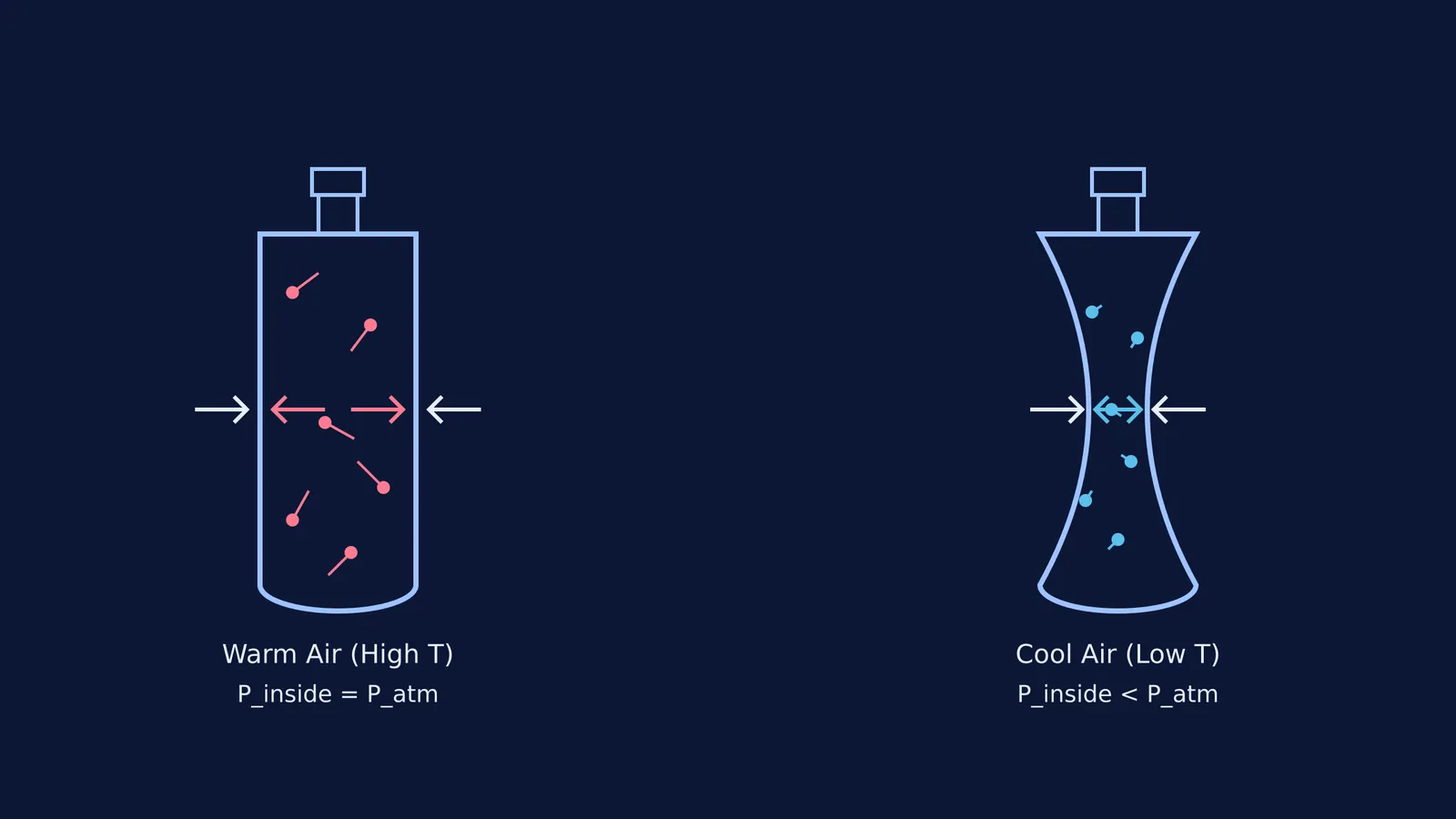
When you heat the air inside the open bottle, the gas molecules gain kinetic energy. They move faster and spread further apart, pushing some of the air out of the open top. At this point, the pressure inside the bottle is exactly the same as the pressure outside it.
The moment you screw the cap on, you create a closed system. The number of gas molecules trapped inside is now fixed. As the bottle sits on the counter, the trapped air begins to lose heat to the cooler room.
This is where the ideal gas law (PV = nRT) comes into play. As the temperature (T) of the gas drops, the molecules slow down. Because they are moving more sluggishly, they collide with the inside walls of the bottle less often and with less force. According to Gay-Lussac's law, published in 1802, the pressure of a fixed mass of gas is directly proportional to its absolute temperature if the volume stays constant. As the temperature falls, the internal pressure drops.
Why does a plastic bottle crush itself when warm air cools?
It is tempting to think that the dropping internal pressure "sucks" the walls of the bottle inwards. However, in physics, suction is not a real force. The bottle is actually being pushed from the outside.
We are constantly sitting at the bottom of an ocean of air. Earth's atmospheric pressure at sea level is approximately 101.3 kilopascals (kPa), which exerts a crushing force of about 10.1 newtons on every square centimetre of surface area.
When the air inside the bottle was warm, it pushed outwards with that exact same 101.3 kPa of pressure, balancing the forces so the bottle held its shape. But as the internal air cools and its pressure drops to, say, 80 kPa, the forces are no longer balanced. The 101.3 kPa of atmospheric pressure outside the bottle is now significantly stronger than the pressure inside.
The outside air simply pushes the flexible plastic walls inwards. The bottle continues to crush until its internal volume decreases enough to raise the inside pressure back up to match the outside atmosphere.
What is the role of condensing water vapour?
If you used very hot water for the experiment, there is another phase change at work that makes the crushing even more dramatic.
The hot water fills the bottle with steam (water vapour). When the sealed bottle cools, this steam condenses back into liquid water droplets on the inside of the plastic. Liquid water takes up significantly less space than steam, shrinking in volume by a factor of about 1,700. This sudden removal of gas molecules from the air mixture causes an extreme and rapid drop in internal pressure, leading to a much more violent crush.
How can you picture these invisible forces?
The hardest part of thermodynamics is that you cannot see the molecules colliding with the walls. If you want to see how kinetic energy translates to macroscopic pressure, the Fermi Simulation Lab provides interactive simulations for the ideas that are easier to see than to read.
You can also explore how these changes are plotted on graphs in our guide to Converting PV, PT and VT graphs of ideal gas processes, or see what happens when gases expand without resisting pressure in Free expansion of an ideal gas: why work and ΔU are both zero.
Understanding the "invisible hand" crushing the bottle is just a matter of realising that the atmosphere is always pushing on us; we only notice it when we take away the air pushing back.


