

On this page
When choosing a cricket bat, it is tempting to go for the heaviest one you can lift. Legendary players like Sachin Tendulkar and Chris Gayle used famously heavy bats, leading to a common belief among young cricketers that more mass automatically translates to bigger sixes. But from a physics perspective, the relationship between bat weight and ball distance is not a straight line—it is a delicate trade-off between the bat's mass and how fast your arms can swing it.
Does a heavier cricket bat hit the ball further?
The short answer is yes, but only if you can swing it just as fast as a lighter bat. This comes down to the fundamental physics of momentum, which is the product of mass and velocity (p = mv).
When your bat collides with the cricket ball, momentum is transferred from the bat to the ball. If two bats of different weights are swung at the exact same speed, the heavier bat will always carry and transfer more momentum. That means higher exit velocity and, consequently, a ball that travels further into the stands.
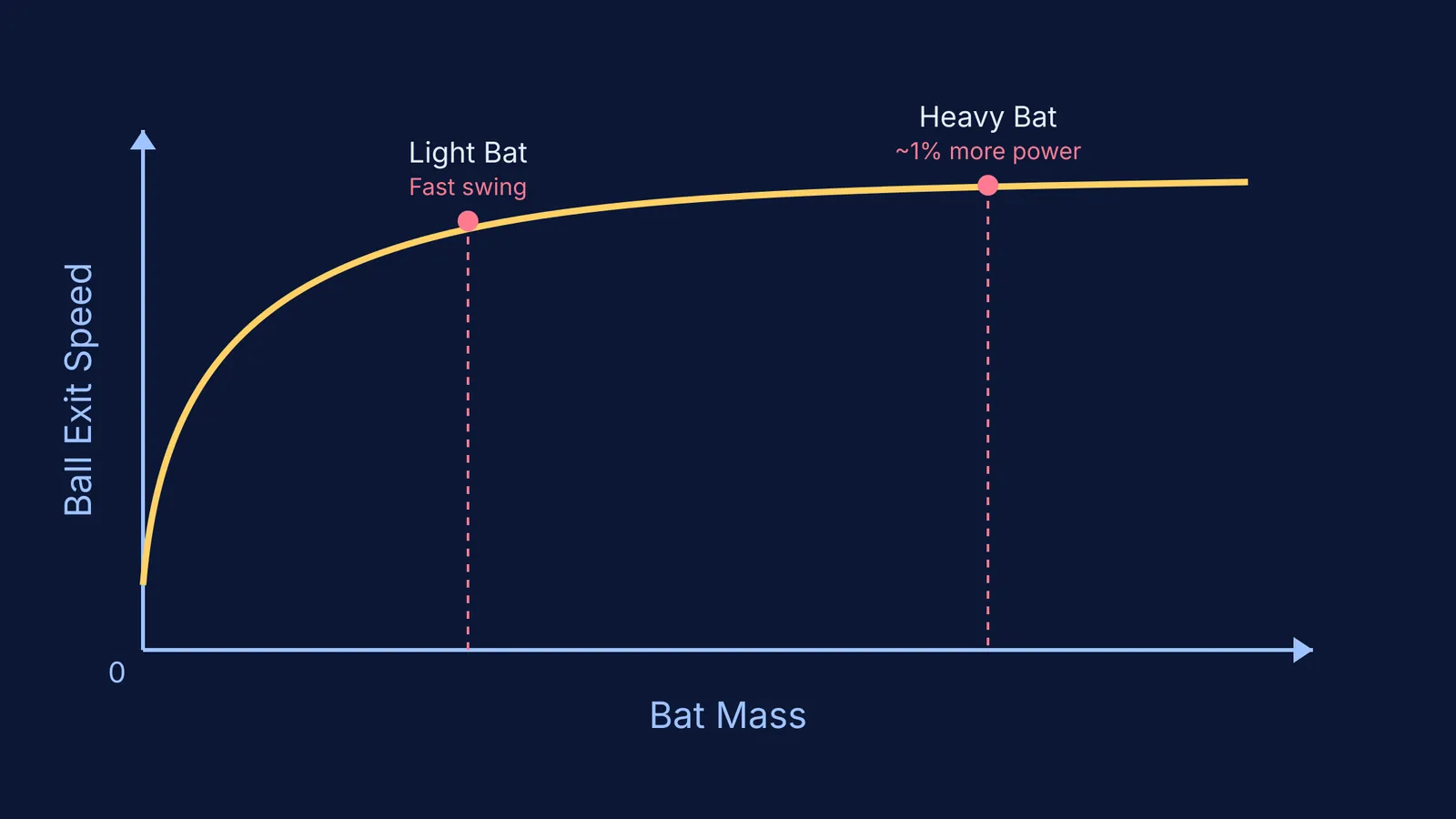
However, human arms are not perfectly consistent machines. A heavier bat is significantly harder to accelerate from a resting position. Because it takes more effort to swing, your maximum swing speed will naturally drop. If that drop in speed outweighed the gain in mass, the momentum transferred to the ball would decrease. Instead, physics research shows the drop in swing speed almost exactly offsets the extra mass, meaning heavy bats provide very little extra power.
Why does swing speed matter more than bat weight?
The reason a drop in swing speed is so punishing comes down to the formula for kinetic energy. The kinetic energy of a swinging bat is defined as KE = 1/2mv². Because the velocity variable is squared in this equation, any change in your swing speed has an exponential impact on the energy you generate. A small drop in bat speed costs you a massive amount of power.
Physicist Dr. Rod Cross at the University of Sydney found that a player can typically swing a light bat about 10% faster than a heavy one. While 10% might not sound like a huge difference, that extra swing speed results in the ball leaving the bat about 7.5% faster. This speed boost almost entirely compensates for the lighter bat's lower physical mass.
If you are a student struggling to picture how mass and squared velocity interact during a high-speed impact, you can build and observe your own inelastic collision models in the Fermi Simulation Lab to see the math play out in real time.
Is there any real advantage to a heavy bat?
If a light bat swings faster and generates excellent kinetic energy, why do some professionals still prefer a heavy one? According to the same University of Sydney research, a heavy bat is still technically about 1% more powerful than a light bat when both are swung with maximum effort.
Beyond that tiny margin of raw power, a heavy bat offers a significant advantage in stability. A heavy bat generally has thicker edges and more wood behind the "sweet spot". This extra mass means the bat resists twisting in your hands if you mistime the ball or hit it slightly off-center. A mishit with a heavy bat might still clear the infield, whereas the same mishit with a light bat might pop straight up for a catch.
However, that 1% power advantage and extra stability come at the cost of maneuverability. A lighter bat allows for a much faster "pick-up," giving you crucial fractions of a second to react to a fast bowler or a sudden yorker.
How to find your optimal bat weight?
Because of these physics trade-offs, there is no single perfect bat weight. Instead, there is an "optimum weight" for your specific strength and timing. To find the heaviest bat you can swing without sacrificing crucial speed, try this practical three-step framework:
The top-hand test: Hold the bat horizontally in your top hand (your left hand if you are a right-handed batter) with your arm extended straight out in front of you. If you cannot hold it steady for 10 seconds without your wrist dropping, the bat is too heavy for your forearms.
The shadow swing check: Take your normal batting stance and play a full shadow drive. If you feel the bat pulling your shoulders forward or ruining your balance at the end of the follow-through, you are losing control to the bat's momentum.
The reaction speed test: Stand in the nets against a fast bowler or a bowling machine. If you find yourself consistently late on the ball or slicing it, drop down to a lighter bat. A fast, well-timed swing with a light bat will always beat a slow, late swing with a heavy one.
If you are currently studying mechanics for your exams and want to see how these principles apply elsewhere, you might also find our guides to the horizontal projectile from a cliff: time, range and impact speed and the collision of two projectiles midair: the relative motion test helpful for your revision.


