

On this page
We count money in tens and hundreds. We measure distance in metres and kilometres. Yet when we check the clock or measure an angle, we suddenly switch to counting in sixties. If you have ever wondered why an hour is not simply 100 minutes long, the answer lies in the ancient world.
The division of time into sixties is a legacy of the ancient Sumerians and Babylonians, who used a sexagesimal, or base-60, numbering system. While modern mathematics runs on base-10 because humans have ten fingers, the Babylonians realised that 60 is a vastly superior number for dividing things up into equal parts.
Why did the Babylonians choose 60?
The number 60 is what mathematicians call a highly composite number. According to Michael A. Lombardi, a metrologist at the US National Institute of Standards and Technology, the Babylonians used base-60 because it is evenly divisible by 12 different numbers: 1, 2, 3, 4, 5, 6, 10, 12, 15, 20, 30, and 60 (Scientific American).
Consider the problem with our modern decimal system. If you try to divide 10 by 3, you get a messy, repeating decimal (3.333...). But if you want to split a 60-minute hour into thirds, it divides cleanly into exactly 20 minutes. You can divide 60 by a half, a third, a quarter, a fifth, and a sixth, and always get a clean, whole number. For ancient civilisations trading goods, dividing land, and calculating astronomical charts without calculators, this flexibility made fractions beautifully simple.
Historians also suggest the system originated from human hands, using a method more sophisticated than counting ten individual digits. If you use your thumb to point to the three finger joints (phalanges) on your other four fingers, you can count to 12 on one hand. If you use the five fingers of your opposite hand to keep track of each set of 12, you reach exactly 60 (12 × 5). This finger-counting theory explains how a base-60 system could have felt natural to early merchants and record keepers.
Where did the words "minute" and "second" come from?
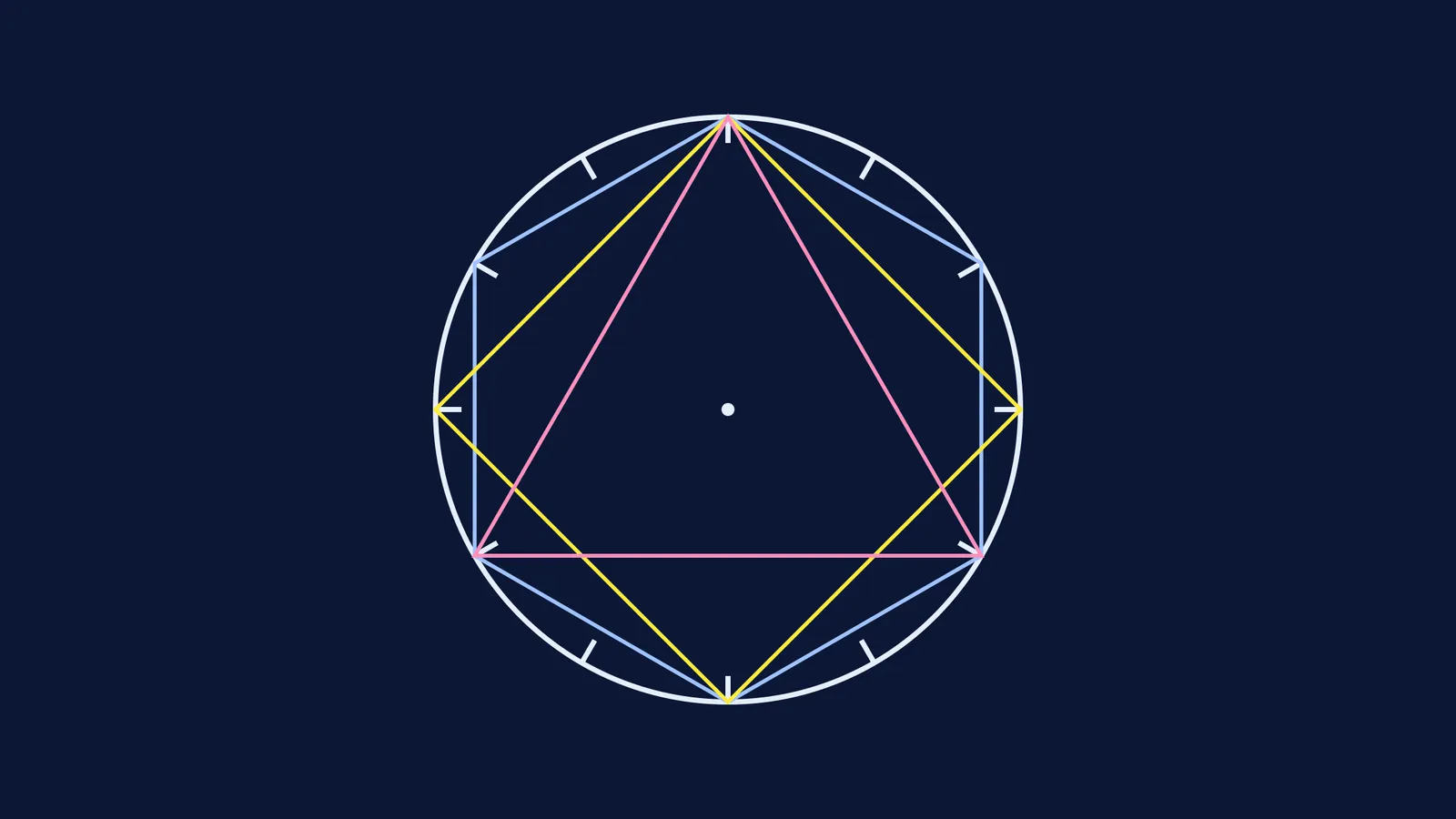
The Babylonians applied their base-60 system to astronomy, dividing the sky into a 360-degree circle (6 × 60), which closely mirrored their calculation of the days in a year (Scientific American). In the second century A.D., the Greek astronomer Claudius Ptolemy formalised this system to subdivide degrees of coordinates in his influential work, the *Almagest*.
When Ptolemy's writings were later translated into Latin, his base-60 subdivisions were given specific names. A single degree was broken down into 60 *partes minutae primae*, which translates to "first small parts"—giving us the word "minute". Each minute was then divided into 60 *partes minutae secundae*, or "second small parts," which became the modern "second" (Scientific American).
Interestingly, these subdivisions were originally used almost exclusively for angles and geographic mapping. For centuries, sundials and water clocks were simply not accurate enough to track such tiny slices of time. It was not until the invention of highly precise mechanical clocks in the 16th century that the 60-minute hour became a practical standard for daily life.
How does base-60 help you in physics and maths today?
The Babylonian system is still how we measure circular motion, phases of waves, and angles in geometry. If you are learning trigonometry or calculating projectile trajectories, you are relying on a 360-degree circle and its base-60 fractions.
In physics word problems, forgetting the base-60 rule is a surprisingly common trap. When students plug time into a kinematics formula, they often write "1 hour and 20 minutes" as 1.20 hours. Because time is sexagesimal, 20 minutes is actually 20/60, meaning the correct value is 1.33 hours. Whenever you are converting a quantity between unit systems, always double-check whether your time variable needs to be in seconds, whole hours, or a fraction of 60.
If you struggle with the leap from degrees to radians, or from hours to seconds, the Fermi Concept Library can help you visualise the maths. By letting you play with the variables interactively, Fermi's AI tutor helps you build an intuition for why these ancient geometric rules still define modern physics, whether you are finding the exact value of sin 18° or tracking the angular velocity of a satellite.


