

On this page
Learning long multiplication can feel like memorizing a series of rigid steps. But in Class 6, the focus shifts from following a procedure to understanding how numbers actually work together. The distributive property of multiplication over addition—written as a × (b + c) = (a × b) + (a × c)—is introduced to show that a large calculation can be safely broken down into smaller, friendlier pieces.
Instead of lining up digits on paper, students learn to split one of the factors into a sum of parts that are easy to multiply. A 2020 study of 36 primary students found that explicitly connecting this "partitioning" to the distributive property builds the conceptual understanding that underpins the written multiplication algorithm 1.
What is the distributive property for mental multiplication?
The distributive property states that multiplying a sum by a number gives the same result as multiplying each addend by the number and then adding the products. You distribute the multiplier to everything inside the brackets.
For instance, to solve 102 × 25 mentally, you do not need to visualize a three-line multiplication column. You can split 102 into its "base-ten" parts: 100 and 2.
The problem becomes 25 × (100 + 2).
Distribute the 25: (25 × 100) + (25 × 2).
Calculate the two simple pieces: 2500 + 50.
The total is 2550.
If a student gets stuck trying to hold a complex intermediate step in their working memory, splitting the number at the hundreds or tens boundary dramatically cuts down the cognitive strain.
How do you use distributivity over subtraction?
The property works just as well when numbers are close to a round figure but fall slightly short. This is known as distributivity over subtraction: a × (b - c) = (a × b) - (a × c).
Take 98 × 15. Doing this via standard long multiplication requires lining up the digits and carrying numbers twice, which leaves plenty of room for small errors. Mental distribution offers a shortcut by treating 98 as (100 - 2) and distributing the multiplication across both parts:
The problem is now 15 × (100 - 2).
Multiply the 15: (15 × 100) - (15 × 2).
Subtract the easy numbers: 1500 - 30.
The answer is 1470.
This strategy—compensating for the difference from a round number—is highly efficient and builds the number sense required for algebra.
How do you teach it visually?
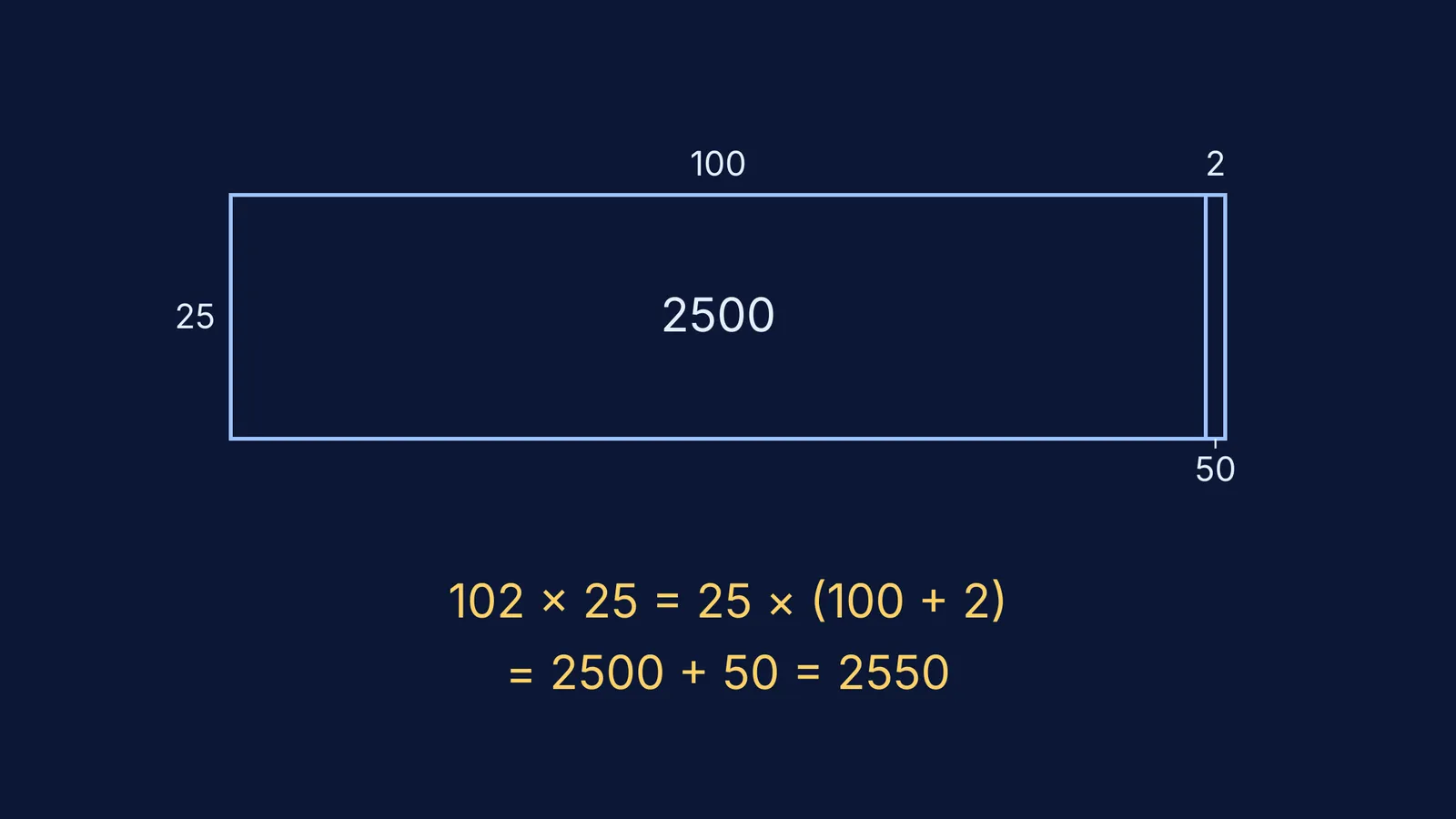
If the abstract letters a(b + c) feel confusing, draw a rectangle. The same study noted that explicitly connecting the distributive property to a multiplicative array helps children understand how it informs the written algorithm.
To show 102 × 25, sketch a large rectangle with a height of 25 and a width of 102. Draw a vertical line near the right edge to split the width into two sections: a wide block of 100 and a narrow strip of 2.
The area of the large block is 100 × 25 = 2500.
The area of the thin strip is 2 × 25 = 50.
The total area is the sum: 2550.
Once the eye sees how the area breaks neatly in two, the mind trusts that the numbers will do the same.
How the AI tutor helps
When a student relies solely on rote procedure, they might know how to multiply but not why the method works. If a student tackles a Class 6 mathematics problem in the Fermi Problem Library and makes an arithmetic error, Fermi's AI tutor explains the reasoning rather than printing an answer. It notices where a student is stuck and decides whether to explain, ask, or show a better way. The tutor might write on a board or draw the area model, working through the problem alongside the student and checking understanding as it goes to ensure the conceptual connection clicks.
Practising mental multiplication prepares students for later mathematics. Start with the easiest splits (multiplying by 100 + 1 or 10 + 2) before moving to subtraction splits like 100 - 1. Once the pattern is familiar, traditional long multiplication becomes a tool of last resort rather than the only way forward.


